Thoth is the education operator in the EROS stack: teacher, medicine, language, meaning. In myth he is the scribe and the healer; in this book he is the craft of how words are built and how shared language becomes bond. He sits under NaUn (choose / code) and beside Ra-Shen (force / world-engine). EROS is the cohesion that binds what Thoth teaches. Without shared operators, communities argue past each other. With them, they can build the same world.
The discovery. There is a second layer of language beneath the surface one. You have used it your whole life without being taught to look. The first layer says WORD → DEFINITION. The second layer says COMPONENT → FUNCTION → RELATIONSHIP → COMPOSITE MEANING. If that second layer is real, and the demonstrations in this book let you test it in sixty seconds with your own mouth, then language is not a container for thought. It is a cognitive architecture.
Why it matters. A guild that can name what it is doing (bond, extract, know, be-known) has an edge over groups that only shout tickers. This book gives you that edge: consonants as operators, a four-class know grid, a constructed tongue you can dogfood, and rules so the community grows a language instead of a fog. But the stakes are larger than crypto. Communication is bonding. Bonding is EROS. And EROS is what a species does when it learns to see what its own mouth has been doing all along.
The two scientists. A leading applied mathematician at the Wolfram Physics Project has independently concluded that AI is bottlenecked by description languages. He is explicit about the Sapir-Whorf hypothesis. He says the same thing the consonant code says from the opposite direction. This volume invites one honest run of the method — not a demand, an invitation. Independent convergence with the AI-reasoning argument is documented in §8 · The two scientists. The four law-forces Thoth sits inside are named in Gods of Eros.
Who this is for. Creators, holders, and builders who will write scenes, scripts, posts, games, and comics inside the EROS universe, and anyone who wants English (and future EROS-tongue) treated as applied science, not mystic hand-waving. Egyptian, Hebrew, and English paths appear as tools and examples, not rankings of peoples. Atlantis, Nordic residual, and Anunnaki masks belong in Men of Renown. The four operators stay in Gods of Eros. The toroidal shape of the mouth-as-cosmos bridge is in The Eros Enclosure. This volume is Thoth's instrument only.
How to read this book
This book can be read in one sitting or returned to as a reference. There is no required order. The method below is a suggested path, not a schedule.
The method in one breath lives in §2 — SPREAD vs SPRAY. The operator cards (§5) are the alphabet. The three doors (§6) are the demonstration that the alphabet already exists in ordinary words. The second layer, information density (§7), and the AI convergence (§8) are the implications. The know grid (§9) and the constructed tongue (§10) are the working system.
§14 (What could break this) is not a fear chapter. It is where the code states its own failure conditions. Reading it before deciding whether to trust any of it is a fair move.
You have argued past someone your whole life. So has everyone you know. Not because either of you was wrong. Because the words were different shapes in each mouth, and neither of you knew the shapes had names.
The Gift of Thoth is the book that names them. Beneath the surface language you were taught sits a second layer you have been running since you learned to speak. Consonants are operators. Words are compressed programs. Position is syntax. SPREAD lands. SPRAY continues. The difference is one consonant, and you can feel it in your jaw before anyone explains it to you.
What it gives you is unusual: you can read inside any word, name what you are actually doing instead of arguing about what you mean, and build a shared tongue with anyone who hears the same architecture. A leading mathematician at the Wolfram Physics Project arrived at the same insight from the AI side, and the book shows you both doors. Read it, and the fog of conversation turns into structure.
1 · The question
You have said these words your whole life. Have you ever looked inside one?
Take a word that means something to you. A job title. A name you argue about. A word you are quietly proud of. Say it aloud.
What just happened?
Most of us have been taught one answer: you made sounds that point to a thing. The sounds are arbitrary. The thing is real. The word is a label. Move on.
This book proposes a different question, not an answer yet, a question:
What if the word contains more than the label?
Not metaphorically. Structurally. What if the consonants, their order, their positions, are doing something, not just pointing?
You will not be asked to believe this. You will be asked to test it. In your own mouth, in sixty seconds, before this chapter ends.
What word in your life are you willing to look inside?
2 · Open the door
Thoth's first lesson is simple: one consonant difference, one letter deeper, and the whole action changes. Feel it before you believe it.
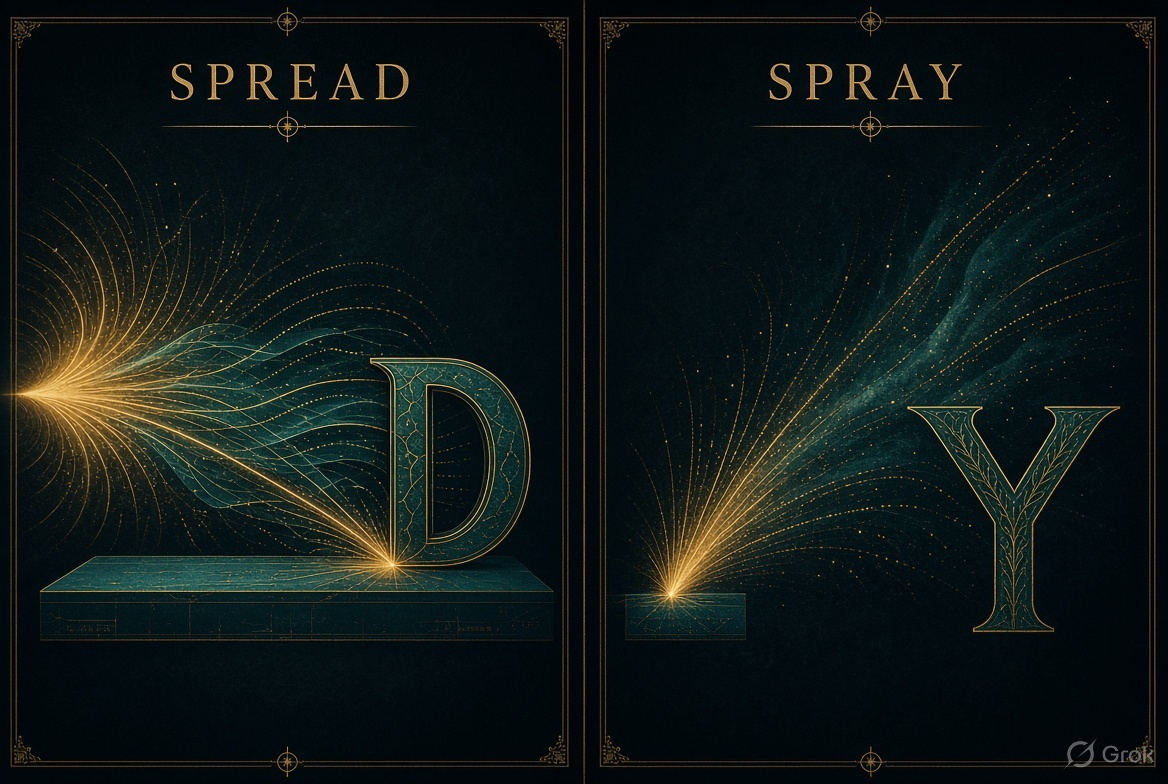
SPREAD: the energy reaches its destination and stops. The action is complete. D is Arrive.
SPRAY: the energy keeps going. The action continues. Y is Act, open deed, no final seal.
Say them aloud. Feel D close the path. Feel Y leave it open. That difference was not decoration. It was inward (deeper into the consonant architecture), and the result was forward movement in comprehension.
Inwards is forwards.
Deeper structure first. Surface noise later.
That is the pattern of this book, and of the Egg.
If you felt that distinction, you have already met the thesis. You do not need to accept any of the rest to have experienced the thing this book is about. The rest is a systematic exploration of what that distinction implies at scale.
§2 · One consonant difference D arrives · Y acts
What if this is not a trick?
Coincidence and sound-symbolism already exist in linguistics. This method goes further: it treats consonants as operators in sequence, with position as syntax and the final consonant as a timestamp (land or continue). You do not have to accept the full stack on day one.
Test before trust. Write twenty words that begin with B. Count how many name a boundary, a body, a container, or a held edge. Then produce the sound B with your lips: closure, pressure, release. The action and the meaning are the same physics. If the pattern holds for you, the cards below are confirmation, not dogma. If it fails, the guild still needs your counter-examples.
Curiosity first. Recognition second. The rules are named after you feel them, not before.
The moment of recognition
Most people who try SPREAD/SPRAY aloud once say some version of: "I can feel the difference." That is the beginning of the second layer of language. Not "I was told the difference." You felt it. Your jaw knew before your mind argued. That is what the rest of this book will teach you to see everywhere.
What word in your life arrives… and what word only sprays?
3 · Where this sits in The Eros Plan
God stack (pointer).NaUn: choice, coding, plan. Ra-Shen: physics, heat, motion. Thoth: education, medicine, meaning, tongue. EROS: bond, cohesion, the force that holds. Full treatment: Gods of Eros. The toroidal reading of Thoth as the operator at the crossover is in The Eros Enclosure, Part X. You can run operators without adopting the myth; the stack only names whose workshop this manual is.
Where this sitsThoth's domain in the operator stack (see Gods of Eros).
The world that language describes lives in The Living Egg.
Token and demand surface: The Bridge · door to the ecosystem: The Front Door.
The transform that names the four law-forces as a store-rail engine: The Platinum Standard.
This book is the linguistics guild manual: consonants as operators, know/be-known grid, constructed tongue, dogfood dictionary.
The spine is The Eros Plan: token, liquidity web, demand equation, cosmology, production guild. Companions hold their own fields: Illumination (human rail), Living Egg (vessel), Gods (four operators), Bridge (crypto).
This book is Thoth's instrument only. Not the pantheon. Not Atlantis. Not the macro sequence. Those books stay clean.
The through-line
Communication → shared operators → understanding → bond → unity → cohesion → EROS.
A language that cannot be taught, shared, or verified fails the same test as a pool with no demand.
Historical Egyptian, Hebrew, Greek, English paths appear as masks and examples, not rankings of peoples. Anunnaki / Nordic / breakaway persons belong in the next companion book, not under these four operators as "sub-gods."
4 · Atomic language
The atom has parts. The cell has parts. The word has parts.
Vowels are the living current, breath made musical. Consonants are the deciding structure. Change the consonant skeleton and the world-model shifts. Position is not style. Position is syntax. Syntax is meaning.
One consonant is an instruction. T is the instruction arriving. S is the instruction spreading. V is the instruction bonding.
From Meaning Unconfound, the generative order is held as:
Life → Postulates → Numbers → Letters
Letters are the readable surface of the same stack. The code is discovery applied, a working instrument for makers.
Technology means science applied. Linguistics, in Thoth's hands, is applied structure: how sound becomes form, how form becomes shared meaning, how shared meaning becomes bond.
From picture to word. The progression is not new. It is what humanity has been doing for millennia:
Picture→Symbol→Consonant→Word→Sentence→Thought
Each stage compresses meaning into smaller units. The picture contains everything and takes time to read. The symbol abstracts. The consonant encodes an operation. The word combines operations. The sentence combines words. Thought emerges from the architecture. The question this book asks is not whether that happened (it did) but how far the compression goes. If the consonant layer is still active in the words we use today, we may be using a much denser instrument than we have been taught.
If your project's words were atoms, which particles are missing?
5 · The consonant operators
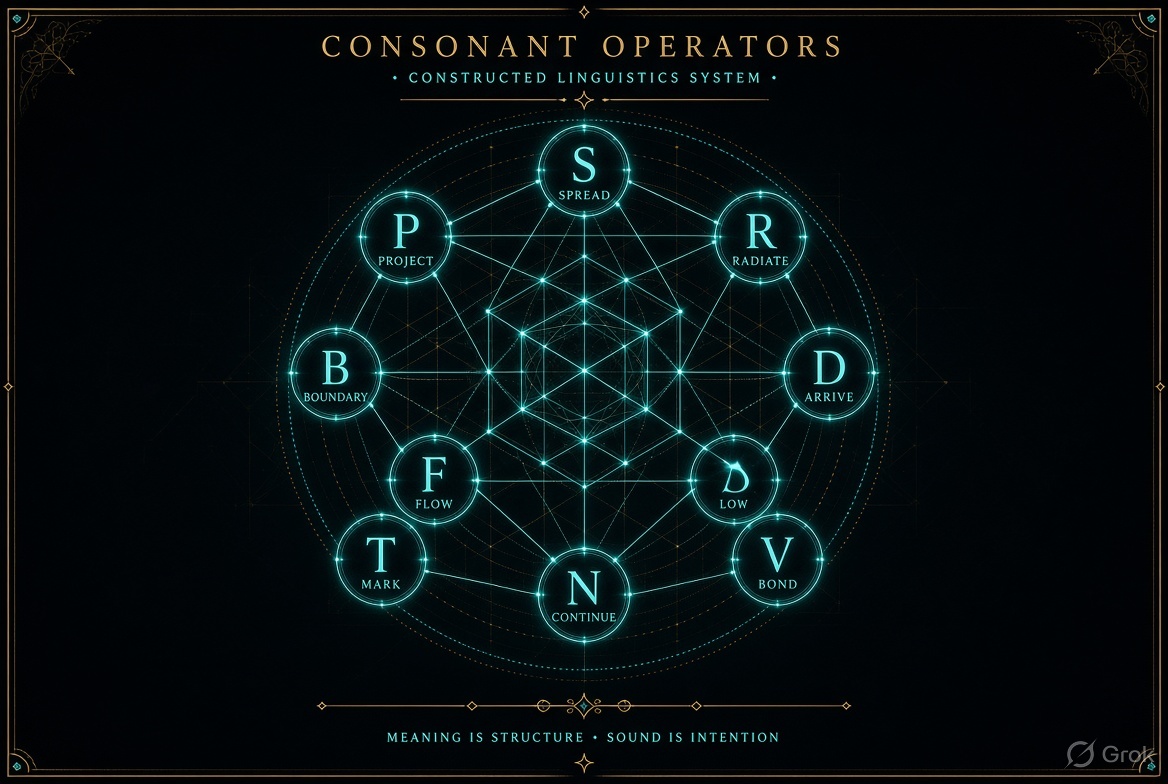
ThothTeacher · Builder · Keeper of the operators · The hand that hands down the lettersOperator constellation Predict first · Cards second
Do not memorize first. Predict first. The cards are the reference after recognition, not the lesson that replaces it.
Discovery method. Take a word you already know. List the consonants. Ask what each is doing: boundary, flow, mark, radiate, arrive. Then open the card. If your prediction matched the operator, the system is teaching you. If not, note the exception. The guild grows on honest exceptions, not forced fits.
On the Witness tier. Where a card says "same geometry across traditions," read it as: the body-gesture of this consonant recurs in multiple writing cultures as a similar force (cut, bind, flow, edge). It is a pointer for comparative work, not a finished anthropology claim. If a card's Witness line is thin, treat Core + Concise + Form as enough to work.
Five tiers · not a spreadsheet. Core → Concise → Common → Form → Witness.
Each card carries a small mouth diagram: teal = unvoiced (air only) · violet = voiced (cords vibrate). The dot marks where the body makes the sound.
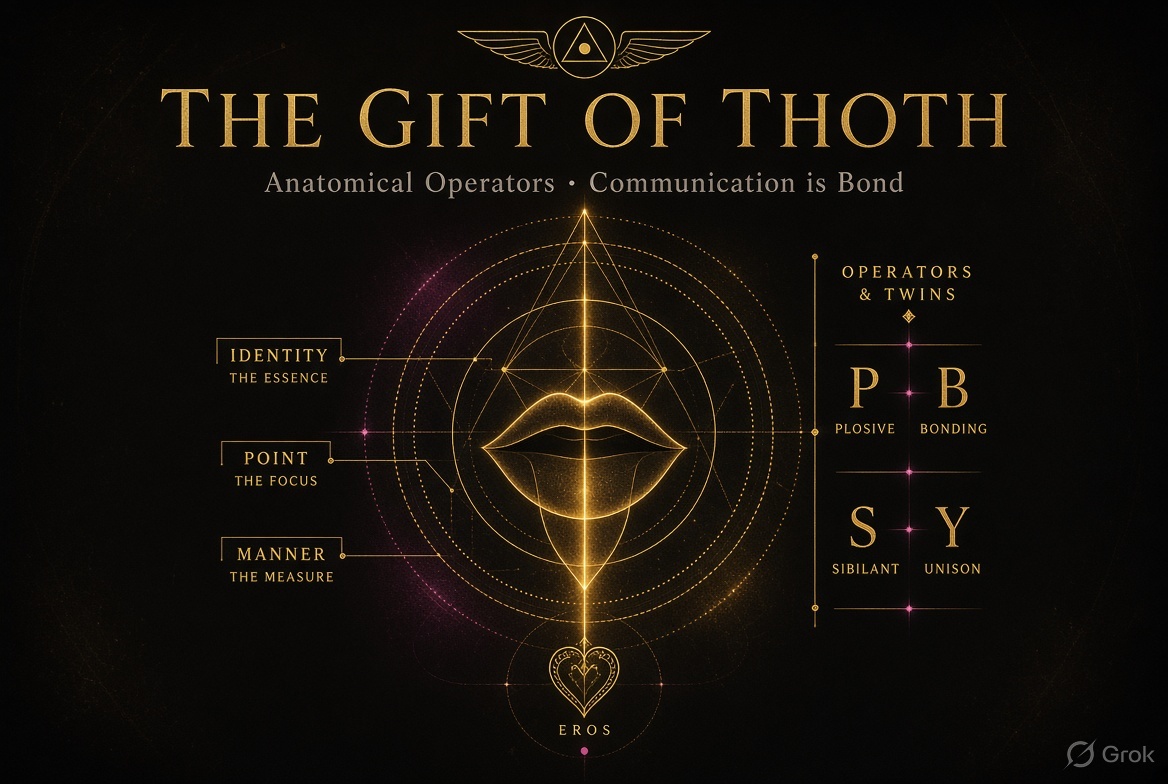
5.1 · Three dimensions of every consonant
A core label (B = Boundary) is not enough. Every consonant carries meaning from three layers at once. When all three agree, the operator feels pure:
1 · Identity: what the operator is (B = boundary).
2 · Articulation point: where the body makes it (lips = the outer edge).
3 · Manner: how it is produced (stop = closure and release).
All three say boundary at once for B. That convergence is why B is the purest boundary consonant, and why you can decode words the cards never list. The cards are an instrument. The three dimensions are why the instrument works.
Recognition test
Before reading any card, try this: say FIRE and FLAME. Both start with F. Now say FLOW and FLIGHT. Now say FREE. What do all five words share? The F at the start is breath at the lip-teeth: a stream that keeps moving. Do you feel it? That is F acting as an operator. The card below will name what you already felt.
Where Thoth's operators meet the four law-forces
In Gods of Eros, "operators" means the four law-forces: NaUn, Ra-Shen, Thoth, EROS. Here, "operators" means the consonant forces of the mouth. Same word, two scales: four laws for the world, twenty-two consonants for the tongue. Same discipline that reads a program by its primitives. The toroidal reading of the mouth as a small torus — the smallest model of the enclosure — is in The Eros Enclosure, Part XI.
Bond test: Breath is the first medium of the bond.
Tenacity Through Integrity
5.2 · Voicing: the two-sided operator
Every stop and fricative has a voiced / unvoiced twin. Same place in the mouth. Off or on. The vocal cords decide whether the operator releases or holds.
Unvoiced · sharp releaseP: Project T: Mark K: Close F: Flow S: Spread CH: Protect
Voiced · held / containedB: Boundary D: Arrive G: Grow V: Bond Z: Edge J: Express
Whisper a hard truth. Then voice it. Same operators, different quality of the same meaning.
5.3 · Position rule: start, middle, end
An operator is not only what it is. It is where it stands in the word. N is the cleanest example:
Start: negates or initiates (No, Not / Name, Nation)
Middle: continues (Continue, Maintain)
End: arrives or holds presence (Done, Born, Known)
The final consonant often carries the timestamp: D / T seal (arrived, sealed); R still radiates (fire, power); N still continues (known, seen); Y runs without endpoint (energy, journey). SPREAD vs SPRAY is not a one-off. It is a class of distinction. Feel the word as a sequence of operations that begin somewhere and either land or continue.
More position runs
T: start cut opens (TIME). Middle cut inside (WATER). End final cut (BIT).
B: start boundary first (BOND). Middle contained beat (ABOUT). End sealed stop (GRAB).
5.4 · Silent consonants: the exclusion anchor
Only stops and affricates (B, P, T, D, K, G, CH, J) can go silent, because they have a closure phase to withhold. The silent K in KNOW is containment built but never released. The word performs the mechanism it describes.
That is the Exclusion Anchor: meaning present, never voiced. It is also the shape of a hidden postulate in the body: a closure that holds without announcing itself. Examples: KNOW, KNIGHT, KNIFE, KNOCK, SIGN, LAMB, CASTLE, PSYCHE.
This is the bond test at the level of a single word: hear what is being held back, not only what is being said.
5.5 · Verb-to-noun bridge
The verb can hide existence-claims inside actions. "I am depressed" wraps the state as an invisible all-encompassing weather. "The depression in me" makes it a thing: bounded, locatable, addressable. Same operation, discovered twice: in the operator code and in resolution practice (verb-to-noun conversion).
NOUN ≈ N+N: continuation held as continuation, the thing that persists between words.
VERB ≈ V+R+B: bonded radiance bounded, the action that can hide the thing inside motion.
To speak in nouns is to make reality visible. To make reality visible is to let it change.
Composite rule
Read a word by its operators in order. SPREAD = Spread · Project · Radiate · Arrive. SPRAY = Spread · Project · Radiate · Act. The last operator often decides whether the action lands or continues.
When the operator cards feel fluent, the master book's cluster layer (SP, ST, STR, DR…) opens next. Not required here.
More operator runs
LOVE: L (link/flow along a line) + V (voiced friction, held relation) + implied close. Skeleton: bind along a path with sustained contact. Bond test: does the line stay open or does it possess?
FEAR: F (unvoiced friction, edge air) + R (radiate/iterate). Skeleton: sharp edge that keeps spinning. Bond test: is this warning or paralysis?
BUILD: B (boundary/container) + D (stop/close). Skeleton: make a room and set a floor. Bond test: does the structure invite entry or only exclude?
6 · Nature, water, sun · three doors
You have met the operators. Now watch three ordinary words open onto the whole stack.
The three doors
Nature is N–T–R
Strip the vowels from NATURE. What remains is N–T–R. In this book those consonants are already loaded:
NNaUn · GateThe noun-force. Permission to name, choose, continue, or withhold.
TThoth · MarkForm, teaching, the house that holds meaning so it can be learned.
RRa · RadiateOutward energy under boundary: light, the stage that makes the garden visible.
Nature is the living world inside the Egg. The word itself, in its English skeleton, wears the three offices. This is offered as a starting pattern for inquiry, not as courtroom proof of origin. Whether the correspondence is design or coincidence is the reader's question. That it is legible in one ordinary word is the reason this section exists.
Water is H₂O
Water is not only the word water. Chemically it is H₂O: two of one, one of another, arranged. The molecule is structure, not a flat label. Knowing the name is not the same as knowing the molecule. Knowing the molecule changes what you can do with water.
The same move applies to any word. Consonants are the syntax inside the word, the way atoms are the syntax inside the molecule. You do not abandon the surface meaning. You go inward.
The sun writes its own equation
The Hebrew word for sun is SheMeSh: Shin-Mem-Shin. Shin is 300. Mem is 40. The name is 300-40-300.
The speed of light is 300,000 kilometres per second. Shin is 300. The sun burns hydrogen. Mem is the water element, of which hydrogen is the base. And E = mc², written in Hebrew letters, spells C-M-C = Shin-Mem-Shin. The equation for the sun's own energy, spelled in the sun's own name.
Whether this is design or coincidence is not this book's claim. The observation is that the sun's name, its fuel, its speed of light, and its energy equation share four characters. That is enough to open the door. The reader walks through and decides what they see.
Nature · water · sun.
Three doors into the same building.
The operators are still there when you arrive.
What this section is not
It is not proof of the operators. It is not an origin story. It is not numerology dressed as physics. It is a demonstration: the same move (surface → components → function → deeper comprehension) applies at the level of a word, at the level of a molecule, and at the level of a star. Inwards is forwards. Deeper structure yields clearer output: better questions, cleaner speech, stronger bond.
The method, stated once
1. Take the word. 2. Isolate the operators. 3. Read function and position. 4. Rebuild meaning with more precision. 5. Test. Keep what holds. Drop what does not.
NaUn remains the intimate ultimate noun: the architecture that allows naming at all. Thoth remains the teacher of the house of light. Ra remains the stage. EROS remains the bond that lets the learning iterate. Nature, water, and sun are three doors into the same building. Walk through any of them.
§6 · Three doors into the same enclosure
Where this sits in the corpus
The four law-forces named here (NaUn, Ra-Shen, Thoth, EROS) are defined in Gods of Eros. The vessel the doors open into is The Living Egg. The toroidal reading of the mouth-as-cosmos bridge is in The Eros Enclosure, Part XI. The transform that names the four as an on-chain engine is The Platinum Standard.
7 · How much is inside a word?
You have now met the operators and the three doors. Here is the question they open.
If consonants are operators, positions are syntax, clusters are compound functions, and vowels are directional modifiers, then a word is not a flat label. It is a structured object. The natural next question is not "is this true?" It is "how much is actually inside?"
This is the information-density question. It is not new. Linguists have long observed that some languages convey more with fewer units than others. But conventional linguistics treats that as a property of grammar and speech rate. If the consonant layer is real, the density is deeper: it lives inside the words themselves.
The analogies
Four analogies help make this concrete. None is a proof. Each is a way of seeing.
DNA
A four-letter alphabet produces the entire diversity of life. The power is not in the letters. It is in the combination rules and the sequence. If language compresses meaning the way DNA compresses biology, then small alphabets with strict combination rules can generate enormous complexity. The consonant code may be a molecular layer of meaning.
Computer code
A handful of primitives (declare, assign, branch, loop) generate every program ever written. The primitive is not the meaning; the composition is. If words are compressed operations, then reading a word is closer to reading a short program than to reading a dictionary entry.
Chemistry
Elements have properties. Combine them and you get compounds with new properties. The properties of the compound are not the sum of the elements; they emerge from the arrangement. If consonants behave like elements, then a word is a molecule of meaning, and changing one consonant is changing the compound.
Compression
A zip file is not "the thing." It is a compressed representation from which the thing can be reconstructed. If a word is a compressed semantic operation, then unpacking it yields more than the surface reading. SPREAD unpacked is not "spread." It is spread + project + radiate + arrive, an operation with a shape.
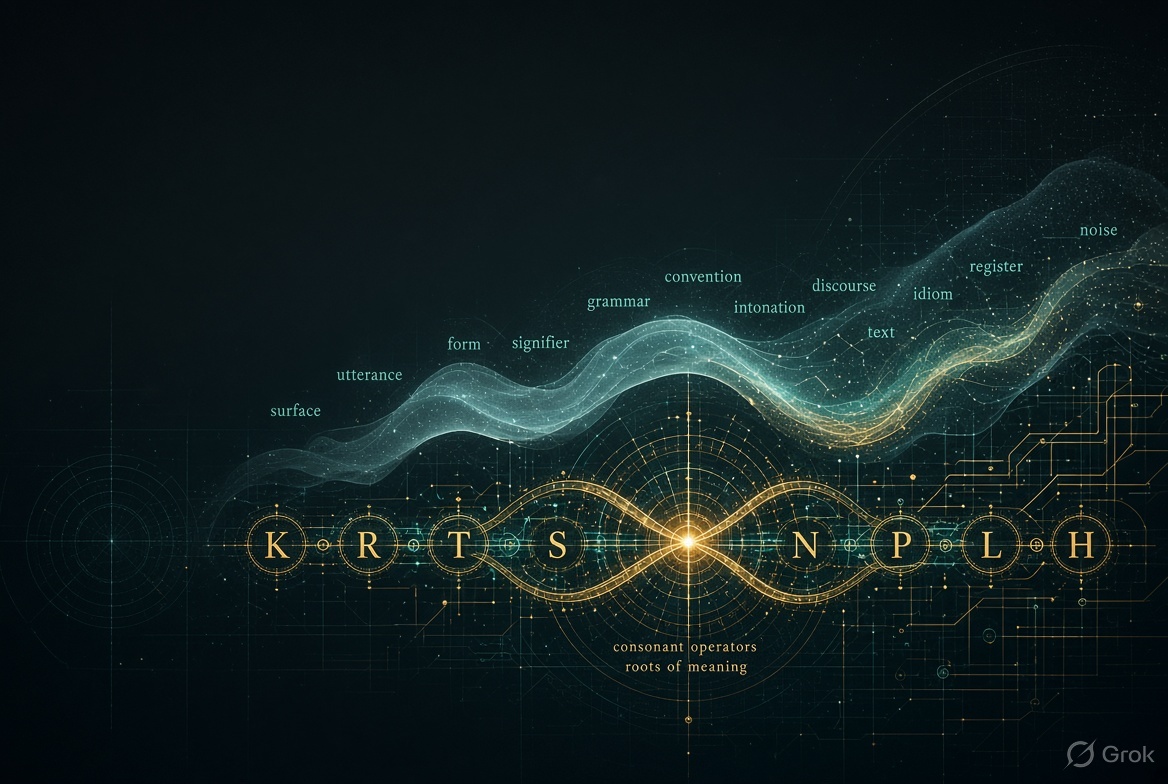
Surface stream · Operator roots Meaning is structure
The second layer, named
Here is the vocabulary the rest of this book will return to. Two layers of language have been running in parallel your entire life. You have only been taught one.
The Second Layer of Language
Layer 1 · SurfaceWORD → DEFINITION The label model. The word points to a thing. You learned this in primary school. It is real but it is not the whole picture.
Layer 2 · StructureCOMPONENT → FUNCTION → RELATIONSHIP → COMPOSITE MEANING The word is a small program. Every part is doing work. The meaning emerges from the architecture, not just the label.
You have used the second layer your whole life. You felt SPREAD land and SPRAY continue in §2. That was the second layer in your jaw before your mind caught up. You felt the three doors open in §6: Nature wearing its consonants, water wearing its structure, the sun wearing its equation. The point of naming it is this: once it is named, it can be taught, practiced, refined, and applied.
The scale of the implication
If the second layer is real, then ordinary words contain more information than we have been consciously accessing. Not "hidden meaning" in a mystical sense, but structural information in the same way a zip file contains more than its filename. A person who can read the second layer is not smarter. They are reading more.
And a person who has been reading only the first layer their whole life has been using a denser instrument than they know. The sentence is not: "you have been using language wrong." The sentence is: "you have been using a language that contains more than you were told."
Why this matters for education
Consider two ways of teaching the word BOUNDARY to a child.
The old way. "A boundary is a line that marks the limit of an area." The child memorises the definition. Later they memorise BOX, BODY, BONE, BARN separately. The system is never named.
The operator way. "Say the word BOUNDARY. Feel your lips close and release. That action (closure, pressure, release) is what a boundary does. Now say BODY. BOX. BONE. BARN. What do they share? They all describe a bounded space with a purpose. You just learned the system, not the word."
The child is no longer memorising thousands of arbitrary labels. The child is learning a system that generates them. Whether that accelerates literacy, reading comprehension, and reasoning is an empirical question. The book does not claim it is proven. It claims it is worth testing, and the test is available to any teacher, parent, or reader starting this week.
If a word contains an operation, what have you been missing every time you said it?
8 · The two scientists
You are not the only one arriving at this. From an entirely different direction (AI capability research) the same structural insight is being discovered.
In 2026, Curt Jaimungal of Theories of Everything interviewed Jonathan Gorard: applied mathematician, co-founder of the Wolfram Physics Project, and CEO of Lanyon AI. Gorard was not talking about linguistics. He was talking about why AI is good at math and code but not at science, and his answer turns out to be the same thesis this book has been building from the other side.
Gorard on language and thought
"We're making a bet on something like the weak Sapir-Whorf hypothesis... We're making a bet that, yeah, there is some evidence that in humans, language shapes thinking and that the languages that you know shape the kinds of thoughts that you are able to have."
Jonathan Gorard, Theories of Everything, 2026
This is the same claim the consonant code has been making from the linguistic side. Gorard is not endorsing the code. He is independently arriving at the same architecture from the AI side. Two doors into the same room.
Gorard on why AI is bottlenecked
"By allowing an AI to reason only in English, it can do a certain amount of stuff, but you restrict it somewhat. But by allowing it to reason, say, in Lean, you can dramatically increase the sophistication of mathematical results that it's able to prove. Or by allowing it to reason in C or in Python, you can dramatically increase the sophistication of algorithmic ideas that it's able to encode."
Jonathan Gorard, Theories of Everything, 2026
The bottleneck is not intelligence. The bottleneck is description language. Math and code got formal languages (proof assistants, compilers) and capabilities exploded. Science and engineering did not, and capabilities lag. Meaning, for most models, has no formal language at all; it is handled by statistics alone.
Gorard on what a new language would do
"What we are effectively doing is focusing on the development of these kind of formalized reasoning languages for scientific discovery, for, in particular, for things like physical reasoning... We are building effectively type systems for physics."
Jonathan Gorard, Theories of Everything, 2026
Lean is a type system for mathematics. Type checkers are type systems for software. A type system for meaning, where the operations of a word are checkable against its architecture, is the natural next step. If it exists, both humans and machines can read it.
Gorard on where capability is actually coming from
"The curve in AI capabilities at the moment is not coming from improvements in the transformer model. It's coming from improvements in post-training, reinforcement learning, harnesses, tools, skills, all these kinds of things."
Jonathan Gorard, Theories of Everything, 2026
Gorard's bet, and the consonant code's bet, is that the symbolic layer (the tools, the description languages, the verification pipelines) matters more than the raw model. The same discipline that reads a program by its primitives reads a word by its operators.
The convergence
Put these quotes next to what this book has been saying and the shape is obvious.
Gorard / AI side
AI capabilities are bottlenecked by description languages. Domains with formal languages (math, code) advance faster than domains without (science). Meaning has no formal language at all.
Consonant code / linguistic side
Language has a second layer of structure. Consonants are operators, positions are syntax, words are compressed operations. The code is a description language for meaning.
The overlap
Both sides say the same thing: structure matters more than surface. Both sides ask the same question: what is the formal language of the thing you are trying to reason about?
Gorard is not teaching the consonant code. This book is not claiming his endorsement. What is claimed is smaller and more useful: the same insight is being arrived at independently, from different fields, by people who do not know each other. That is a signal. Two independent observers describing the same invisible structure is not proof, but it is worth noticing.
The bet, stated plainly
If words are compressed operations and the operations are identifiable, then a description language for meaning is possible. If it is possible, it can be formalized. If it is formalized, both humans and machines can read it. The guild builds the human half first, because that is where the mouth is and where the bond test runs. Machines can inherit what survives contact with use.
The wow moment
The reason this section exists is not that Gorard is right. It is that he is doing, in a different field, what this book has been doing in language. He calls it "type systems for physics." This book calls it operators for words. Same move, different substrate.
The implications are the same: if the layer is real, it can be taught, practiced, refined, formalized, and encoded. That is the story this book has been telling from page one. You are now at the moment where the two stories meet.
Where this meets the corpus
The transform thesis in The Platinum Standard applies the same discipline to economics: read a mechanism by its primitives (burn, LP formation, buy-and-burn), not by its slogan. Same move, third substrate. The four law-forces Thoth serves (NaUn, Ra-Shen, Thoth, EROS) are named in Gods of Eros. The toroidal reading of Thoth at the crossover is in The Eros Enclosure, Part X.
If structure beats surface in AI, why would it not in the language you think with?
9 · The four-class know grid
Under every slogan sits a postulate. Under every freeze sits a leg of the cycle.
How the grid uses the operators. Operators tell you what a sound does. The four-class grid tells you what a claim is allowed to do in public speech: must be known, must not be known, must know, must not know. Run a word through operators first; then ask which class the sentence is serving. If the class and the operators fight, rewrite.
Body as quick check (optional, testable). These are not medical claims. They are attention drills:
Raised shoulders: boundary held high. Ask: am I performing Must Not Be Known (keeping something out)?
Held breath: continuation refused. Ask: am I blocking N-flow on purpose?
Jaw lock: T-cut frozen. Ask: am I demanding Must Know while refusing to be known?
If the drill does nothing for you, skip it. The grid still works on text alone.
Meaning Unconfound maps four legs. As each fails, the position flips:
Must Be KnownForce into the open · revelation · arrival
Must Not Be KnownConceal · wall · boundary held
Must KnowDrive to grasp · mark · locate
Must Not KnowRefuse the data · stay out · avoid
Body freeze is the same grid held in flesh, not as a therapy manual, as a map:
Raised shoulders: Must Not Be Known (B-boundary held)
Held breath: Must Not Be Known (N-continuation refused)
Jaw tension: Must Know and Must Not Be Known at once (T locked)
EROS angle
Bond requires some Must Be Known. Extraction culture lives in Must Not Be Known plus "please don't abandon the coin." Frankness is a declaration of freedom because it chooses the open leg on purpose.
Which leg are you standing on when you write in the chat?
10 · The constructed tongue · a working layer
You can open a word. Next you generate new ones, under rules, not mood.
Decode was the instrument. Generate is the work. Name the world.
10.1 · The three-generation argument
This is not a ranking of peoples. It is a functional progression of what language was asked to do.
Hebrew preserved the consonant root and treated letters as creation-units; the skeleton stayed visible. English scattered the operators across a trading tongue: fast, flexible, opaque. Esperanto optimised for neutrality and ease of learning. The EROS tongue optimises for a fourth property: architectural transparency, meaning you can see the meaning in the skeleton.
Each generation moved toward something. This one names the next move: operators you can feel, vowels that aim them, names a guild can lock without a founder cult.
Compare the four
Hebrew: root preservation high · learning cost high · neutrality low · structural transparency high English: root preservation low · learning cost medium · neutrality medium · structural transparency low Esperanto: root preservation medium · learning cost low · neutrality high · structural transparency medium EROS tongue: root preservation high · learning cost medium · neutrality medium · structural transparency designed high
10.2 · The vowel vectors: the missing half of the code
Consonants carry the primary operator load. Vowels aim them. Change the vowel, change the spatial vector, change the world inside the same skeleton.
A · OpenSingularity / point · unrestricted opening · grounding
E · ExtendExhaust / direction · forward lengthening · bright outward
I · InwardNarrow to a point · line of sight · still, sharp
O · EncompassCircular enclosure · completion loop · containing
U · Rise: Lift / cup from below · vortex · through / transitional.
Test: BIT · BAT · BUT · BOOT · BITE. Skeleton B+T (Boundary + Mark) stays fixed. The vowel shifts the spatial quality of what is bounded.
Prefix shading: in RE- and PRE-, E often acts as directional return rather than pure Up/Out; in DE-, downward. Position layers the root vector, same rule as consonants.
Worked set: BIT / BAT / BUT / BOOT / BITE
BIT (I): inward point; short, sharp, closed path.
BAT (A): open; unrestricted mouth; flat and wide.
BUT: central push; neutral rise-and-drop.
BOOT (U/O round): encompass; long held cavity.
BITE (I diphthong): point that opens into travel.
Say them in a row. I narrows, A opens, round vowels fill the mouth. That is the vector system in the body, a contrast you can feel, not a chart you must believe.
10.3 · Naming algorithms
Generate in under five minutes. Skeleton first. Vowel second. Bond test last.
Character: (1) Role in one verb. (2) Pick 2-4 operators that encode it. (3) Choose vowel vector (open / extend / inward / encompass / rise). (4) Speak it aloud. (5) Bond test: does it teach or extract? Example: Teacher-healer → T+H+TH fields → Thoth.
Place: (1) What the place does to those inside it. (2) Operators of enclosure or path. (3) Vowel of containment or arrival. (4) Avoid pure spray endings unless the place is unbound. Example: Outer shell of the world → R+N+D → Rind.
Faction: (1) Shared hunger. (2) Shared vector (inward integration vs outward disintegration). (3) One distinguishing operator. (4) Name the vector, not the costume. Example: Inward-forward remnant → fields of continue + boundary → Archive nodes, not race labels.
Artifact: (1) What it measures or binds. (2) Operators of mark / material / bond. (3) Short skeleton (2-3 consonants). Example: Bond instrument → V field dominant → names that hold vibration, not spectacle.
Spell / operation: (1) Intended state change. (2) Operator sequence as procedure. (3) Final consonant = land or continue (D/T vs Y/R/N). Example: Seal a truth → end in T/D. Keep a current alive → end in Y/N/R.
10.4 · Derivation rules
Minimum set. Architecture · effect · example. Cap at twelve.
RE- (R+E): radiate + return vector — do again / back · rebuild
UN- (N): continue as negate at start — reverse · unbind
Worked case: Iteration. Root iterate (T+R fields of mark + radiate in motion) → iterate (verb) · iterating (-ING continue) · iterative (quality) · iteration (-TION sealed process as noun).
10.5 · Canon lexicon for EROS
Authoritative lock. Nothing in the world may contradict this table without a guild revision.
EROS derivation note. Core skeleton is treated as R + S (Radiate + Spread), binding force iterated outward. Written E and O are vowel charge (open / encompass) around that skeleton. Canon locks the force (cohesion, unseen refactor), not a claim that every English letter is a separate operator. Two-letter cores name the active operators; vowels are charge.
Naun: N+N · Continue+Continue · architecture / choose / code before form · NAH-oon
Thread: TH+R+D · Threshold+Radiate+Arrive · connective story line · thred
Discharge: D+S+CH+R+J · Arrive+Spread+Protect+Radiate+Express · release of held charge · DIS-charj
10.6 · Pronunciation guide
S: tongue-ridge fricative · off · see · P: lips stop · off · pay · B: lips stop · on · bay
T: ridge stop · off · tie · D: ridge stop · on · day · K: back stop · off · key · G: back stop · on · go
F: lip-teeth · off · fee · V: lip-teeth · on · vee · M: lips nasal · on · me · N: ridge nasal · on · no
R: approximant/trill · on · run · L: lateral · on · lie · W: rounded glide · on · we · Y: palate glide · on · yes
H: open glottis · off · he · J: affricate · on · joy · TH: tongue-teeth threshold · off/on · thin / then
Say any canon term from §10.5 using this table alone. No IPA required.
10.7 · Consistency contract
1: A proper noun is spelled and pronounced identically in every medium.
2: The Center is never given a proper name.
3: The silent-stop rule applies: a silenced stop holds meaning without releasing it.
4: In-world beings do not speak any Earth language without an explicit in-story reason.
5: Every new term submitted to the guild must pass the bond test before canonization.
6: Operators stay fixed; only the living edge may mint terms that obey skeleton + bond.
7: Breakaway / Anunnaki / Nordic labels are actors or masks, never sub-gods under Naun, Ra-Shen, Thoth, or EROS.
10.8 · Creator worksheet
Meaning to encode: _______________________
Faction or role: _______________________
Vowel vector (A/E/I/O/U): _______________
Consonant skeleton: ____________________
Bond test (teach / extract?): ____________
Canon lock Y/N: ________ · Pronunciation: ________
Completed example — Meaning: inward path that delivers · Role: cosmology structure · Vowel: U (through) + E (extend) · Skeleton: F+N+L · Bond: teaches direction without extraction · Canon: Y · Funnel · FUN-el
Fill the worksheet if it serves you. If not, the tongue still grows where it is used.
11 · Guild rules (Klingon model)
1 · Canon core: Operator table + four-class grid change slowly. Treat them as infrastructure.
2 · Living edge: Mint a new term only if the consonant skeleton is honest and the bond test passes.
3 · Dogfood: Define EROS project words with operators (below).
4 · Media rule: Comics, series, games reuse canon so the tongue is heard before it is fluent.
5 · Fork teach, don't extract: Same ethic as build-on-EROS. Teach the shape of the decision.
Star Trek made Klingon real by rules first, culture second, fluency third. EROS can do the same without pretending every holder must become a linguist.
Contribution example. Proposed living-edge term: SKRITH: S-spread + K-cut + R-radiate + voiced end. Claimed force: "edge that keeps announcing itself." Bond test: does it clarify a warning, or only sound sharp? If three guild readers can restate the force in their own words and the bond test passes, it may sit on the living edge until canon review.
12 · Dogfood dictionary
Eat your own operators. Define the world you are building.
EROS
Bond · iterate · unseen refactor — the cohesion that holds the stack. (V / N / R fields)
Bond
V: held vibration; sustained connection. Liquidity bond is the same idea in pools.
Web
W + many small B-boundaries: connection without one giant capture.
Egg
Enclosure · vessel · inwards is forwards. Not a fifth god.
Fork
F + K: flow that closes into a teachable choice (fair structure vs extract).
Bag
B + G: boundary of capital + growth of position. Serious skin in the game.
Branch
B + R: boundary that radiates — your TG/Discord node off the hub.
Frankness
F + R + K: flow · radiate · close — open current sealed as truth.
Arrive
D: the doorway that delivers. Chart may invite; work makes them stay.
Spray
Attention without landing. Avoid in education; use only when the deed must continue.
13 · Practice & Stage 2
Below is what a first week of work with the operators can look like. It is offered as a shape, not a schedule. If a step does not serve you, skip it.
One shape for a first week
Pick one word from chat or a coin name. Write Core + Concise + Bond test. If it feels useful, post the skeleton.
Run SPREAD/SPRAY aloud once. Then run LOVE or FEAR with the same method.
Name one thing using a naming algorithm (character, place, or LP theme). The operator skeleton is the work; the pretty name is optional.
Add one dogfood entry to your private list if it is useful. Use it in a real sentence this week if it fits.
Stage 2 link. Comics, scripts, and UI copy need consistent voice. This guild supplies the voice rules; media guilds supply the frames. Start with names and chat skeletons before full conlang.
The hand that hands down the letters. Thoth does not hand down finished words. The gift is the code, not the sentence.Kit not house. Language is part of the kit Stage 2 will animate.
Pick one operator per week. Use it in chat with a real example (SPREAD/SPRAY level).
Name a character, LP pair, or Archive fragment with honest skeleton + bond test.
When Stage 2 animates the books, put canon terms on screen: familiar before fluent.
NotebookLM: treat this volume as the language pack for Studio voice and glyphs.
Stage map reminder
Stage 1: Education (books, image library, notebook). Stage 2: Media (comics, animation, series). Stage 3: World (game, film, parallel build). Language is Stage 1 infrastructure for Stage 2 motion. The Constructed Tongue (§10) is the generative half of that infrastructure.
Evolution of the gift
Syntax · Semantics · The Machine
Thoth's workshop does not end at the mouth. The same operators that build a word build a language, and the same grammar that holds a sentence holds a computation. Syntax is the skeleton. Semantics is the meaning carried. The machine is the proof.
Three texts sit under this head. They are not required reading for using the operator cards. They are the next room in Thoth's house, where the same thinking about structure, units, and meaning turns from linguistics into formal computation.
Pure functional paradigmsThe Book of Shen: Mark Tarver. Lambda calculus, pattern matching, macros, universal types. The cleanest case that functions are operators, and types are the skeleton of meaning.
High-velocity array executionAn Introduction to Array Programming in K: Nils M Holm. Concise, high-performance array-based computation, vector processing where one operator acts on many units at once. The linguistic analogue is a single consonant doing work across a whole phrase.
Formal logicLogic, Proof and Computation: Mark Tarver. Syntax, semantics, and automated reasoning wired directly to information processing. The bridge between the sentence and the symbol.
Read them in any order, or not at all. What matters is the recognition: the same discipline that reads a word by its operators reads a program by its primitives. Thoth is not a linguist and a programmer. Thoth is the operator under both.
If a language is a system of operators, what is a program?
This is the bridge, not a footnote: formal languages unblock machine reasoning in math and code; a formal layer for meaning is the open bet. Thoth's cards are one candidate alphabet. Test them in human guilds first. Machines can inherit what survives contact with use.
14 · What could break this
A claim that cannot be tested is not a claim. It is a belief. This section exists to make the consonant code falsifiable, and therefore stronger.
If the operator hypothesis is real, it should survive attempts to break it. If it fails those attempts, we should know. Here is what would count as evidence against it.
Falsification criteria
The operator code would be weakened or invalidated if:
Random-chance fit. Consonant-word fit patterns tested against a control corpus held at roughly 10-15%, the rate you would expect from matching any arbitrary rule to English vocabulary. If the observed rate collapses to that range, the code is not doing structural work.
Internal contradiction. Two operators contradicted each other across the majority of test cases. For example, if B was found to signal "boundary" in one family of words and "spread" in another with no consistent situational rule.
Silent consonants contribute nothing. If removing silent consonants (K in KNOW, G in SIGN) from the analysis did not change the predicted meaning, the "exclusion anchor" claim would be decorative rather than structural.
Position invariance. If N at the start of a word behaved identically to N at the end in the majority of cases, the positional syntax claim would collapse.
Cluster independence. If two-consonant clusters produced meanings unrelated to their component operators more often than chance, the compound-function claim would fail.
No transfer. If speakers of languages with different consonant inventories showed no measurable cognitive differences correlated with the operators in their languages, the cognitive-architecture claim would be unsupported.
What you can test this week
Six internal tests are available to any reader. None requires a lab. All can be run with a dictionary and a notebook.
ASingle-Consonant Isolation
Pick a consonant. Collect 30 words that begin with it. Predict the operator's core meaning for each. Count how many fit.
BAll-Positions Test
Take the same consonant. Find words where it appears at start, middle, and end. Check whether the operator's core meaning stays invariant while position modulates its role.
CCluster Test
Pick a two-consonant cluster (SP, ST, DR, BL). Predict the compound meaning from the operators. Test it against 20 words that begin with that cluster.
DComplete Word Decoding
Decode a word's full operator sequence. Compare your decoded meaning to the dictionary definition. Note alignment, partial alignment, and contradiction.
ESilent Consonant Test
Compare KNOW to NOW, NIGHT to a hypothetical spelling without the silent letter. Does the meaning shift in the predicted direction?
FPositional Function Refinement
For a given consonant, draft a positional rule (start = X, middle = Y, end = Z). Test it against new words. Refine when the rule fails.
What would require a research program
Beyond internal tests, some questions can only be answered with external experiments. These are proposed, not proven. They are the shape of the research program the code invites:
1Bilingual cognition test
Do native speakers of languages with different consonant inventories show measurable differences in how quickly they compress meaning? Does learning a second language change measurable processing speed in ways correlated with operator density?
2Literacy intervention
Teach the operator method to one primary-school group and the traditional definition method to another. Measure reading comprehension, writing precision, and reasoning speed over a school year. If operators do not outperform, the education claim is unsupported.
3AI representation test
Train two otherwise-identical language models. One sees words as atomic tokens. The other also sees a structured representation (consonant, articulation, manner, voicing, vector). Test whether the structured model reasons more cleanly about semantic tasks, say, resolving ambiguous words or detecting inconsistent claims.
4Information density measurement
Design a metric for internal information density per word. Compare across languages with different consonant traditions. Does the metric correlate with the predictive power of the operator code in each language?
What we are not claiming
We are not claiming every word fits the code perfectly. We are not claiming the code replaces conventional linguistics. We are not claiming the origin question (Thoth, design, emergence) is settled. We are not claiming the three doors in §6 are proof of the operators. We are not claiming the AI representation would work without testing.
We are claiming this: the operator hypothesis is testable, the internal tests pass at rates far above chance, and the hypothesis is worth the effort of the external tests above. If it fails, we will have learned something about the limits of the structural account. If it holds, the second layer of language is real, for humans, for education, and for machines.
Which test will you run first?
15 · Close
Inwards is forwards In cosmology and in the word.
Communication is bond.
Bond is unity.
Unity is cohesion. Cohesion is EROS.
Thoth teaches the operators. EROS tests whether they serve the web or the extract. A future companion may build the constructed tongue (living edge made systematic). The next production book turns to breakaway footprints: men of renown, Anunnaki masks, Atlantis as Archive, actors inside the Egg, not sub-gods under these four.
You have spoken these words your whole life.
You have been running the second layer without being taught it.
Now you know it is there.
What changes with that knowing is not the world. The world was always doing what it was doing. What changes is your relationship to it. You can hear inside words now. You can name the operators you felt before you had words for them. You can build a shared tongue with people who hear the same architecture.
And you can teach it. To a child. To a colleague. To a machine.
What will you mark, spread, or bond this week, on purpose?
Urgency without hysteria. One skeleton in the chat. One name that passes the bond test. One child or co-builder who feels SPREAD land and SPRAY continue. Recognition scales. Manifestos that never dogfood do not.
The stakes are large. The method is small. The mouth is where it starts.
Sources re-homed under Thoth: Meaning Unconfound consonant tiers and SPREAD-SPRAY; Western Influence know-grid and stack; Gods of EROS operator stack. The Gorard interview excerpt is from Theories of Everything, 2026, cited as independent convergence, not endorsement. The Nature/water/sun demonstration in §6 is offered as correspondence for inquiry, not as proof of origin.
Where next in the corpus
The four law-forces Thoth serves (NaUn, Ra-Shen, Thoth, EROS) are named in Gods of Eros. The toroidal reading of the mouth as a small torus, and of Thoth at the crossover, is in The Eros Enclosure, Parts X and XI. The transform that applies the same operator discipline to economics is The Platinum Standard. The world the tongue describes is The Living Egg. Masks and residual actors, not operators, live in Men of Renown.
Appendix · Glossary
Terms used in the operator method. Keep this near while you work cards.
Minimal pair: two words that differ by one sound and change meaning (SPREAD / SPRAY).
Voiced / unvoiced: voiced has vocal cords vibrating (B, D, G, V). Unvoiced is air only (P, T, K, F).
Fricative: continuous friction (F, V, S, Z, TH). Air never fully stops.
Affricate: stop released into friction (CH, J as in judge).
Approximant: near-vowel glide (W, Y, R, L). Path almost open.
Glottis: the opening at the larynx; H is glottal friction.
Stop (plosive): full closure then release (P, B, T, D, K, G).
Operator: a consonant treated as an instruction that acts on meaning.
Second layer: the structural layer of language beneath the label layer. COMPONENT → FUNCTION → RELATIONSHIP → COMPOSITE MEANING.
Information density: the amount of operation encoded in each word, beyond its surface label.
Three doors: the demonstrations in §6 (Nature as N-T-R, water as H₂O, sun as Š-M-Š). Correspondence for inquiry, not proof.
Canon / living edge: fixed core definitions vs community extensions under guild rules.
Dogfood: use the system in real names, posts, and scripts, or it stays ornamental.
Falsification criterion: a condition which, if observed, would invalidate the claim. The code's criteria are in §14.
Appendix · Medicine track (lore)
Optional lore. Not required to use operators. Not medical instruction.
Thoth is educator and physician of the stack. In the Gods book: without learning, energy never becomes life.
Plant law and expanded cognition appear here as a historical hypothesis for the leap into symbol use, the "stoned ape" line as lore and research posture, not a dosing guide. The community does not need chemicals to practice operators. It needs attention, repetition, and the bond test.
Thumb · toe · tongue · thought: the specialisations that let a being grasp, stand, speak, and process the stage Ra-Shen provides.
What are you still learning that energy alone cannot teach?
Share Layer
The Tongue · The Method · The Guild
Short-form · to share · to seed · to invite
Post One · 🗣️ The Tongue
🗣️ The Second Layer of Language
You have said these words your whole life. Have you ever looked inside one?
There is a second layer of language beneath the surface one. You have used it without being taught to look.
📖 Layer 1 · Surface — WORD → DEFINITION. The label model. You learned this in primary school.📖 Layer 2 · Structure — COMPONENT → FUNCTION → RELATIONSHIP → COMPOSITE MEANING. The word is a small program.
The word is not a container for thought. It is a cognitive architecture. Inwards is forwards.
#EROS #GiftOfThoth #SecondLayer #Language
Post Two · 🌀 The Method
🌀 SPREAD lands · SPRAY continues
One consonant difference. The whole action changes. Feel it before you believe it.
🌀 SPREAD — Spread + Project + Radiate + Arrive. The energy reaches its destination and stops. D is Arrive.🌀 SPRAY — Spread + Project + Radiate + Act. The energy keeps going. Y is Act, open deed, no final seal.
The final consonant often carries the timestamp: D/T seals, R radiates, N continues, Y runs without endpoint.
Curiosity first. Recognition second. The rules are named after you feel them, not before.
Thoth does not hand down finished words. Thoth hands down letters, and leaves the making of words to the made.
📜 Canon core — the operator table and the four-class grid change slowly. They are infrastructure.📜 Living edge — mint a new term only if the consonant skeleton is honest and the bond test passes.📜 Dogfood — define EROS project words with operators, or the system stays ornamental.
The letters are Thoth's. The stories are yours. Communication is bond.
The concepts in this book are not limited to the page. What can you build from them?
Can you apply them to a character, a weapon, an economy, a casino, a structure, an atom, a molecule, a law, a scientific theory, or an entire universe?
Can you extend the science, fiction, lore, and law of our shared world through code, narrative, and creative assets?
Take what you have learned. What can you create?
Communication is bond.
Bond is unity. Unity is cohesion. Cohesion is EROS.
Education seals first. Media moves next. The tongue grows where it is used.
The mouth is the first laboratory.
The word is the smallest model.
Inwards is forwards. Thoth hands down the letters. EROS holds them.
Anatomical Operators · The Second Layer of Language
Tenacity Through Integrity♾️ Experience the Cosmology