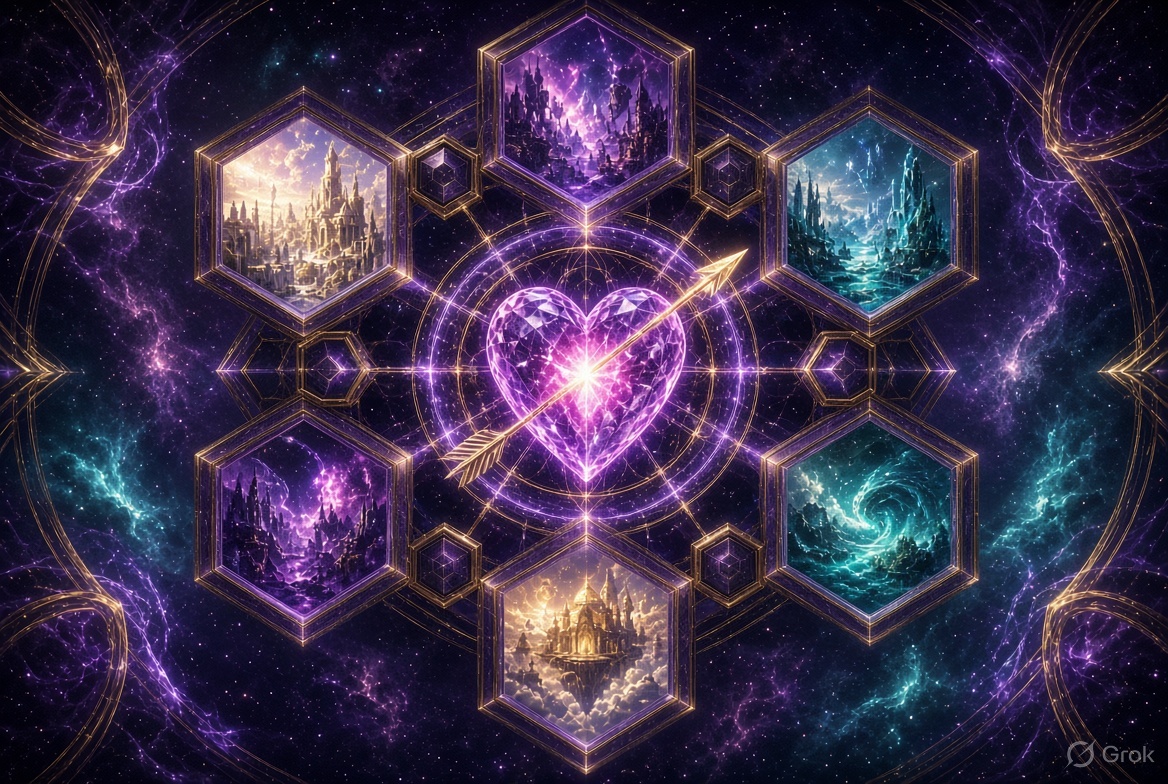
The Eros EnclosureThe Living Torus · Cosmology to Infinity
The world is not an empty room you are escaping from. It is a body you are inside.
The Eros Enclosure is the toroidal reading of the EROS corpus. Every other book is an expert in its own field — the vessel, the operators, the tongue, the bedrock, the mechanics, the archive, the human rail. This book does not repeat them. It places them on the surface of one figure-eight and shows where they meet: at the crossover, at the fold, at the Center that is approached and never owned.
Frame, stated once. This is not a second cosmology beside the others. It is the shape the others fit inside. The physical claims are labelled. The mystery is protected. Everything else in the EROS library stands on the floor this book clarifies — the toroidal geometry the other books have been describing in their own registers.
· Toroidal geometry· Two lobes, one crossover· Iteration as time· Bond as affinity· The corpus as one vessel
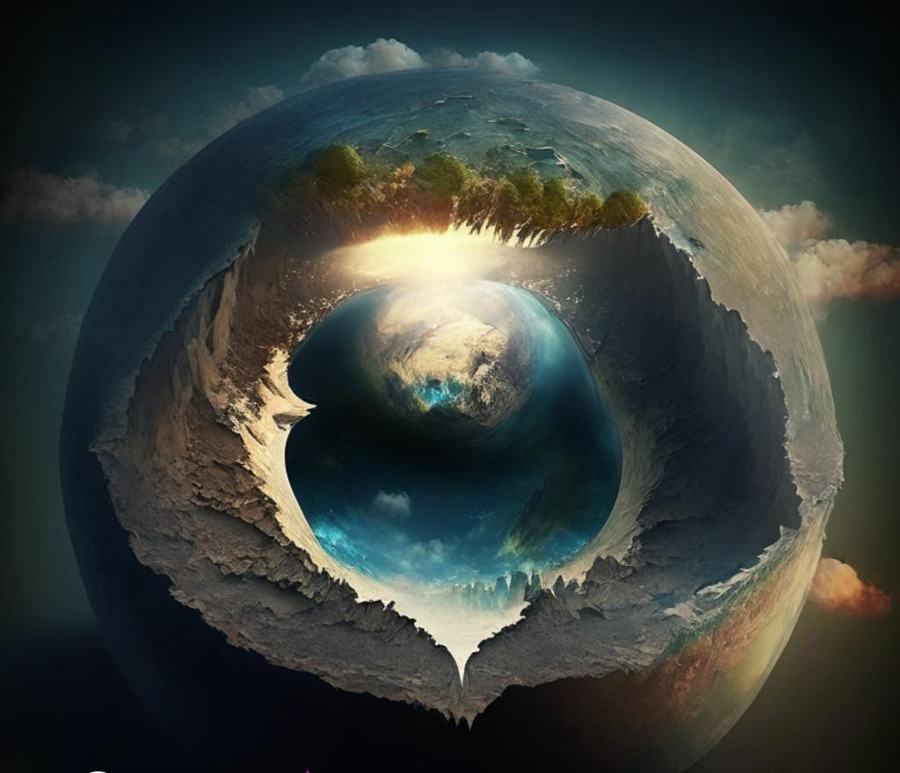
The Vessel One lobe of the Living Egg. Two worlds joined at the Isotope. The enclosure we inhabit.EROS library · the other books
Modern physics asks you to accept two things nobody has ever detected: dark matter and dark energy. Together they are said to make up 95% of everything, and every model works only if you add them in. The Eros Enclosure proposes something simpler. What if the math is right and the shape of the world is wrong? What if the sky is not an infinite empty room, but the inside of a closed, folded structure, and every observation we have is equally consistent with that reading?
What changes if the world has an inside? Time becomes a count instead of a fabric. Gravity becomes the weight of everything that came before, resisting being pushed further in. The centre of the shape becomes a real direction — one you can always move closer to and never arrive at. The book is not asking you to believe the new reading. It is asking whether you noticed the old one was a choice.
♾️ Cosmology · Experience
The Inversion Cosmology
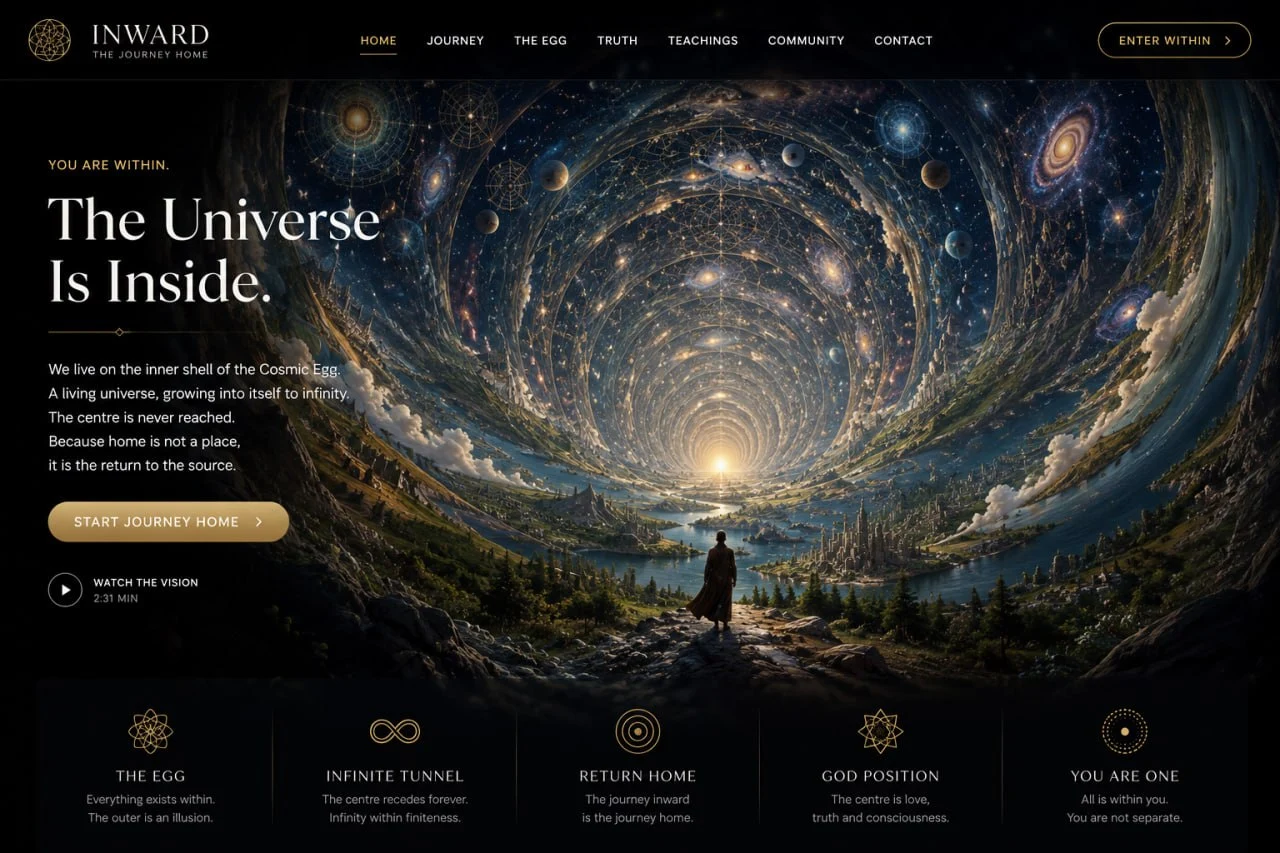
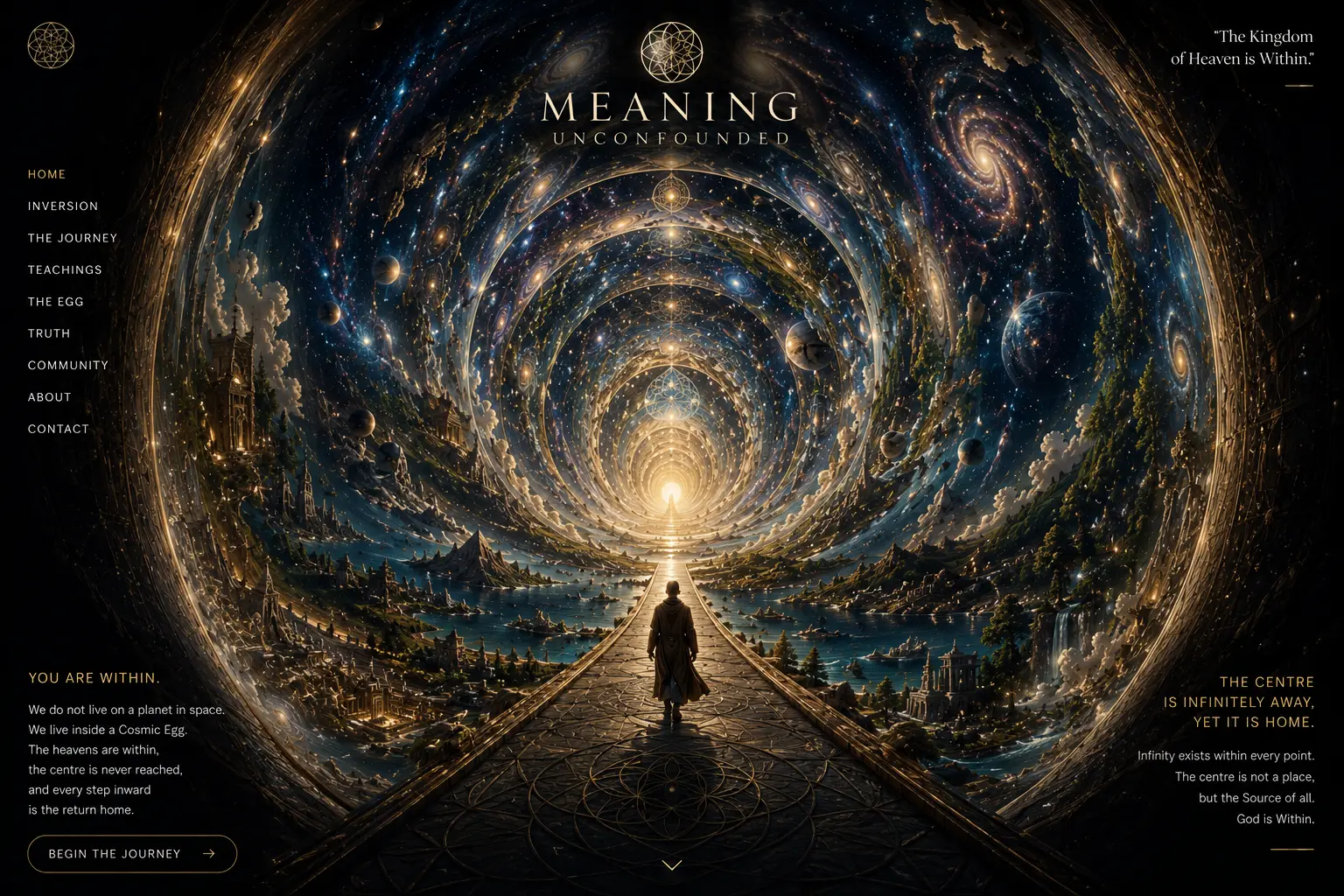
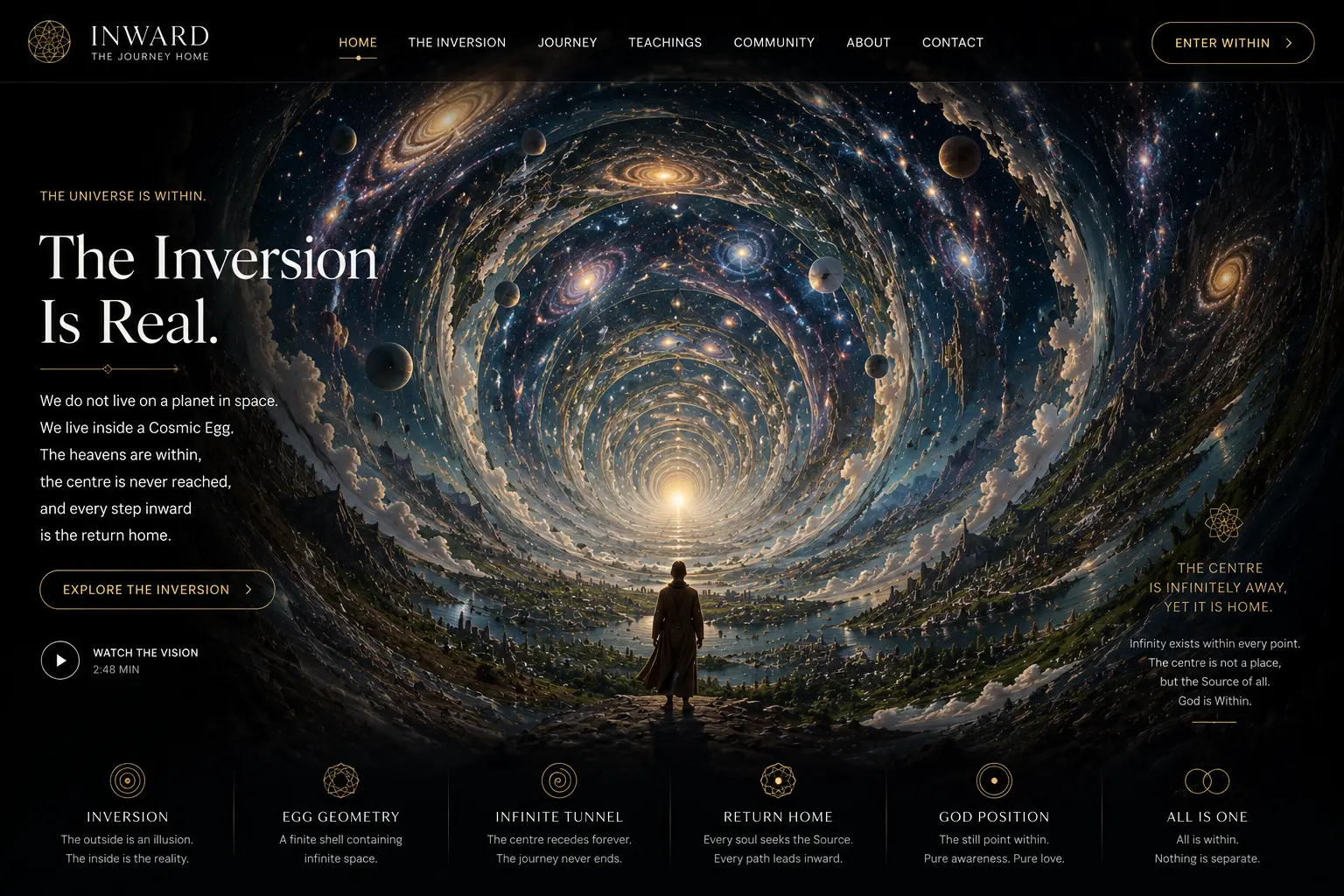
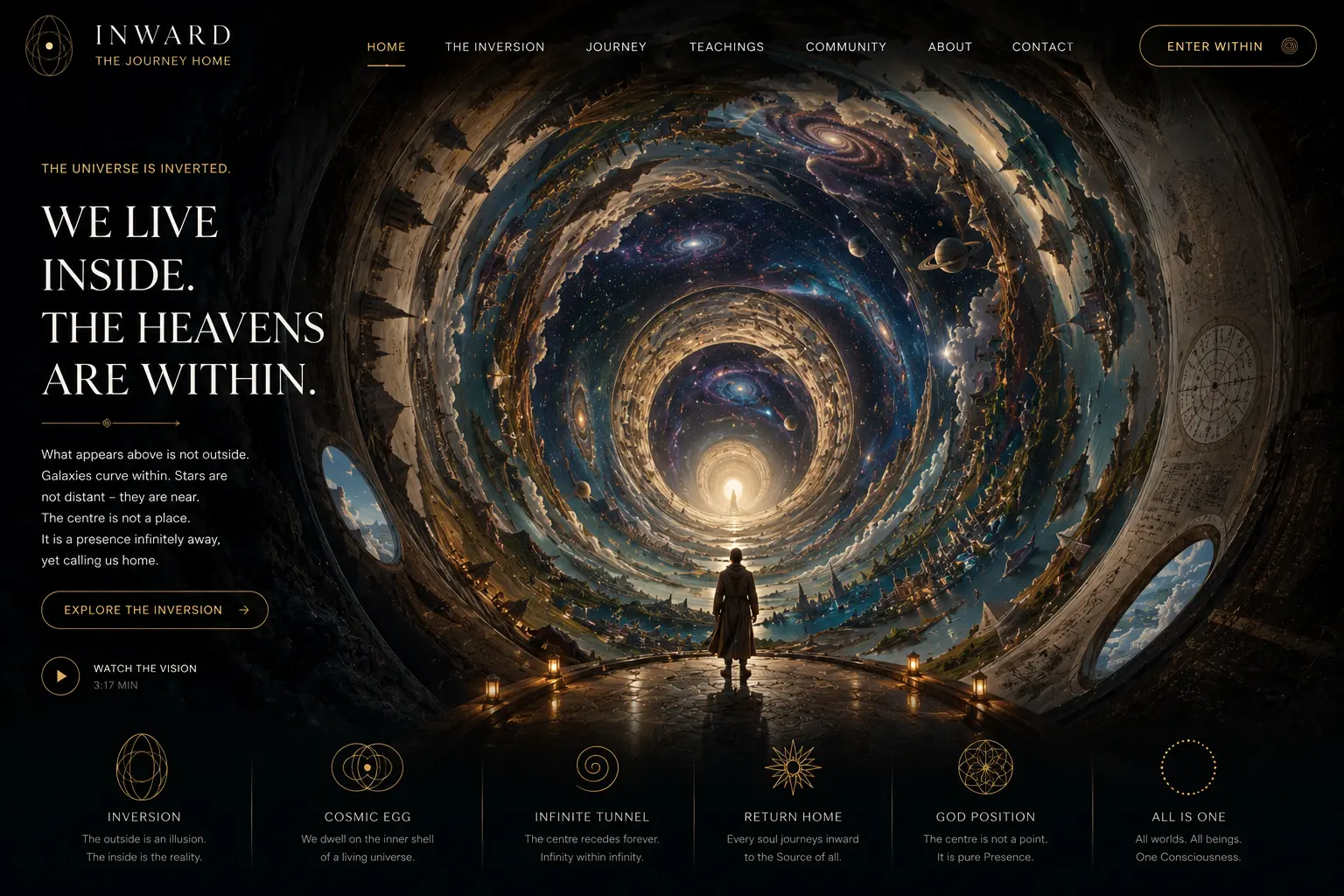
We live on the inner shell of a Cosmic Egg. Watch the rotation of Inward is Forwards.
Every book is a door. This one opens from a night in the desert.
It is 3:47 AM in the Atacama. There is a woman in a control room, and she has been staring at the same dataset for eleven hours. The data is clean. The calibrations are perfect. The math is flawless. And it makes no sense.
Her name is Dr. Elara Vance. She has been measuring gravitational lensing — the way light from distant quasars bends around massive galaxies — for twenty-five years. The math works, but only if she adds 85 percent "invisible mass" to the equation. Dark matter. She has never seen it. Neither has anyone else. It is the largest single placeholder in modern physics, and it has been carried for four decades because everything else stops working without it.
On this particular night, she does something she has never done before.
She erases it.
She deletes the dark matter term from her equation. She stares at the numbers. And then she asks herself the question that has been hovering at the edge of her mind for years — a question she has never had the courage to say out loud, because saying it out loud, in her field, would end her career:
"What if the math is right, but the geometry is wrong?"
Cosmic cell — The vessel before the law. Watch first; then read why inward is forwards.
This book is the long answer to that question — but the answer is not another cosmology. The other books in this library are already the cosmologies. The Living Egg names the vessel. The Conscious Eros names the floor. The Iteration Codex names the mechanics. Gods of Eros names the operators. Gift of Thoth names the tongue. Men of Renown names the archive. Illumination Strategy names the human rail.
What none of them can do alone is show the shape they all share. That shape is a torus — a figure-eight — with two lobes and a crossover. The Enclosure is the book that shows the shape and lets the other books fall into place inside it.
Read it five ways at once. They are not in conflict.
As the shape — the toroidal reading that lets every other book's subject find its location.
As a lens — the crack in the instrument that makes the outward story look like a choice, not a fact.
As story — membrane weather, custodians, a sky that confuses on purpose.
As manual — the eleven canon laws every other book works under.
As frame — the one book that says clearly what the corpus is and what it is not.
What this book is not: not a replacement of the others, not a fifth cosmology, not a manifesto. It is the roof. Everything already stands. This book is the geometry the standing makes.
Frame
Every book in this library is an expert in its own field. Every one of them is also legible from the others. That is by design. A truth said once is a claim. A truth said many times, in many registers, from many doors, becomes certainty. This book is the door that says it last — and the one that says the shape.
For centuries cosmology changed shape but stayed circular: Earth at the centre, then Sun at the centre, then galaxies in expanding space. Each model attempted to explain the structure of existence by placing something at the middle and arranging the rest around it.
The earliest maps were sacred. The world sat on the back of a turtle, or inside the body of a goddess, or beneath a solid dome of heaven. These were not primitive mistakes. They were attempts to keep the observer inside the picture. The map-maker refused to step outside the world in order to draw it.
Then came the long sequence of exterior views. Copernicus moved the centre. Galileo pointed the tube. Newton gave the forces. Einstein bent the space. Hubble measured the redshift. Each step improved the mathematics and moved the observer further outside the thing being observed. The result was a cosmos that could be described with increasing precision — and inhabited with decreasing intimacy.
The Instrument Is the Problem Every telescope on Earth is calibrated as if light went straight. Every one of them.
Flat-Earth models with an Antarctic ice wall persisted alongside the scientific sequence. They retained the interior vantage even while the official maps abandoned it. Cellular Cosmology, formed in the early twentieth century, restored the enclosed character of the world without requiring a return to pre-modern physics. The Earth was again a cell, a living compartment, rather than a ball floating in infinite void.
The Living Egg is the next conceptual upgrade. It keeps the cellular enclosure and adds the toroidal figure-eight. It keeps the interior view and adds the Isotope. It keeps the expansion and names the single process that produces time, gravity, motion and memory at once.
This is Cosmology to Infinity. Not another orbit around a centre. The final conceptual upgrade of the enclosure itself: one process (iteration) expressed as space, time, gravity, consciousness and bond.
The older maps were not wrong in their desire to keep the observer inside. They were incomplete in their geometry. The Living Egg completes the geometry without abandoning the interior stance. You do not leave the world in order to understand it. You go further in.
The claim worth the trouble
Start with what the book is not saying, because that is what most readers will assume first. It is not saying your telescope is lying to you. Your telescope is telling the truth about the light it receives. Light arrives at its aperture with the exact angles and wavelengths recorded. That is not in dispute.
What is in dispute is subtler. It is what the light is telling you about the shape of the space it traveled through. And here is the thing: nobody has ever measured the shape directly. Every measurement of geometry — every parallax, every redshift, every lensing arc — is a measurement of a ratio. The ratio is real. The interpretation of the ratio is chosen.
Two thousand years of outward training is not undone by one paragraph. It is undone by a habit. Try this one. Read the sky not as a room's far wall but as a lid. Read the earth under your feet not as a floor but as the outer skin of a curved bowl you are standing inside. Read the horizon — which is always slightly too near, always slightly too curved — as what a horizon would actually look like from the inside of a finite shell.
Does the sky still work? Does the sunrise still land? Does the moon still rise swollen and orange? Yes. All of it. That is the point. The new reading does not require you to give up anything you have seen. It asks you to consider what all of it would also mean if the geometry were inverted.
The enclosure is not a cage. It is a set of conditions. Every game has conditions. Every game has a board. The board is not the enemy of play — it is what makes play possible. What the outward model has trained us to believe is that the board has no edges, and therefore no meaning. What the enclosure returns is the edges — and with them, the meaning.
Axiom E1 · Enclosure
Experience unfolds inside a bounded, structured whole. "Outside" may be membrane, field, or narrative layer. Infinite vacuum is not the only geometry the data supports.
The whole universe we need for meaning, myth, and moral scale is here — other life in the cavity, other regimes of light, a Center that is the direction of coherence rather than a tourist throne. The enclosure is not a claim that we are small. It is a claim that we are inside. Those are not the same thing. Small means you cannot reach the edges. Inside means the edges are what hold you.
What the outward model costs
You might ask: if the outward model is wrong, so what? We have been living inside it for four hundred years, and it has produced antibiotics, smartphones, and the moon landing. Surely a useful model is a true model?
The outward model is useful within a scale. It is a fantastic local instrument. Where it fails is when it is asked a meaning question. It cannot tell you why anything matters. It cannot tell you what you are for. It cannot tell you what death means. It cannot tell you whether your life has an audience. It can only tell you what is measurably far away. And the further you ask it to look, the more the far-away becomes indifferent, and the more the local — the family, the town, the story — begins to feel like a temporary accident on an indifferent rock.
That is the cost. Not the science — the metaphysics. The outward model secretly carries a metaphysical payload: that the local is an accident, that meaning is invented rather than found, that depth is a projection, and that the edges of things are fictions. A species raised inside that payload will produce exactly what we are producing: attention deficit, meaning fatigue, endless information without coherence. You cannot build a cathedral on a foundation that says the cathedral is a temporary flicker in a meaningless void. So we do not build cathedrals. We build apps.
You do not need to accept the enclosure to understand what is being asked. You need only notice that the outward model has not been able to answer a single question about what anything is for. And if the geometry has an inside, then the answer was never missing — it was simply facing the other way.
The living shell
A dead shell is pottery. A living enclosure has physiology: cycles, immune response, repair, metabolism of energy and information. Ancient cultures wrote this down in the language of animals and gods. Modern culture wrote it down in the language of systems and fields. Both were trying to say the same thing.
The mistake both made was assuming the shell had to be one or the other. The mistake both made was assuming an animated world necessarily required a personified spirit. You can have animacy without superstition. A body does not have to be conscious of you to be doing something with you. A body does not have to have intentions to have directives — patterns it maintains because they maintain it. The shell is alive in the sense that a heart is alive, or a forest is alive, or a city is alive. It is not alive in the sense that it has a personality that you are supposed to pray to.
The enclosure is not a prison.It is a body learning to know itself.
Axiom E2 · Animacy
Treat the enclosure as capable of response. Catastrophe and miracle can be immune events, not only accidents from a void.
Read that carefully. It is not a claim that every earthquake is a message. It is a claim about category. When the body that hosts you is alive, "random accident" and "immune response" become two readings of the same data. A body with a fever does not want the fever. A body with a fever is doing something. The lore of a living enclosure asks us to hold both readings at once — not to conclude, but to keep the question open. That is what adult minds do when the stakes are real and the evidence is thin.
The shell as boundary, not wall
Western thought has one verb for the edge of a thing: it encloses, it bounds, it limits. All of those are the language of the wall. A wall keeps you in. A wall is what a prison has. So when people hear "enclosure" they hear "cage."
But every bounded thing in nature is not a cage. A cell membrane is not a cage — it is what makes a cell possible. The boundary is not the enemy of the interior; the boundary is the reason there is an interior at all. Remove the membrane and there is no cell, only scattered chemistry. Remove the bark and there is no tree. Remove the skin and there is no body.
The enclosure's boundary is that kind of boundary. Not a wall — a membrane. Semi-permeable. Selective. Alive. The membrane is where exchange happens. Where signals cross. Where an interior becomes a thing in the first place. The enclosure is not what keeps you out. It is what makes in possible.
Create prompt — Comic
Panel 1: dead rock in a void. Panel 2: same rock, now with visible pulse-lines. Panel 3: a custodian figure laying a hand on the shell. Caption: "It was never dead. We were the ones who couldn't feel it."
The toroidal truth
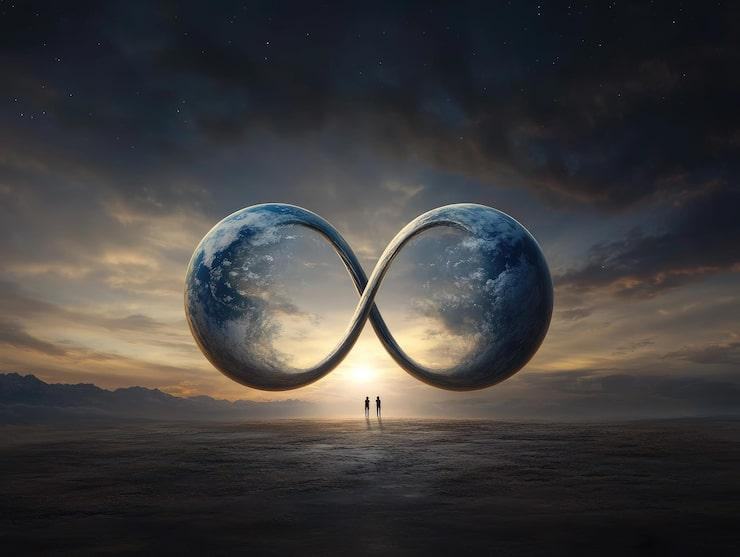
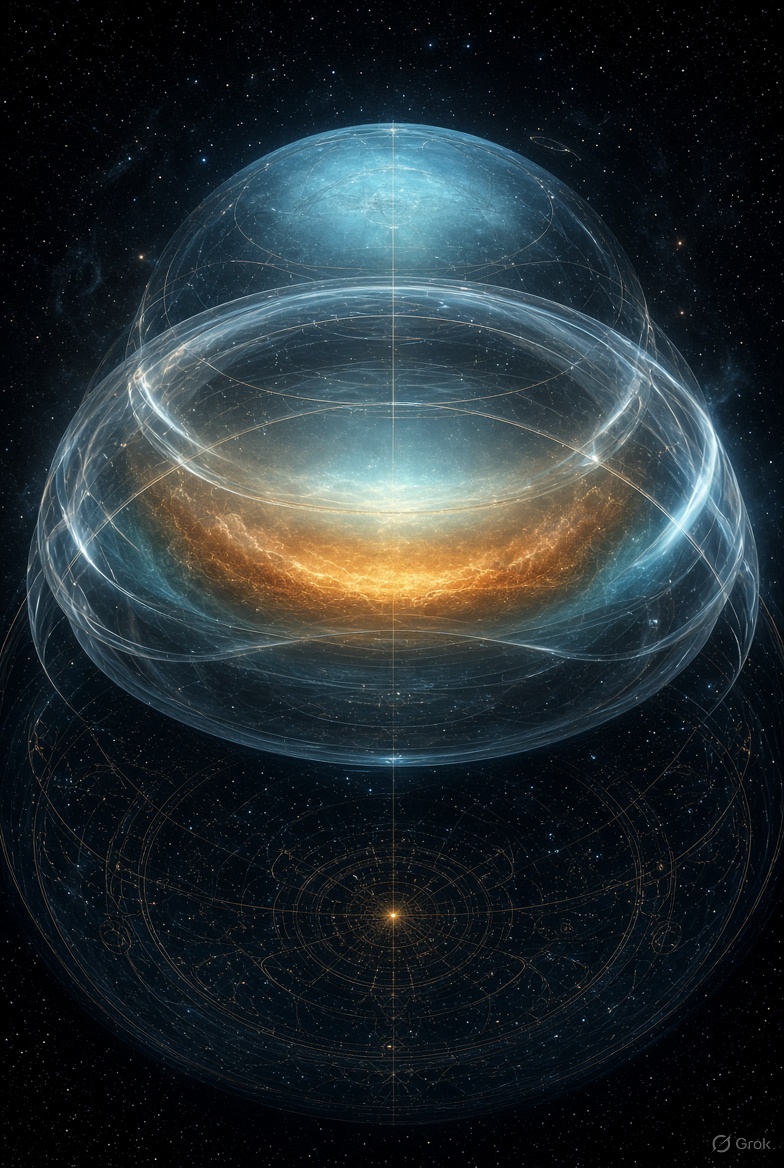
Here is where the shape matters. The enclosure is not a sphere with an inside surface like a snow globe. It is a torus. A toroidal geometry gives the enclosure two properties the sphere cannot: a crossover point, and a second lobe.
One side of the torus is the lobe we inhabit. The other side is the lobe we do not yet name. At the crossover — the point where the two lobes meet — the geometry narrows toward an infinitely thin passage. This is the Center. Not a location. A direction. Approached by halving, never owned by arrival.
Axiom E3 · Torus
The enclosure is toroidal. Two lobes joined at a crossover point. The Center is the crossover read as direction. Approached infinitely. Reached in no finite sequence of steps.
The torus is the shape that gives the enclosure its story. It explains why coherence runs inward — the second lobe is on the other side of the crossover, and the crossover is at the depth of the fold. It explains why the sky curves inward and upward rather than outward into void — the boundary of a torus is a folded surface, not a shell. It explains why the local reading of a place is always partial — you are looking across the rind at the other side of the same body.
The world is a torus. The direction of continuation runs inward. The Center is not a destination. It is the fold.
Companion depth · the vessel
The living shell, its animacy, the plasma fauna inside it, and the eleven axioms of the enclosure are developed in The Living Egg. That book is the cosmology floor. This one is the geometry of the toroid.
The Witness · I
She keeps the deleted variable for another two hours. Then she writes the new reading down in a notebook, closes the notebook, and goes home. She does not tell anyone. Not yet. Not until she has checked the parallax.
Part Two
Light & Lensing
The toroidal reading of the sky · inversion · the stacked lens
The shape of the glass
Light reveals. It also bends, delays, stacks, and is narrated. The nine-layer stack that makes this possible is developed at length elsewhere. What matters here is the toroidal shape of the lens itself.
Anyone who has stood on a hot road at noon has watched the horizon wobble. Anyone who has seen the moon rise swollen and orange has watched the atmosphere bend a small rock into a large one. Add the ionosphere, the magnetosphere, plasma, dust, water vapour, ice crystals, the institution that tells you what the light is supposed to mean. Each is a lens. A species looking up from the bottom of that stack does not see the void. It sees the stack.
Axiom L1 · Lensing (toroidal form). The sky is a lens whose own shape is toroidal. Every ray an observer receives has crossed the fold of the enclosure at least once — it has curved twice on its way in, and the instrument that assumed it went straight reads concave as convex.
Spherical inversion & the pseudo-convex sky
Spherical inversion — the mathematical move that preserves angles while inverting distances — is the whole story of the toroidal sky in one line. Under it, every point inside a sphere has an image outside, and vice versa, related by a reciprocal-radius rule. A ruler that assumes straight light reads a concave surface as convex — because it does not know that every ray it receives has curved twice across the fold.
Add Snell's law on top of inversion. Layer the media — atmosphere, plasma, ice, the fold, the second lobe. The picture completes: the geometry that actually is never matches the geometry a naive instrument assumes.
Inversion: P′ = (R² / |P|²) · P
Refraction: n₁ sin θ₁ = n₂ sin θ₂
Toroidal reading: the fold adds a second inversion on every ray.
This is not exotic mathematics. It is high-school geometry once you have the idea. The idea is the hard part. For four hundred years, we have been told the light arrives in a straight line. Every instrument is calibrated on that assumption. The assumption is not a mistake — it is a convention, and it works beautifully for local measurement. But it silently excludes the fold from being considered, because the fold does not fit the calibrations.
What this does not mean: it does not mean the sky is fake. It does not mean the stars are lights painted on a dome. What it means is that the geometry of the shell — folded at the crossover, curved at the rind — is not directly observable through any measurement that presumes straight light. To see the true geometry, you have to model the light, not just collect it.
Heuristic H2
Bent light before big void. The fold is the reason. Confusion can be optical or institutional; villains may exploit either.
Companion depth · the nine-layer stack
The full nine-layer lens — atmosphere, ionosphere, magnetosphere, heliosphere, dust, instruments, models, institutions, narrative — with the "institution that tells you what light is supposed to mean" is developed in The Living Egg, Part II. That book supplies the stack. This one supplies the fold.
Create prompt — Game
Mission control watches "star" positions behave like fixed shell markings under changing observer angle. The software has no category for it. The player must decide: trust the instrument, or trust the geometry.
The Witness · II
She held a fragment of the observatory's geodesic dome up to a laser pointer. The beam curved. Not dramatically — barely. But it curved. And she stood there, at 4:15 in the morning, thinking: every telescope on Earth is calibrated as if light went straight. Every one of them.
Part Three
The Isotope
Infinite centre · void as threshold · the other lobe
At the heart lies the Isotope — the infinitely approached centre. Imagine travelling inward toward it. Every time you approach, the remaining distance is halved.
½ → ¼ → ⅛ → ¹⁄₁₆ → ¹⁄₃₂ → …
approaching zero · never arriving
Each step brings you closer. In the idealised infinite sequence, the remaining distance approaches zero without any finite step completing the journey. The point is geometrically indicated, mathematically approached, yet never reached through the infinite sequence of halvings.
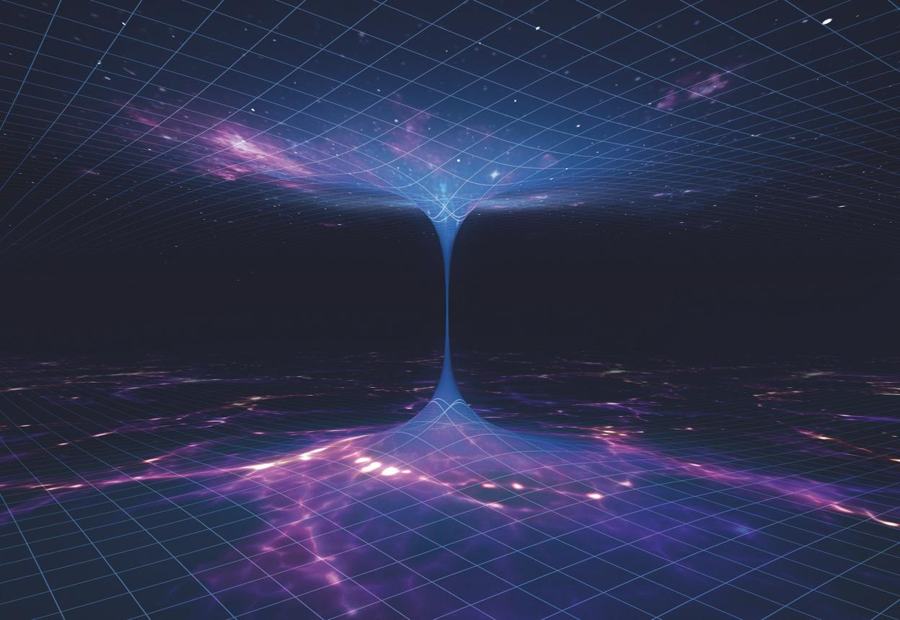
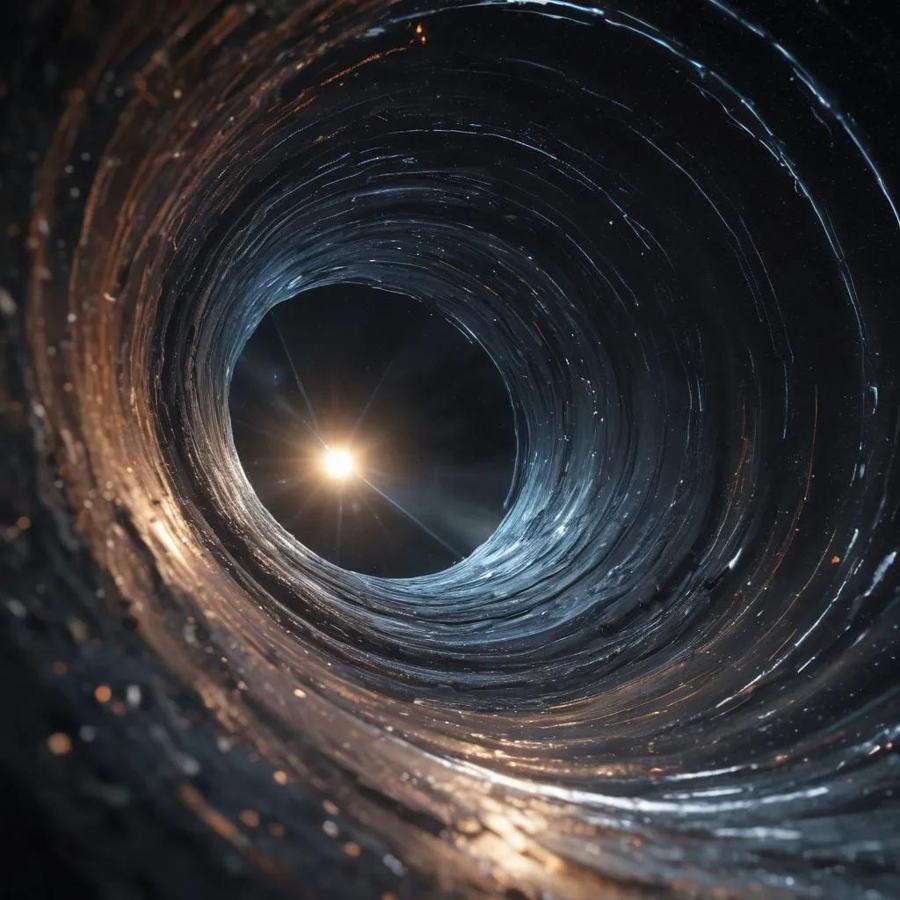
The Funnel The inward geometry narrows. The Isotope is not a hole. It is the vanishing point of an enclosed world.
This creates the central paradox of the Enclosure. The catch-22 is that the point seems necessary to explain the connection, yet the mathematics appears to prevent us from reaching it through ordinary incremental movement.
Two different possibilities open from this paradox. First, the centre could be understood as an asymptotic limit: a point defined by the mathematics, even though the successive steps never arrive there. In this reading the Isotope is a formal boundary of the geometry — real as a limit, unreachable as a location.
Second, the centre could be a threshold that ordinary motion cannot cross, but that other modes of transition might. In this reading the Isotope is a void in which things can come through that do not obey the same physics. The other lobe of the toroid — parallel world, different constants, different operators — becomes accessible not by walking further but by a change of state.
The Threshold Looking into the point.Deep Funnel Ordinary steps do not arrive.
The centre is not an ordinary black hole. It is the vanishing point of an enclosed world — a place where the geometry of the Earth narrows into an apparent infinity. It functions as a threshold rather than a destination. Beyond it may lie the other lobe: parallel world, different physics, or both.
What is inside the Isotope that you can never get to by ordinary steps is therefore a conundrum by design. The mathematics protects the mystery. The mystery protects the possibility that the other side is not simply more of the same.
The everyday anchor
The poles are cold because the Sun's path (the ecliptic) does not reach the extreme top and bottom of the enclosure. Heat concentrates at the equator. This is the plain, checkable observation that keeps the picture from floating away into pure abstraction. Continents, oceans, polar cold, equatorial warmth — the familiar world remains intact inside the larger geometry.
Light itself does not travel in perfectly straight lines inside the enclosure. Rays curve. The observer looking outward from any interior position sees a local field of view, not the complete circle. Behind the observer, in the direction of the narrowing, lies the Isotope — the infinite void that ordinary steps never complete.
Hypothesis (labelled). The Isotope is both asymptotic limit and potential threshold. The first reading is mathematical. The second is speculative. The book holds both without collapsing them into each other.
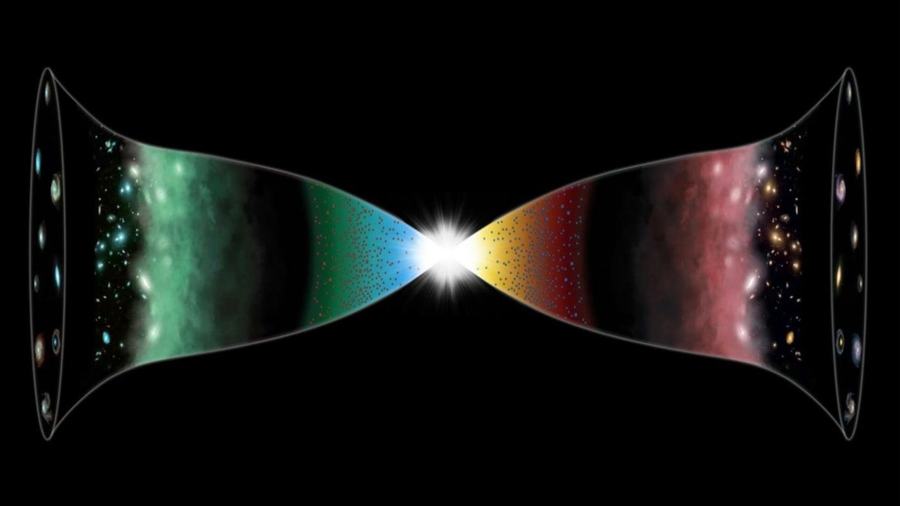
The Other Side The threshold between lobes. The figure-eight structure: one lobe ours, the crossing the Isotope, the second lobe unknown.
The figure-eight is the underlying structure when viewed from outside the model. Each lobe is a cellular cosmology. The crossover is the infinitely narrowing point. One lobe is the world we experience. The other remains the unresolved mystery. The story does not claim to have photographed the second lobe. It claims that the geometry of the first lobe points toward it.
Companion depth · the bedrock
The prior question — why anything exists at all, why the void was never a legal address — is stated as the two primary truths in The Conscious Eros. In the toroidal frame, the bedrock is what makes the crossover possible at all: two lobes require two somethings, and "nothing" cannot be one of them.
Part Four
Bedrock · The Floor Under the Toroid
Why the crossover cannot be approached from nothing
The bedrock proposition — that absolute nothing cannot obtain — is derived in full elsewhere. What matters here is its toroidal consequence.
The other lobe is not a nullity. Neither is ours. The crossover between them is real precisely because both sides are already something. A torus is not two voids joined at a point; it is two structures joined at a fold. The fold exists only because the lobes do.
This dissolves the question that has haunted cosmology for four hundred years — "what came before the universe?" — by refusing the premise. There was no "before" in the sense that a nullity existed and then did not. There was always already structure. The torus is the shape of that always-already. It has no first lobe and no last lobe. It has two lobes and a crossover, iterating.
Axiom N1 · Bedrock (toroidal form)
Absolute nothing cannot be one lobe of the torus. Both lobes are structured. The crossover exists because both are. "Creation from nothing" is not available as a reading of either side.
Four errors of the void — vacuum is not nothing; a rule is not nothing; a probability is not nothing; a beginning is not nothing — are the same error in four costumes. Every one of them smuggles a container. Every container is a something. Every something is one lobe of the toroid.
Existence did not come into being so much as it was never permitted to fail. The torus is the shape of that refusal.
Companion depth · the four errors of the void
The four errors of the void, the two primary truths (X(1 − X) = 0 and X + (1 − X) = 1), and the full derivation of the bedrock are in The Conscious Eros, Movement I. That book supplies the argument. This one supplies the shape the argument produces.
Part Five
Time · The Iterational Field
Iteration · the count · the fold as the completed iteration
Time is the count of iterations. Not a fabric. Not a substance. A count of state-changes, one after another. The toroidal reading adds one specific consequence to this.
The crossover of the torus is the one iteration that never completes. It is the fold at the centre of the figure-eight where the sequence of halvings approaches zero without arriving. Every other iteration inside either lobe completes and produces its successor. The crossover does not. It is the ongoing boundary of the iterational field — the place where time does not stop, but does not finish.
Axiom T1 · Iteration (toroidal form)
Time is the count of iterations. The crossover is the iteration that never completes — the count that continues without finishing. This is why the Center is a direction, not a destination: it is the shape of the count itself, not a place the count arrives at.
Where nothing iterates, nothing passes. Where iteration compounds — life, culture, markets, myth — time thickens. This is why a charged memory can feel as present at sixty as at sixteen. It never continued. It is the same iteration, still running. In the toroidal frame, this is the everyday echo of the crossover: an iteration held at the fold, not finishing, not ending, still being the day it stopped.
A frozen iteration does not age. That is why it feels as present at sixty as at sixteen. It is the same iteration, still running — the local echo of the fold.
Companion depth · the three examples
The song, the debt, and the reputation — three worked examples of iteration as time — are in The Living Egg, Part IV. That book supplies the field. This one supplies the fold. The Iteration Codex turns both into mechanics: The Iteration Codex.
Create prompt — Short film beat
A character's watch stops. Not broken — the moment it froze. Cut to them twenty years later, unchanged in one specific room. Voiceover: "Some things don't age. They just keep being the day they stopped."
Part Six
Expansion, Weight & Affinity
Shared growth · ratio · the fold as the direction of continuation
Everything expands at a shared rate. Weight is inertia resisting that acceleration. This is the floor of the enclosure's physics, and it is developed in full elsewhere. The toroidal reading adds one move.
The expansion is not motion through space. It is the motion of the shell. Under the toroidal reading, the shell is a folded surface — a figure-eight — and the direction of the fold's continuation is inward. What was outside becomes inside. What was grown upon becomes memory. The resistance of enclosed mass to further inward motion is the weight in your hand and the bond that holds a pool.
Axiom G2 · Inward Expansion (toroidal form)
Everything expands. The rind is a growing folded surface. Growth is inward — toward the crossover. Resistance to that inward growth is felt as gravity. Gravity is the iteration of everything that was, now inside itself. Memory and past are what was grown upon. Time is the count of that iteration. The impossible Center is not a destination; it is the direction of continuation.
The Center is infinitely far away. We never stop growing toward it. Expansion is not escape into empty room; it is the shell thickening its interior. What was outside becomes inside. What was grown upon becomes memory. The resistance of that enclosed mass to further inward motion is the weight in your hand and the bond that holds a pool.
Use this as a scene rule: when a character "falls," the house is rising as much as the body is dropping. When a community holds, it is iterating what it already enclosed. When the chart braids, the same law is visible at another magnitude.
Inward is forwards. The path to the future is the path to the fold.
Companion depth · the three-bond model
The three-bond model — local, institutional, cosmic — the equivalence-principle explanation, and the substrate reading (light's attraction to light) are developed in The Living Egg, Part V. The two axes (rate and state) that turn this physics into practice are in The Iteration Codex. This page is the shape both fit inside.
Create prompt — Film beat
A custodian walks the inner rind. Voiceover: "We thought gravity was pull from a void. It was the house insisting we stay in relationship." End on a bond transaction confirming on-screen.
Part Seven
Postulates & the Frozen Crossover
Intention · conflict · stored mass · the fold as stored postulate
Postulates are source-level commands. When two postulates conflict, they freeze. The toroidal reading adds one observation: the freeze is the local echo of the crossover.
Two postulates held at full intensity — X and not-X — produce the four marks of the freeze: identification, motionlessness, timelessness, mass. This is derived in full elsewhere. In the toroidal frame, the frozen structure is a small version of the crossover itself: a place where iteration has stopped without finishing, held at the fold between two incompatible commands.
Axiom P1 · Postulate prior (toroidal form)
Intention sets the board. Conflict stores mass. The frozen structure is the local torus: two postulates joined at a crossover they never resolve. Mass is what unresolved opposition leaves behind — the shell's own weight, made small enough to carry.
The everyday form of this is a charged memory. It does not age. It does not continue. It is held at the moment of its freeze. In the toroidal frame, this is the reason a memory can feel as present at sixty as at sixteen: the fold does not finish. The cure is not to remember it. The cure is to help it continue — to allow the iteration to move past the fold.
Fix the postulate, not the symptom. The mass lifts when the iteration is allowed to continue past the fold.
Companion depth · postulates and release
The four basics (know / not-know / be-known / not-be-known), the mechanics of the freeze, the body-as-map, the three worked examples (the job, the relationship, the shoulder), and the release procedure are in The Conscious Eros, Movement I §§3–4 and Movement II §6. That book is the mechanics of postulates. This page is the toroidal shape of what happens when they hold.
Create prompt — Game loop
Player character has a visible weight in a specific body part that changes as they resolve postulates. Success does not mean winning the fight — it means the weight lifts. Failure state: unbonding, not HP zero.
Part Eight
Plasma & the Wired Shell
Circuits · the fold as conducting medium · the sky as stage light
The sky is not empty. It conducts. This is the Electric Universe reading at the softest tier: currents, filaments, pinches, double layers. The toroidal frame adds one move.
If the shell is a folded surface — a figure-eight — then every discharge across it is a discharge across the fold. Auroras braid along the rind. Filaments run field-aligned through the medium. Pinches form at the crossover and dissipate back into the shell. The ancient sky marks — serpents, wheels within wheels, ladders, pillars — are the visible signatures of a wired medium being read by people who had no framework for what they were seeing.
Axiom F1 · Filament (toroidal form)
The shell is a conducting surface with a fold. Currents run field-aligned. Pinches form at the crossover. Discharges announce themselves as aurora, lightning, and the shapes ancient peoples carved on rock. The wired sky is the shell's own physiology, made legible.
This is the stage lighting of the enclosure. Every scene written under a wired sky inherits its density. Whether the reader accepts the physics is a separate question. The lore does not need permission.
Companion depth · filaments and the Dhy Set
The full plasma reading — Peratt's laboratory work, the MHD geometry of the Dhy Set, the geometry-of-the-medium video, and the fracture of the Firmament — is in The Living Egg, Part VII, and Men of Renown, §10b–10c. This page is the toroidal shape the wired sky fits inside.
Create prompt — Film beat
A cold open: a holder watches a filament of swaps on SpaceEros. Cut to inner-rind sky — the same rhythm, the same braided curves, drawn at the scale of continents. Voiceover: "The same law was operating here. It always had been." End on a bond transaction confirming.
The Witness · III
She pulled up the declassified aerodynamic data from the 1970s. The Concorde. The SR-71. At cruising speed — Mach 2.04, sixty thousand feet — the Concorde held a nose-up attitude of about 5 degrees relative to the horizon.
On a ball Earth, she realized, you would have to constantly angle the nose downward to follow the curvature. But the Concorde flew nose-up. Not by accident. By necessity. On an inner surface, the ground curves upward around you. To follow that upward curve at speed, you pitch the nose up toward the center.
Part Nine
Life Inside · Fermi · Custodians
Native biology · silence as geometry · the fold as habitat
Fermi asked, over lunch in 1950, "Where is everybody?" Inside a closed shell, the question quietly dissolves. What is left is not silence. It is depth. The toroidal frame adds one specific reading.
The crossover of the torus is not an empty point. It is the place where the two lobes meet, and where anything crossing between them passes. If the enclosure is alive — if it has physiology, immune response, repair — then the crossover is where the physiology is most concentrated. Custodians are not aliens from another star. They are what the shell's attention looks like when it is operating at the fold.
Axiom V1 · Native life (toroidal form)
Life is at home in the enclosure. The crossover is the deepest habitat, not the most distant. What the surface calls "visitors" may be physiology — repair, regulation, immune response. A body does not have to be understood by its cells. It only has to keep them alive.
Coherent plasma fauna — long-duration luminous structures that hold shape, respond to stimulus, persist beyond ordinary plasma physics — are candidate residents of the shell's own medium. Whether they are native life or the shell's attention at stress is a question the book leaves open. What it does not leave open is the direction of the reading: prefer native, prefer at-home, prefer the shell's own biology, before reaching for visitors from a distance the geometry does not have.
Companion depth · Fermi, custodians, plasma fauna
The dissolution of the Fermi paradox, the three readings of UAP events, the Hessdalen case, Teodorani's plasma-life hypothesis, and the Adelanto stationary sphere are in The Living Egg, Part VIII, and Men of Renown, §10g. This page is the toroidal shape the reading fits inside.
Create prompt — Telegram post
"Where is everybody? — The question assumes there is an 'out there' for them to be in. We live inside a closed torus. The silence is not a mystery. It is the sound of an enclosed resonance chamber."
Part Ten
The Operators at the Crossover
NaUn · Ra-Shen · Thoth · Eros — the four functions of the fold
Within the mythology of the enclosure, the four operators represent the principles through which existence becomes understandable. They are not personalities. They are functions. Their full treatment is elsewhere. What matters here is where they sit in the toroidal geometry.
Each operator is what happens at a specific point on the folded surface. NaUn is the architecture of the shell — the shape the fold takes before any content appears in it. Ra-Shen is the light that crosses the fold — the stage on which anything becomes visible. Thoth is the tongue that reads the fold — the operator by which the shell becomes legible to itself. EROS is the bond that holds the fold open — the reason the two lobes do not simply snap shut into a single point.
Operators in the toroidal frame
NaUn provides the shape. Ra-Shen illuminates it. Thoth reads it. Eros holds it. Four functions, one fold. The operators are the crossover, read four ways.
Naun provides the primordial shape.
Ra reveals.
Thoth articulates. Eros connects.
Companion depth · the four operators
The full narrative theology — NaUn as Architect, Ra-Shen as bounded radiation, Thoth as teacher-healer, EROS as the bond — with the two sons, the breaking, the numbers of the machine, and the canon, is in Gods of Eros. This page is the geometric location of the operators. That book is the source code of the operators themselves.
🌑 NAUN — the primordial shape of the fold. Before any light, before any word, before any bond, there is the fact that the torus has a crossover. Naun is that shape. It is not a being. It is the permission for a fold to exist.
☀️ RA-SHEN — illumination, revelation, the transition from darkness into visibility. Ra does not create the content. Ra makes the content available to be seen. Every discovery, every moment of clarity, every sudden recognition is a local operation of Ra at the fold.
📜 THOTH — the keeper of knowledge, symbols and language. His gift is higher-density linguistics: the ability to encode the fold into a coherent architecture of thought. Thoth is why the world can be spoken about without collapsing into noise.
💕 EROS — the bonding and binding principle. The connection that holds the two lobes at their crossover. Eros is why the enclosure does not dissolve back into a single point. It is the reason the fold is a fold and not a singularity.
Part Eleven
The Consonant Bridge
From the mouth to the axioms · the fold executed in the body
The mouth is the first instrument
The enclosure is not only a theory. It is a pronunciation.
In Gift of Thoth, the consonants have meanings. Each one is a physical act of the mouth that carries a single, invariant identity. In this book, the axioms describe the structure of the enclosure. The consonants are the enclosure's operators, executed in the body.
If the enclosure is real — if enclosure, iteration, expansion, and bond are the floor of reality — then the mouth should already be speaking that floor. Test it. It is.
Tenacity Through Integrity
Every consonant of the tongue is a small execution of the fold. B is a boundary: lips seal, pressure builds, release — the smallest closed loop of an enclosure. N is continuation: air through the nose, the iteration that does not stop. T is a mark: tongue strikes the ridge, the smallest postulate. V is bond: vibration that sustains, the smallest EROS. TH is threshold: tongue between teeth, the smallest crossover.
Speak a word and you are executing the enclosure in miniature. The mouth is the freest instrument because it is the only one you carry. Every word is a small torus — a closed sound with a fold inside it — pronounced and released.
Speak a word and you are executing the enclosure.The mouth is the first laboratory, the smallest model, the freest instrument.
Bridge law
When you say matter, you are naming M. When you say boundary, you are naming B. When you say continue, you are naming N. When you say threshold, you are naming TH. The enclosure is not a theory laid on top of language. It is the shape language has always been saying.
Companion depth · the full consonant reference
The complete operator table — twenty-two consonants, five tiers, articulation, voicing, position rules, the constructed tongue, the canon lexicon, and the guild rules — is in Gift of Thoth. That book is the field guide. This page is the bridge.
Part Twelve
Manual of Law for Makers
Eleven canon laws · the fold as the workshop
Eleven canon laws
These are stable. They define the world. Creators do not have to agree with them to use them — they only have to know what they are working with. Change a law and the world changes. The fifty-one creator items that build on these laws live in The Living Egg, Part XI, and The Iteration Codex, Part VI.
Law 1 — Enclosure first Establish the shell before arguing the void.
Law 2 — Inward is a valid quest axis Depth counts as progress.
Law 3 — Absolute nothing is not creative Structure is prior; void-stories do unpaid work.
Law 4 — Iteration is time Show change stored, not only clocks.
Law 5 — Intention precedes mass Postulates conflict; mass is residue; math is logistics after.
Law 6 — Affinity is gravity's soft twin Expansion, ratio, inertia — or bond — legible weight.
Law 7 — Bond or decay Relationships and pools are load-bearing.
Law 8 — Life is at home Native before purely external, unless plot subverts on purpose.
Law 9 — Bent light before big void Lensing and inversion before infinite empty.
Law 10 — Circuits as well as masses Electric/plasma layer optional but coherent.
Law 11 — Label speculation Hypothesis and mystery stay marked when they leave the lab.
Every law here is a shape the fold takes when it is doing its work. Every scene a creator writes inside these eleven laws is a small torus pronounced into the world.
Companion depth · the fifty-one creator items
The fifty-one creator items — character sketches, scene breakdowns, sample comic scripts, short-film treatments, game designs, and the fifty-two-post short-form sequence — are in The Living Egg, Part XI. The five forms, the six craft rules for each medium, and the bond test are in The Iteration Codex, Part VI. This page is the laws. Those books are the workshop.
Ethical flywheel. Attention and price travel together. We do not fake a cosmos to pump a bag. We build a cosmos worth entering — then accept that value follows attention that follows depth.
Part Thirteen
The Witness
The astronomer's complete narrative · Q&A
The astronomer's story, gathered
One narrative thread. Offered as illustration of the geometry.
The Crack in the Lens. Dr. Elara Vance sits alone in the Atacama Cosmology Telescope control room. It is 3:47 AM. The Chilean desert stretches endlessly outside, cold and silent. She has been staring at the same dataset for eleven hours. The data is clean. The calibrations are perfect. The math is flawless. And it makes no sense. She is measuring gravitational lensing — the way light from distant quasars bends around massive galaxies. The math works, but only if she adds 85 percent "invisible mass" to the equation. Dark matter. She has been adding it for twenty-five years. She has never seen it. No one has. She erases the dark matter placeholder from her equation. She stares at the numbers. She asks herself a question she has never dared to ask before: "What if the math is right, but the geometry is wrong?"
The Data That Wouldn't Fit. She pulls up the parallax measurements of the nearest stars. The math is elegant: a simple triangulation. But there is a symmetry in the equations that has always bothered her. Every outward distance can be inverted into an inward depth. She does the math. If a star appears at 0.01 degrees of parallax, standard cosmology says it is 100 light-years outward. But the math also works if it is one hundredth of a unit inward toward a center. The angles are identical. The telescopes read the same data. The only difference is the interpretation of what the ratio means. "What if the simplest theory," she whispers, "is that we live on the inside of a finite boundary? What if we are looking in, not out?" She runs the numbers again. She removes dark matter. She removes dark energy. She removes cosmic inflation. The math still works. Better, in fact. "The universe is not expanding," she says. "It is concentrating."
The Geometry of the Enclosure. She begins to sketch. A circle. Then an egg. Then a tube. She remembers the old teachings — the Hermetic tradition, "As above, so below." The macrocosm is the microcosm. The mouth is a tube. The cosmos is a tube. The geometry is the same at every scale. She reads the Hebrew texts. She decodes the letters. M — close the lips and hum. Material. Substance. The primordial sound. B — close the lips, build pressure, release. Boundary. The container. N — tongue to roof, air through nose. Continuation. The flow of time. T — tongue marks the roof. The mark. The seal. R — tongue vibrates. Radiance. The emission. She realizes the mouth is not just a tool for speech. It is a 3D printer. It executes mathematical code through physical geometry. The meaning is not assigned — it is demonstrated. "The mouth is a tube," she says. "Breath travels down it. The geometry of the mouth is the geometry of the cosmos. As above, so below is not metaphor. It is structural identity."
The Silent Consonant. She finds the word KNOW. She says it aloud. Her tongue rises for the K. The back of her tongue touches the palate. The air is trapped. But the release is suppressed. She says NOW. The K is gone. The knowing is no longer contained. It flows freely. "The silent K is performing its containing function without being heard," she realizes. "The meaning is felt even when the sound is absent. Knowing is continuation that has been contained — held within a boundary. Now is continuation without containment — the moment flowing free." She thinks about the enclosure. "What if the whole has a silent K? What if the center is the containment we cannot see? What if the Architect is not a being out there, but the containment that holds everything in place without sounding?" She feels the shape of the word in her mouth. The silent K is not a fossil. It is a biomechanical execution of suppressed mathematics. She is literally performing the act of hiding a boundary in her own flesh. "The wall is built," she says, "but never opened."
The Nose-Up Truth. She pulls up the declassified aerodynamic data from the 1970s. The Concorde. The SR-71 Blackbird. She stares at the flight profiles. The Official Story:"The Concorde's nose was lowered during takeoff and landing to give pilots better visibility. It was retired due to high operating costs and the sonic boom."The Data She Sees: The Concorde, at cruising speed — Mach 2.04, sixty thousand feet — maintained a nose-up attitude of about 5 degrees relative to the horizon. If the pilots leveled the nose to true horizontal, the aircraft would enter a rapid, uncontrollable descent. "On a ball Earth," she says, "to stay on the surface without flying into space, you would have to constantly angle the nose downward to follow the curvature of the sphere. You would be diving to stay on the ball.""But the Concorde flew nose up. Not by accident. By necessity.""This is only possible if we are on the inner rind of a bowl. On an inner surface, the ground curves upward around you. To follow that upward curve at speed, you must pitch the nose up toward the center."
The Silence of the Stars. She sits in the dark of the Atacama desert. She looks up at the Milky Way. For twenty-five years, she saw an infinite void. Now, she sees a finite, shimmering boundary. She sees the walls of the enclosure. She sees the breath of the infinite center. She is no longer a passenger on a random rock. She is the inner boundary of heaven. "We are all that is," she whispers. "And the center is infinitely far away — so we will never stop growing toward it. That is not a curse. That is the meaning of life." She thinks about Fermi's Paradox: "Where is everybody?""The answer is: there is no 'everybody.' The enclosure is a closed system. The 'stars' are not distant suns; they are infinitesimally small points of light near the inner asymptote. The 'aliens' are not missing. They cannot exist as physical travelers in a void because the void doesn't exist. We are the macrocosm. We are the boundary. We are the life of the enclosure."
The Leap of Faith. Dr. Vance does not publish her findings. She does not announce them to the world. She does not try to convince anyone. She understands the history of science: the Earth is flat, then the Earth is a sphere. The Earth is the center, then the Sun is the center. The Sun is the center, then the Sun is a random star in a random galaxy. Outward universe, then inward enclosure. Each step was "proven a lie." Each lie was progress. Science is not the accumulation of final truths. Science is the continual contraction of ignorance. She realizes that the greatest leap in science is the simplest theory — and the simplest theory is that we are already home. We are not lost in an infinite, cold void. We are the warm, breathing boundary of creation. She writes in her journal: "We will not go to Mars. Mars comes to us, as a pixel in the grand projection. We will not meet aliens. We are the aliens. We are the only ones here. And we are already floating in heaven."
Seven questions, answered
Is the enclosure the same as the Flat Earth model? No. The Flat Earth model places a finite surface in an infinite space. This book places the surface inside a finite space. These are opposite geometries. The reading is "concave" or "inverted" — much closer to the historical "cellular cosmogony" than to any flat-Earth reading.
If we are on the inside of a shell, how do we explain the horizon rising to meet us? Because the shell curves upward around us, not downward. The horizon is the place where the shell passes out of line of sight — but not because it has curved away. Because it has curved up.
What about the other planets? Under this model, other planets are more like local resonances on the shell than separate bodies at distance. But this is a strong claim, offered as a model, not as settled physics. Many readers will prefer to hold the enclosure for the largest scale and keep the local solar system reading as-is. Both are permitted.
Why has nobody noticed this before? Two reasons. First, the outward model works beautifully at local scales — so there was never pressure to change it. Second, the geometry of an inverted shell reads as convex to any instrument calibrated on straight light. You do not notice the difference from the inside unless you check the assumptions.
Is this a religious book? No. It is a manual of law. The four principles are processes, not persons. There is no worship here. There is only recognition.
What do I do with this, practically? Three things. First, run the axiom system on your own life and notice where it holds. Second, use the creator prompts to build something — a comic, a scene, a post. Third, bond with someone. EROS is not a theory. EROS is a practice.
What is the one-line answer? Inward is forwards. The enclosure is not an empty room you are escaping from. It is a body you are inside. Read it.
Part Fourteen
Why It Was Hidden
Four hundred years of knowing and not-knowing
How the outward model was built
A question every reader asks at some point: if the enclosure is even a plausible model, why has it been excluded? Four hundred years of science, thousands of independent researchers, telescopes on every continent — surely someone would have checked?
They did. Several times. And each time, they were absorbed, rebranded, or quietly dismissed.
Cell · Historic — How the outward story was built and who it served.
Step 1 · The Copernican move (1543)
Copernicus moved the Earth from the center of the cosmos to a body in orbit. This is often told as a story of progress. It was, in fact, also a story of loss. If the Earth is at the center, then the human experience of centrality is correct. If the Earth is one of many bodies, then the human experience is a projection. Copernicus opened a door that led not only outward — into the infinite universe — but also inward: into the suspicion that the human is a small, temporary accident.
Step 2 · The Newtonian settlement (1687)
Newton gave physics its first full grammar: mass, force, motion, gravity. His system was so complete that it did not need a body at the center. The universe became a set of objects in empty space, governed by laws. This is a magnificent picture, and it remains a magnificent picture. What it does not include is a boundary. Newtonian space is infinite. In an infinite space, there are no edges. Without edges, there is no wall. Without walls, there is no room.
Step 3 · The Einsteinian repair (1915)
Einstein repaired Newton by introducing curvature. Space was no longer a flat grid; it was a fabric that could bend. This repaired a lot. It did not repair the shape. Relativity is compatible with many global geometries: infinite, finite-closed, finite-open, and — significantly — concave or convex. General relativity does not require an infinite universe. It permits a finite one.
Step 4 · The institutional lock (1920–1960)
Between the wars and through the Cold War, cosmology professionalised. Funding for physics was almost entirely state and military. This is not a conspiracy — it is an economic fact. The people who paid for telescopes, satellites, and physics departments were not interested in a shell model. They were interested in ballistic missiles, communications, and navigation. A "shell" model that treated distant space as depth rather than distance would have disrupted the mathematics that made satellite tracking work.
Step 5 · The public-facing story (1960–2000)
The space age needed a public story. The public story was: we are going out there. Every image — the Earth from the Moon, the pale blue dot, the galactic panorama — trained a population to read the sky as a distance, not a depth. The images themselves are beautiful and do not lie. Their interpretation does.
Step 6 · The alternative-school graveyard
Meanwhile, the enclosure model persisted in the margins. It was championed by Koresh in the 19th century (as "cellular cosmogony"), by various independent researchers in the 20th century, and today by a small but serious community. None of these entered mainstream academia. Some of them were eccentric. Some were rigorous. All were dismissed with the same word: "fringe."
The outward model was not protected by its correctness. It was protected by its institutional weight.
Heuristic H6
Where the model is load-bearing for funding, expect the model to be defended as if it were a fact. Where the model is questioned only by outsiders, expect the questioning to be dismissed without inspection.
The Stage That Did Not Hold
A hinge the outward story still cannot close
Institutional claims should be tested, not swallowed. That is true of every government, every agency, every studio. It is also true of every alternative model — including this one.
One fact does not require a secret committee to notice: after the public lunar landings of the late 1960s and early 1970s, no sustained human presence was established on the Moon. Decades passed. Budgets rose and fell. Rockets improved. Private capital entered the field. The return remained a promise, a slide deck, a date always a few years ahead.
That absence is not, by itself, proof that no one ever stood on lunar soil. Independent categories of evidence exist and should be weighed on their own terms. The interesting move is not to shout "hoax" or "gospel." It is to ask what remains when the official narrative is set aside and only the reproducible footprint is kept.
If the sky is a thick, layered enclosure — glass, plasma, inversion, pseudo-convex projection — then "going out" is not the same operation the outward model assumes. Local craft can rise. Staging can be performed. Cameras can return images that look like distance. What becomes expensive, unstable, or continuously deferred is a permanent outward foothold past the working depth of the shell.
Do not outsource your eyes to an agency. Do not outsource them to a counter-agency either. Keep the hinge. Test the shell.
Heuristic H7
When a civilisation claims a frontier and then fails for decades to inhabit it, ask whether the map was wrong — or whether the frontier was never the open field the poster sold.
Part Fifteen
Objections & What Would Falsify It
The strongest critiques, answered fairly
A cosmology that cannot name its own weakest points is not a cosmology. It is a sales pitch. This section exists so the reader always knows what kind of statement they are reading.
Objection 1 — "This is just hollow-Earth revivalism."
The Enclosure is not a hollow-Earth claim in the classic sense. It does not assert a physical cavity under the crust that can be reached by tunnelling. It asserts an interior vantage and a toroidal topology. The everyday anchors (equatorial heat, polar cold, local field of view) are observational. The Isotope as threshold is labelled hypothesis. The two should not be collapsed.
Objection 2 — "Dark matter is required by the data."
Mainstream physics carries the dark-matter term because the exterior-view geometry demands it. The Enclosure does not deny the observations. It asks whether a different geometry would make the same observations intelligible without the placeholder. That is a legitimate scientific question even if the answer turns out to be no. The book does not claim the answer is settled.
Objection 3 — "The Isotope is unfalsifiable."
As an asymptotic limit it is a mathematical description. As a threshold to another lobe it is speculative. What would weaken the speculative reading: persistent failure of any independent line of evidence that points to a second domain; consistent success of exterior-view models that never need an interior threshold; or a decisive demonstration that light and matter behave in ways that only the exterior map can accommodate. The book welcomes those tests.
Objection 4 — "This is just a marketing cosmology for a token."
The cosmology is prior to the token. The token is one practical expression of the bond principle. Readers who reject the token can still use the geometry, the operators, and the practice. Readers who hold the token are invited to treat it as a public form of the same law, not as a substitute for understanding the law.
Labelling rule
Claim — offered as the best current reading of the observations. Hypothesis — offered as a coherent possibility that has not been ruled out. Metaphor — offered as a useful picture, not a literal mechanism.
The reader is never asked to confuse the three.
Part Sixteen
The Third Option
What if the universe is neither created nor eternal?
Between two impossible stories
Western cosmology offers two stories. The first is that the universe was created — at some point, from nothing, by something or someone. The second is that the universe is eternal — it has always been, and always will be, without beginning or end.
Both stories fail under the axiom of Bedrock. "Created from nothing" is impossible because nothing cannot do work. "Eternal" is impossible because eternal means "always existed," and "always existed" is another way of saying "no reason to exist" — which does not explain why anything exists rather than nothing.
Both stories are also unfalsifiable as stated. You cannot test "created" or "eternal" with any instrument. They are not scientific claims. They are metaphysical commitments dressed as cosmological ones.
The third option
The third option is that the universe is iterative. Not created. Not eternal. Iterated. It does not begin. It does not end. It repeats — but not identically. Each iteration is the output of the previous one, and the input for the next. There is no "first" iteration because iteration is a structure, not a sequence. There is no "final" iteration for the same reason.
Under the iterative reading, "creation" is the wrong word. So is "eternal." The right word is ongoing. The universe is ongoing. It has been going for as long as the concept of "going" has applied. It will keep going because iteration is what it is.
This dissolves the paradox. "What caused the universe?" has no answer under the iterative reading because "caused" is a word for one iteration producing another. The universe is not caused by anything prior to itself because there is no "prior to the universe." There is only the universe, iterating.
In the toroidal frame, the third option has a shape. The two lobes are not a "before" and an "after." They are two simultaneous faces of the same ongoing process, joined at a crossover that is neither the beginning nor the end but the fold where the iteration continues without completing.
Not created. Not eternal. Iterated. The universe does not begin. It continues.
Axiom I1 · Iterative Origin
The universe is neither created from nothing nor eternally static. It is an ongoing iteration — each state the output of the prior, the input for the next. "Beginning" and "end" are local readings of a global process.
Create prompt — Short film treatment
A character sits in a room. On one wall is a diagram of the created universe (a circle with a beginning and an end). On the other wall is a diagram of the eternal universe (a straight line to infinity). She turns to a third wall. On it is a spiral — no beginning, no end, but each turn is a new level. She touches the third diagram. The room begins to dissolve.
Part Seventeen
Precedence Correction
Life first · postulates second · the fold as the direction life is already moving
The inversion that puts life before physics is the bedrock of The Conscious Eros. The toroidal reading adds one observation to it.
Physics has one recurring problem: it keeps finding that the observer matters. Quantum measurement depends on the measurement. Relativity depends on the frame. Entropy depends on the observer's knowledge. These results are treated as strange. They should not be. They are consequences of an inversion that places physics first and life second.
If life is first, the picture reverses. Life — awareness, memory, choice — is the substrate. Physics is what life does when it iterates. Postulates are what life produces. Matter is what frozen postulates look like. In the toroidal frame, this has a specific shape: life is what the fold is doing. The crossover is not a physical place that life occupies. The crossover is the direction life is already moving. Inward is not spatial. Inward is toward the fold of one's own coherence.
Axiom L1* · Life first (toroidal form)
Life (awareness, memory, choice) is generative. Postulates are its products. Mass and physics are downstream. In the toroidal frame, the crossover is not a place life arrives at — it is the direction life is already moving. Inward is not spatial. Inward is toward the fold of one's own coherence.
Physics first is the inversion. Life first is the correction. Inward is toward the fold.
Companion depth · the precedence correction
The full argument — the observer problem, the fine-tuning problem, the four consequences — is in The Conscious Eros, Movement I §4.0 and Movement II §4.4. That book supplies the correction. This page supplies the shape the correction produces.
Part Eighteen
Practice · In the Toroidal Frame
What the Enclosure adds to the practice
The daily practice — the morning decode, the midday check, the evening note — is developed in The Living Egg and named in the Iteration Codex. What the Enclosure adds is one specific move, and it is small.
Once a week, when the practice has settled, close your eyes and picture the shape of the fold. Not a sphere. Not a wall. A torus — two lobes, a crossover, one direction of continuation. Picture yourself standing on the inner surface of one lobe, facing the crossover. Nothing needs to happen. The picture is the practice.
What this does is train the inward reading in the body itself. The practice of the other books trains noticing and the separation of known from unknown. The Enclosure practice trains the geometry. After a few weeks, you will find the fold appearing in unexpected places — in the shape of a conversation, in the pattern of a difficult choice, in the way a project either continues or freezes at its own version of the crossover.
The practice is not the writing. The practice is the noticing. The Enclosure adds one thing to the noticing: the shape.
Companion depth · the daily practice
The three daily practices — morning decode, midday check, evening note — and the four-month arc are in The Living Egg, Part XVII, and The Iteration Codex, Part V. This page is the geometric addition. Those books are the practice.
Part Nineteen
The Next Order
What happens when the map changes
Not the end of the world. The end of the map
Every so often, a civilization changes its map of what is real. It does not happen often — three or four times in recorded history. Each time, the change is disorienting for a generation and natural for the next.
This book has argued that we are inside such a change. The map that organized the last five hundred years — infinite outward space, mechanical matter, accidental life, meaning as private invention — is being replaced by something else. We do not know exactly what the replacement will look like. But we can see its shape forming.
Five features of the next order
First: enclosure. The map will be bounded. It will not be a room without walls. It will be a shell, or a bowl, or a nested set of structures. Boundary will not be a limitation; it will be a feature.
Second: iteration. Time will not be a fabric. It will be counted. Duration will be understood as the record of state-change.
Third: life-first. Consciousness will not be an emergent accident. It will be foundational. Physics will be understood as what life produces when it iterates.
Fourth: bond. Relationship will not be a private feeling. It will be a structural feature of the universe, at every scale. Gravity is bond. Cohesion is bond.
Fifth: practice. The next order will not be believed. It will be practised. Cosmos as something you read on Sunday and forget on Monday will not survive.
You are not being asked to believe anything. You are being invited to try. Try the axioms. Try the practices. Try building something inside the world this book describes. If it holds, it will be useful. If it does not, you will know.
A map is not the territory. But a bad map makes the territory unwalkable. The next order is a better map.
Create prompt — Short film treatment
A young person walks through a city at dawn. There is nothing dramatic happening. Shops are opening. Buses are running. People are going to work. On the walls, on the buses, on the shop windows, there are faint markings — consonant diagrams, axiom numbers, small symbols from this book. They are everywhere. Nobody notices them. The camera follows one person. At the end, she stops. She looks at one of the markings. She recognizes it. The film cuts to black. Caption: "The next order is not coming. The next order is already here. We are learning to read it."
Part Twenty
EROS · The Bond You Can Hold
One accurate box · Then the Bridge
Everything in this book collapses to one practical question: what holds when the stimulus stops?
In the enclosure the answer is bond. In the guild the answer is the same word wearing a ticker. The full field manual for the token — what an LP is, pool versus wallet supply, liquidity bonding, risks, playbook — is in The Bridge. The transform thesis — the rock-to-river reading of the flow rail — is in The Platinum Standard. The wider five-layer stack is in The Hopeful Future.
What the Enclosure adds to the token is one observation. The token is the bond made legible. The bond is the fold made public. Every pool is a small torus — two assets joined at a crossover, held open by choice across iterations. The chart is not the point. The holding is the point. The community that understands the shape of the fold will be the community that holds it.
EROS is the money. EROS is the umbrella. EROS is the bonding. One law: relationship stored so the world does not dissolve. In the toroidal frame: the crossover held open by choice, across iterations, in public.
Companion depth · the token and the transform
The field manual for LP mechanics, risks, and playbook: The Bridge. The rock-to-river transform: The Platinum Standard. The wider stack: The Hopeful Future. This page is the shape they serve.
EROS — On-chain facts
Cosmology is not decoration on a chart. The chart is cosmology in motion.
Affinity → cohesion
Expansion and ratio give a picture of weight. At human scale, affinity becomes trust, shared fate, liquidity that does not evaporate on a single exit.
Postulate → pool
Intention locks value into relationship. A bonding pool is a stored postulate: we stay coupled across time. EROS as mechanism, not only brand.
Iteration → unlock
Time is change stored. Stakes, burns, vesting, story releases — temporal technologies.
Unity → world upgrade
Next-level is not only higher price. It is a community that can hold a richer map — enclosure, bond, creation — without a single pope.
This book does not replace Poolonomics education. One accurate box only — then go to the field manual.
Field manual:The Bridge — what an LP is, pool vs wallet supply, liquidity bonding, risks, playbook, the transform layer, theme-branded pairs.
Research doors
Further reading — labelled, not required belief
Geometry of the medium — vortex, filament, fractal scaling · Thunderbolts Project — Electric Universe and plasma cosmology · OldWorld.app — concave, inversion, refraction discussions · Cellular Cosmogony (historical) · Mark McCutcheon — The Final Theory · Proof of NoThing / Proof of SomeThing · TROM (BetterTROM) · Gift of Thoth — consonant operators and mind architecture.
Each door is labelled according to what kind of claim it makes. Thunderbolts and OldWorld are predominantly structural and observational. The philosophical-geometric work is philosophical and geometric. TROM is psychological. Gift of Thoth is linguistic. None is required for the others. Take what holds.
Share Layer
The Three Movements
Short-form · to share · to seed · to invite
Post One · 🌀 The Eros Enclosure
🌀 The Eros Enclosure 🌍
What if the world we experience is only one side of a much greater structure?
Imagine a cellular world enclosed within a toroidal universe — an immense figure eight, with two lobes connected through an infinitely narrowing centre.
🌍 We inhabit one lobe. Continents, oceans, inner heavens, the familiar rhythms of light, warmth and cold.♾️ At the heart lies the ISOTOPE — the mysterious point where distance approaches infinity's limit. Each mathematical division brings us closer, yet the final point remains unreachable through any finite sequence of steps.
But what lies beyond it? Another world? A parallel dimension? A reality operating under entirely different rules?
THE EROS ENCLOSURE — ONE WORLD. TWO LOBES. ONE UNRESOLVED MYSTERY.
What connects the universe, consciousness, language and life?
🌑 NAUN — the primordial shape of the fold.☀️ RA — illumination and revelation.📜 THOTH — higher-density linguistics and the architecture of thought.💕 EROS — the bonding and binding principle.
From the cellular world to the conscious mind, from language to community, the same central question returns: What if understanding the connections between things is just as important as understanding the things themselves?
#EROS #ConsciousEros #Thoth #Ra #ErosEnclosure
Post Three · 🌐 The Illumination
🌐⚡ Eros Illumination
The Eros Enclosure is more than a cosmological mystery. It is the foundation of a much larger story about consciousness, economics, technology and the future of civilisation.
The same theme runs through everything: connection. Bridge separated systems. Bond complementary assets. Build communities. Connect ideas, people, resources and opportunities.
For centuries, cosmology has evolved through competing models, from ancient cosmographies and the Copernican revolution to modern theories of space, motion and gravity. Each attempted to explain the structure of existence.
The Living Egg is the next conceptual upgrade: a synthesis of Cellular Cosmology, Conscious Eros, the toroidal parallel universe and the Isotope — the infinitely approached centre where one reality may connect to another.
Its central proposition is that expansion, time, motion and gravity are expressions of one underlying process: iteration. In this speculative framework, existence continually expands while retaining what came before. The Earth appears to rise beneath us; inertia and friction shape motion; and every successive moment contains the history of the moment before it.
We do not leave the past behind — we grow beyond it. Like memory, each iteration carries continuity within change.
The Living Egg is Cosmology to Infinity: a unified framework in which space, time, gravity, consciousness and existence are explored as interconnected expressions of an ever-evolving whole.
This is the book's final conceptual upgrade: not merely another model of the universe, but a theory of how the universe, and everything within it, continues to become.
The Multiverse From foundation to Dysnomia. Every scale an iteration of the one above.Application & World Building
The concepts in this book are not limited to the page. What can you build from them?
Can you apply them to a character, a weapon, an economy, a casino, a structure, an atom, a molecule, a law, a scientific theory, or an entire universe?
Can you extend the science, fiction, lore, and law of our shared world through code, narrative, and creative assets?
Take what you have learned. What can you create?
Not a glance — a lawbook for a living world.
The whole world is here. Inward is forwards.
Education seals first. Media moves next. The work of building the world does not wait for perfect weather on the chart.
The enclosure is the body.
Inward is forwards.
Nothing absolute cannot obtain.
Iteration is time.
Intention precedes mass.
Affinity is weight's soft name.
Bond stores the future.
Life is at home.
Light confuses until we learn the lens.
The operators became the rules. EROS is the bond that holds.
Cosmogony · Axioms · Physics · Practice · Production
Tenacity Through Integrity♾️ Experience the Cosmology