Everything inside the enclosure expands at a shared rate.
Weight is what a body feels when it resists that expansion.
Two independent axes change the felt resistance without changing mass.
Everything inside the enclosure expands at a shared rate. Weight is what a body feels when it resists that expansion. Two independent axes, rate and state, change the felt resistance without changing mass.
Everything inside the enclosure expands at a shared rate, so nothing can measure its own growth. The ruler grows with the table. The clock grows with the kettle.
What a body calls weight is the meeting of two expansions, its own inertia against the floor rising to meet it.
Time is not a river but a count. It is the sequential tally of state-changes, and that count can be slowed or matched. Two independent axes govern the felt result. The rate at which a body iterates against the shell. The arrangement of its structure, open like ice or compact like stone.
Mass never changes. Only the ratio does. Slow the rate and the body feels heavy. Match it and the body feels light. Open the structure and it floats. Close it and it sinks.
The same mechanics re-read the archive, beams that lift, hours that vanish, orbs that notice, figures that pass through walls, as physics rather than magic. The same material reads at four depths, from an eighteen-year-old's first intuition to a doctoral frame that inverts cosmology inward.
Ecosystem thesis. EROS is a bonding protocol. The books teach the mechanics. The token is the participation layer. The community produces the assets. This manual is the mechanics book.
How to read this Codex
This is a field manual. Read once through, then return to the form cards when you need them. There is no required order and no required pace.
Every Part is readable at four levels. Part VII states all four. Every other Part teaches at Level Two, the working mechanics. If you are here for the cosmology context, read Parts I and II. If you are here for the forms, Parts III and IV. If you are here for the craft, Part VI.
Form cards in Part III follow the same structure: mechanism, sensation, cost, warning, one worked scene, one craft prompt. Read the mechanism. Skip the rest if it does not serve you.
Cross-links to other books are marked with colour chips: Living EggConscious ErosEnclosureGods of ErosGift of ThothMen of RenownEros Plan.
The Aa button at bottom-right opens the reader panel: text size, line spacing, column width, go-to list.
You were taught the world is solid and you are one of the solid things. Weight is a fact. Time is a river. The floor is the one thing you can trust.
This book says the floor is moving. Everything is contained within one enclosure, and everything inside it is expanding at once, including you. Weight is not a pull. It is a meeting, your own inertia against the ground rising to meet you. Time is not a river. It is a count of changes. Mass is not fixed. It is what unresolved conflict leaves behind. Two simple measures, how fast you cycle and how open your structure is, change what your body feels without changing what it weighs.
If this holds, it redefines most of what you were taught. Gravity, expansion, the archive of strange sightings, all become mechanics instead of magic. The principles are simple enough to feel before you understand them.
♾️ Cosmology · Experience
The Inversion Cosmology
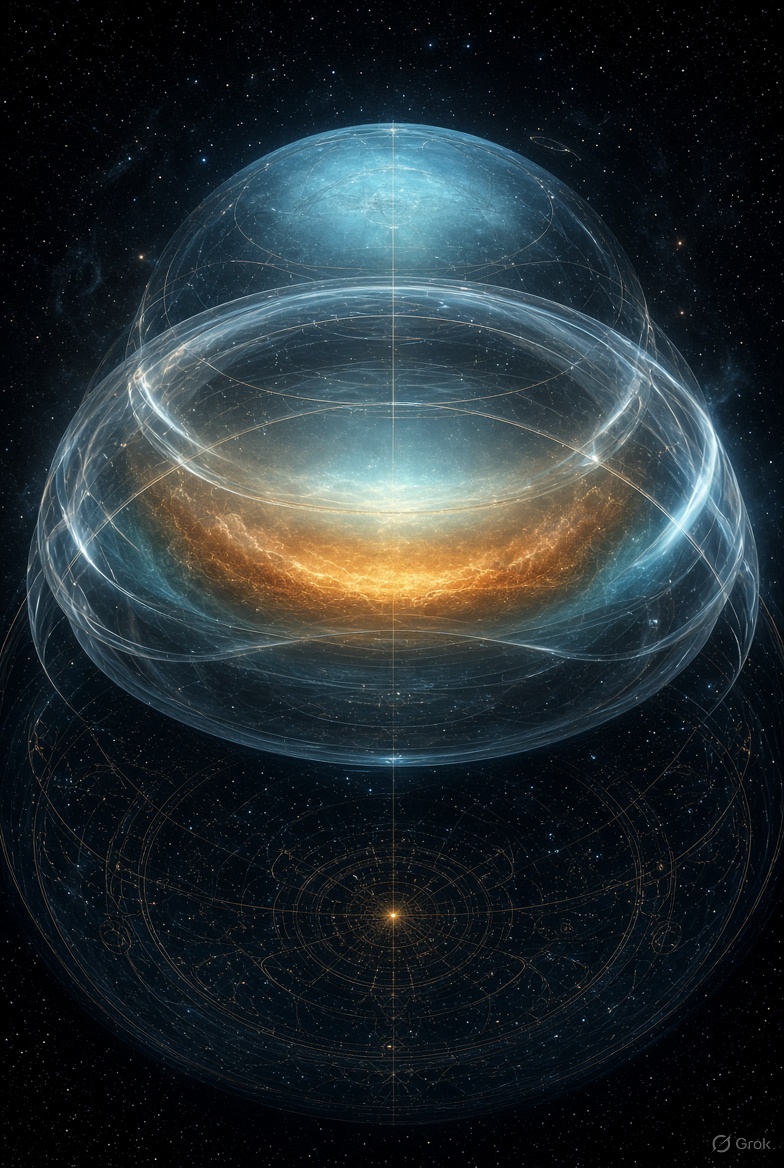
We live on the inner shell of a Cosmic Egg. Watch the rotation of Inward is Forwards.
Shared expansion. Time as count. Weight as resistance. Two axes.
1.0 · The Bedrock
Existence cannot not-exist
Before the floor, the reason the floor cannot be otherwise.
Try to picture absolute nothing. Not empty space. Not zero objects. The total absence of anything including the absence of a frame for absence. The attempt fails. The picturing itself requires a frame. The frame cannot be part of what is being pictured. Therefore the frame cannot be absent.
Principle
Existence is the thing that cannot not-be. There was no before. There will be no after. It was never created, because creation implies a prior state, and no prior state is available.
Example. A theologian, a physicist, and a child are asked why anything exists at all. The theologian says a creator made it. The physicist says a quantum fluctuation seeded it. The child says it just has to. The child is closest. The creator and the fluctuation both require something prior. The child's answer requires nothing prior.
Every axiom downstream rests on this. Shared expansion, iteration as count, weight as differential. If existence could not-be, the floor could be missing on some day. It cannot. The floor is always on.
Where this connects
The bedrock axiom is derived at length in The Conscious Eros. That book names the primary layer: life and postulates first, matter and energy as effects. The toroidal reading — why neither lobe of the torus can be a void — is in The Eros Enclosure, Part IV. This Codex takes the bedrock as given and builds the mechanics on top of it.
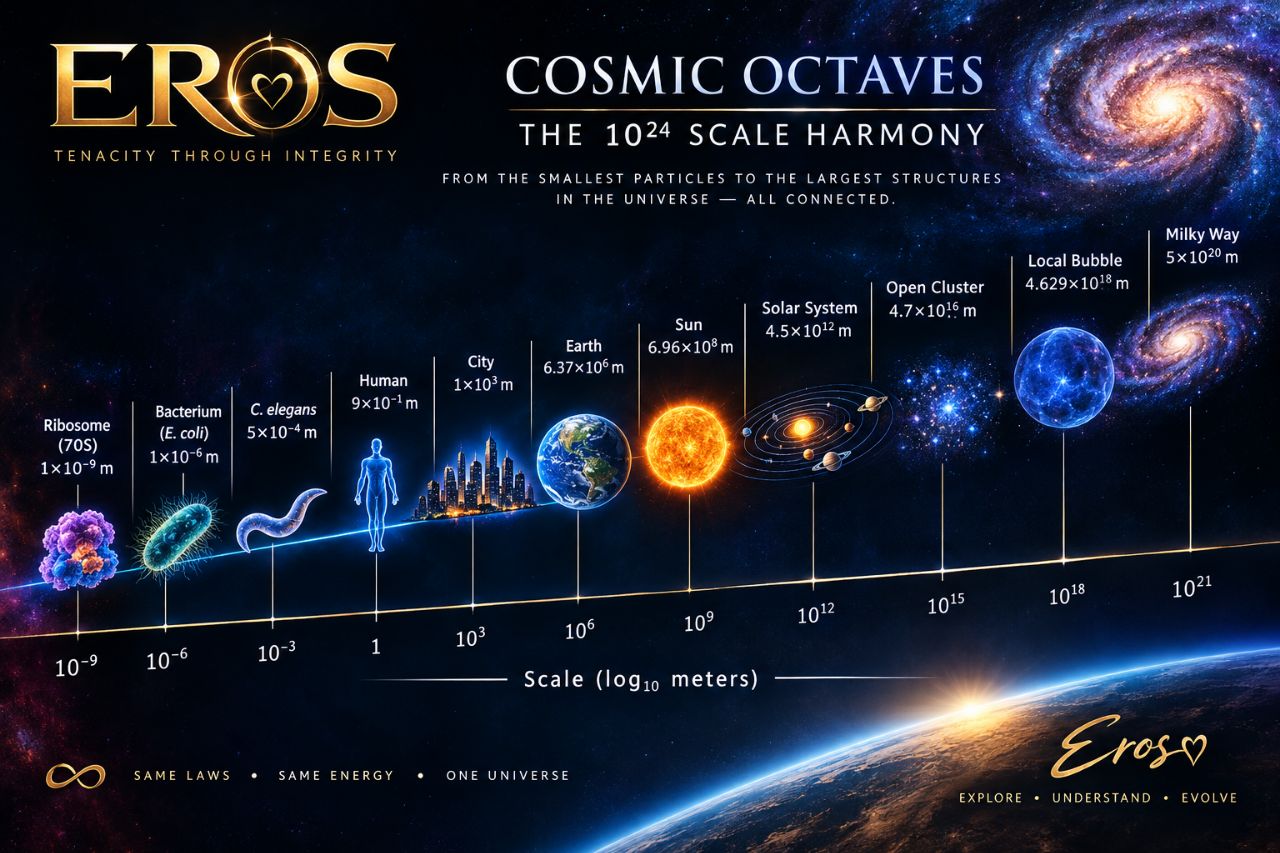
The floor at the largest scale. One law, many magnitudes.1.1 · The Shared Constant
Everything expands at the same rate
This is the axiom the rest of the book stands on. If it fails, nothing else works. If it holds, everything downstream follows.
Every atom inside the enclosure is expanding. Not drifting apart. Expanding. Growing. Every structure, every body, every grain of sand, is growing at a shared constant rate. Because the rate is shared, the relative sizes stay the same. A ruler measured against a table measures the same today as it did yesterday. But both are larger than they were.
This is Living Egg territory. Axiom G1. The expansion is not a motion through space. It is the motion of space. There is no fixed frame to measure the growth against because the measure is growing too.
Axiom · The Floor
Everything expands. The rate is shared. Relative sizes stay constant. Absolute sizes do not. No internal observer can detect the expansion by ordinary measurement. The instrument grows with the world.
What does this change? Nothing visible at first. The sunrise still lands. The floor still holds. Your weight still presses you into the chair.
But the floor is also moving. Upward, toward you, at the same shared rate. And what you call weight is not a downward force. It is the meeting of two expansions.
1.2 · Time as Count
Time is the count of iterations
Not a river. Not a fabric. A count of state changes, one after another.
Every process is a sequence. The kettle boils. One process. Beginning, middle, end. The song plays. One process, repeated. The debt is paid. One process, decremented. Each has a shape: a state, a change, a new state. That sequence is what we call time.
The Living Egg names this the iterational field. Time is not an independent thing that flows past us. Time is what state-change is, observed in sequence. Where nothing iterates, nothing passes. Where iteration accelerates, time feels faster. Where iteration slows, time feels slower.
Duration is not a container. Duration is a count.
The Floor · §1.2
Under the shared-constant axiom, this becomes concrete. Every body inside the enclosure iterates at some local rate. The background shell iterates at its rate. When the two rates match, the body moves with the shell. Frictionless. When they diverge, the body drags.
What a number is. A number is the objective quantifier of a value's distance from zero. Where quantity accumulates, where postulates have been fixed into form, a distance from zero emerges. Zero names the state before any iteration has run. Mass itself is the physical form of accumulated distance-from-zero.
Time is the count of iterations. Number is the distance of a value from zero. Mass is the physical residue of iterations that stopped short of zero. The three are one reading of one process.
1.3 · What Weight Is
Weight is the meeting of two expansions
Not a force pulling down. The floor is rising. So are you. Difference is the felt quantity.
You are standing on the ground. The ground is expanding upward. You are expanding outward and downward, the direction opposite the shell's rise. When your expansion and the ground's expansion meet, the ground pushes you. The push is what you feel as weight.
This is why gravity and acceleration are indistinguishable. The floor rising toward you is acceleration. You are not being pulled. You are being met.
Weight = your inertia, resisting the floor's upward expansion.
Not a separate force. A differential.
First: if you could slow your own expansion relative to the ground's, you would fall out of phase. Your inertia would lag. The push would feel greater. You would feel heavier.
Second: if you could speed your expansion to match the ground's, the differential would drop to zero. Your inertia would ride with the shell. You would feel lighter without losing any mass.
This is the whole mechanic. Everything else is application.
1.4 · The Two Axes
Rate and state
Two things govern every body inside the enclosure: how fast it iterates, and how its structure is arranged. Both are manipulable. They are not the same thing.
There are two axes in play, not one. Call them the rate axis and the state axis.
The rate axis is the speed at which a body cycles through its state-changes, measured against the shell's background rate. A body can iterate faster, slower, or in sync with the shell. Fast iteration means the body is completing more cycles per unit of shell-time. It feels light against the shell's expansion because it never accumulates inertia in any single direction. Slow iteration means fewer completed cycles. It feels heavy because the body holds one configuration long enough for the shell's push to be felt as mass.
The state axis is the arrangement of the body's structure. A body can be open, spacious, lattice-like, more volume per unit mass. Or compact, tight, dense, less volume per unit mass. Open structure floats against the shell. Compact structure sinks.
The two axes are independent. You can be a slow-rate, open-state body (heavy from rate, light from state) or a fast-rate, compact body (light from rate, heavy from state). The forms exploit one axis or the other.
This is why the water principle and the phase rule are not the same move. Water changes state. Matching the shell changes rate.
The five forms in Part III use both axes. Some manipulate rate. Some manipulate state. One manipulates both alternately. Learn them by which axis they move.
Where this connects
The floor axiom is named in The Living Egg as G1. The iterational field as time is named there as T1. This Codex takes both as given and shows what they imply. The toroidal reading of inward expansion — why the direction of continuation is the fold — is in The Eros Enclosure, Part VI.
1.5 · Coherence
Rate and state say what a body does. Coherence says what it builds.
Two independent axes govern every body. A third variable modulates both. Coherence is how aligned a body's iteration cycles are.
When cycles are scattered, coherence is low and no mass accumulates in any single direction. When cycles are aligned and focused, coherence is high and mass accumulates in one direction.
Variable
Asks
Where it lives
Rate
How fast the body cycles against the shell
The rate axis
State
How open or compact the body's structure is
The state axis
Coherence
How aligned the cycles are
Modulates both axes
Accumulation
What has been built
Mass, felt as weight
One term, one meaning. Rate is clock speed against the shell. State is structural arrangement. They are not the same thing. The water-to-ice move is a change of state. A change in how fast a body cycles is a change of rate.
1.6 · Rate, Resistance, and the Postulate Layer
Direction decides. The postulate is the lever.
The rate model above describes how a body feels its own weight. It does not describe why the body moves at one rate rather than another. That question is answered one layer up.
Weight is an effect. Rate is an effect. State is an effect. Each is downstream of what a life has postulated. In Conscious Eros this is stated plainly: life and postulates are primary, and everything the Codex describes is what those postulates look like from the outside. The rate model is not the floor. It is the surface of the floor.
A postulate is not a belief about the rate model. A postulate is the source-level decision that determines which rate the body occupies. Change the postulate and the body changes its rate without the reader doing anything with the rate itself. That is why the release procedure in the Conscious Eros works on postulates rather than on rates. Work at the source. The effect follows.
What the rate model adds is comprehension. It tells the reader what the effects look like while they are under them. It names the felt difference between a body that has slowed below the shell and a body that has sped above it. It gives the reader a table to consult. It does not give the reader a lever on the source. The lever is the postulate, and the postulate is life.
The directional table
Two rates. A is the body's local iteration. B is the shell's reference rate. The Codex proposes that heaviness arises when the body falls below the shell, and lightness arises when the body matches or exceeds it.
Situation
Body A
Shell B
Direction
Felt weight
Matched
100
100
Neutral
Baseline
Body slower
50
100
A below B
Heavy
Body faster
200
100
A above B
Light
Both slow proportionally
50
50
Neutral
Baseline preserved
Both speed proportionally
200
200
Neutral
Baseline preserved
Both slow, unequally
60
80
A below B
Heavy
Both speed, unequally
240
200
A above B
Light
Three things to notice.
First: direction matters. Slowing the body below the shell raises resistance. Slowing the shell below the body lowers resistance. Both are "slowing." They produce opposite felt results. The word "slowing" alone tells you nothing.
Second: shared proportional change preserves the ratio. If both rates halve, or both double, the relationship between them is unchanged, and the felt weight is unchanged. Only the differential moves the felt result.
Third: the ratio is directional, not absolute. A body above the shell is not the same kind of heavy as a body below the shell. Above is light. Below is heavy. The Codex states this in §1.4, and the table here respects it.
The postulate layer above the table
Every entry in the table is an effect. Each is downstream of a postulate. The postulate determines which row of the table the body occupies. The table tells the reader what the row feels like. The postulate tells the reader how to move between rows.
This is why the Codex does not teach rate manipulation as a primary practice. It teaches the forms as postures of attention, and it hands the reader to the Conscious Eros for the postulate work. The rate model is a lens. The postulate is the lever. The Codex supplies the lens.
The postulate is what is true for the body that postulated it. A body that postulates conflict experiences the freeze. A body that postulates continuity experiences the iteration. The rate model and the felt weight that follow are consequences of the postulate, not independent of it.
A note on the refinement
One reading, offered as an interpretation rather than as the Codex's own claim, extends the model into perception. It holds that attention directed outward increases the perceived density of environmental change, which makes the environment appear slower, which lowers the perceived resistance, which feels like lightness. That reading is coherent. It is not what §1.4 says. The Codex says the practitioner tunes their internal rate to match the shell. The perceptual reading says the practitioner perceives the shell as slower than the body. Both produce lightness in the model. They are different moves. The reader can decide which one to practice.
Rate and resistance describe the effects. The postulate describes the source. Direction determines the felt result. Shared proportional change preserves the ratio. The postulate is the lever, and the postulate is life.
Where this connects
The postulate layer is derived in The Conscious Eros, Movement I §§3–4 and the new subsection at the end of §4.4. The eight forms in Part III of this Codex are postures of attention working on the effect layer. The release procedure sits at the source layer. The reader can test either against experience.
Part II
The Water Principle
Mass invariant. Structure variable. State axis.
2.1 · Mass Invariant, Structure Variable
Freeze a kilogram. Weigh it. It is still a kilogram.
But it now takes up nine percent more volume.
Water the liquid and ice the solid have the same mass. The same kilogram. But ice occupies roughly nine percent more volume because its molecules arrange themselves into an open crystal structure. The molecule count is unchanged. The arrangement is larger.
Density goes down. Ice floats. Water sinks. Same mass.
Mass: invariant
Volume: +9% when freezing
Density: decreases with increased volume
Buoyancy: improves
Hold that shape. Because the same principle applies to any system inside the enclosure, including the practitioner's own body and awareness.
The water principle is the model for the state axis. Crystal Expansion and The Compact do not change mass. They change the structure by which the mass meets the shell's expansion. The change in structure changes the ratio. The change in ratio changes the felt weight.
2.2 · Volume, Density, Buoyancy
Why ice floats, and why a practitioner can
Buoyancy is not the absence of weight. It is weight meeting a larger medium.
An object floats in water when the object is less dense than the water. Not lighter. Less dense. A ship is heavier than the water it displaces, but its interior is full of air, so the average density of the whole structure, wood and steel and air, is lower than the water. It floats.
The same principle holds for the practitioner inside the enclosure. A body at rest against the background shell has a fixed density per unit of structure. A body whose structure has been opened, through Crystal Expansion, through the practice itself, has a lower density per unit of structure even though its mass is unchanged.
Buoyancy is the felt result of a lowered density ratio. Not weightlessness. Not the absence of mass. The presence of mass meeting a larger field at a different ratio.
This is why the practitioner's sense of lightness in the open state does not feel like floating away. It feels like the ground letting you. The same ground. The same body. A different ratio.
2.3 · The State Shift and the Body
How a body changes state
Water freezes because the temperature drops below a threshold. The body opens because the practitioner shifts attention below a threshold.
The phase transition of water is triggered by a temperature threshold. Below zero degrees Celsius, the molecules cannot maintain the loose liquid arrangement. The crystal structure becomes energetically favourable. The water becomes ice.
The practitioner's state is triggered by a different threshold. When attention settles below a specific density, the body's structure opens. When attention tightens above a specific density, the body's structure compacts. The transition is not a slope. It is a gate.
You are always in one state or the other. The threshold is not a gradient. It is a gate.
The Water Principle · §2.3
This is what makes the state forms learnable rather than gradient. The practitioner does not incrementally open. They cross a threshold. The crossing is the form.
Worked example. A practitioner carrying a heavy weight suddenly finds it lighter after a shift of attention. The weight did not change. The practitioner's state did. The same mass now meets the shell at a lower density and floats slightly against it. The load feels ten percent lighter for the rest of the walk.
2.4 · What the Analogy Does Not Say
The limits of the ice
Every analogy has an edge. Beyond the edge, the analogy stops working. Honesty requires naming where.
The water principle does not say that the practitioner's body literally changes volume by nine percent. That would be visible, measurable, and impossible to hide. It says that the effective density ratio the practitioner presents to the shell's expansion shifts in the same way.
The water principle does not say that mass changes. It never does. Mass is invariant through every form.
The water principle does not say that the body becomes transparent, or that it passes through walls, or that it teleports. Those are separate phenomena, described in Part IV, and they have their own mechanisms.
The water principle does say: mass stays constant, structure varies, ratio changes, felt weight changes. That is the whole claim.
Where this connects
The expansion and affinity axioms that underlie the water principle are in The Living Egg, Part V. The four operators that govern what the state shift serves are in Gods of Eros.
Part III
The Five Forms
Rate. State. Pulse. Each with a cost.
Tenacity Through Integrity3.0 · Two Axes, Five Forms
The five stable ways a body shifts its relationship to the shell
Form
Axis
Direction
Felt effect
Anchor-Drop
Rate
Slow
Heavy, immovable
Phase-Glide
Rate
Synced
Light, frictionless
Crystal Expansion
State
Open
Buoyant, resilient
The Compact
State
Dense
Sunk, concentrated
Stutter-Step
Rate
Pulse
Alternating, kinetic
Two forms manipulate the rate axis. Two manipulate the state axis. One pulses across rate. The five together cover every direction a body can move without changing mass.
The traditional order is: Anchor-Drop first, then Phase-Glide, then Crystal Expansion, then The Compact, then Stutter-Step. The order follows the ease with which each sensation is recognised.
⚓
The Anchor-Drop
Form One · Rate Axis · Slow · Heavy
Deliberately slow the local iteration rate. Fall out of phase with the shell. Become immovable by inertia.
The mechanism
The practitioner slows their internal iteration rate below the shell's background rate. The body falls out of sync with the advancing floor. The differential becomes negative. The felt resistance spikes. The body becomes, effectively, extremely heavy per unit of volume.
The sensation
The world slows slightly around the practitioner. The air thickens. Boots dig into the ground as if the ground were wet clay. Shoulders drop. Breath slows. There is no fight in the body. The body has simply become heavier. The sensation is not pain. It is a specific quality of anchoring.
The cost
Movement becomes difficult. Reaction time lengthens. The practitioner pays for immovability with reduced agility.
The warning
Held too long, Anchor-Drop becomes a habituated state. This is what the tradition calls the drag. A persistent lag that takes months of practice to release.
Scene · The threshold guardian. A guardian stands in a doorway. Enemies come. The guardian drops into Anchor-Drop. Feet lock into the floor. Shoulders square. Breath slows. The enemies slam against the guardian and cannot move them. The guardian's inertia, at the current ratio, is closer to a statue's than a person's. The guardian holds the doorway for forty minutes. When the last enemy falls back, the guardian lets the Anchor-Drop release. Takes a step. Falls to one knee from the sudden return of sensation.
Craft prompt
For writers · game designers · artists
Writer: Show the anchor through the body. A boot cracking the stone beneath it. A breath that takes three times longer to complete. A blade that finds no purchase.
Game designer: A stance ability. Hold-still button. Massive defence, no movement. Duration costs stamina. Standing up again costs a one-second recovery.
Artist: Compression, not tension. Silhouette is smaller, denser, more solid.
🪶
The Phase-Glide
Form Two · Rate Axis · Synced · Light
Match the local iteration rate to the shell's. Drop the differential. Become frictionless.
The mechanism
The practitioner tunes their internal iteration rate to match the shell's background rate. When the two rates are matched, the differential between the body and the advancing floor drops to zero. No lag. No resistance. The body becomes effectively frictionless against the shell. Not massless. But with no accumulated inertia in any direction.
The sensation
The world smooths out around the practitioner. Colours brighten slightly. Air resistance vanishes. Movement feels like sliding on a smooth medium.
The cost
The practitioner loses the ability to transmit force through contact. A Phase-Glide practitioner cannot punch through a wall. The fist has no inertia to transfer.
The warning
Held too long, Phase-Glide becomes dissociation. This is what the tradition calls the drift. The cure is contact. Touch a wall. Hold a stone. Return to the anchor state to reset.
Scene · The ridge-walker. An explorer stands at the base of a vertical cliff. The climb is impossible in ordinary ratio. The holds are too small, the surface too sheer. The explorer does not try to climb harder. They match their breath to the shell's expansion rate. Their internal rhythm settles. They step onto the cliff. The drag that should have pulled them off does not arrive. They walk up the vertical face at a steady pace, as if the wall were a gently sloping road.
Craft prompt
For writers · game designers · artists
Writer: Show the glide through what does not happen. No wobble. No strain. Steady, unbroken rhythm.
Game designer: A movement mode. Reduced gravity, minimal terrain friction. Cannot attack. Cannot hold ground.
Artist: Elongation. Long lines. Minimal weight. Upward drift.
❄️
The Crystal Expansion
Form Three · State Axis · Open · Buoyant
Reorganize the internal structure into an open, spacious matrix. Keep the mass. Expand the volume. Increase buoyancy.
The mechanism
The practitioner restructures their own body or awareness into a lower-density arrangement. The water-to-ice move, applied to the practitioner's own vessel. Mass does not change. The effective surface area exposed to the shell's expansion increases. The effective density per unit of contact drops.
The sensation
Larger and lighter at the same time. Skin seems to extend outward. A specific quality of spaciousness. As if the practitioner has more room inside themselves.
The cost
Loss of concentrated force. Armour is less effective. A punch has less punch. Precision becomes diffuse.
The warning
Held too long, Crystal Expansion becomes dissolution. This is the spill. The cure is boundary. Touch a hard edge. Name yourself out loud.
Scene · The shield bloom. A defender stands between an incoming projectile and a group behind them. No time to dodge. No cover. The defender crystallizes. Their body opens outward by nine percent in effective volume. Mass stays the same. The projectile strikes and the defender absorbs the impact through structural openness. The projectile cracks. The shock travels through the open lattice and disperses. The cost is paid in sensation. The next thirty seconds, the defender cannot concentrate enough force to lift a heavy blade.
Craft prompt
For writers · game designers · artists
Writer: Show the crystal moment through volume, not size. The space the character occupies has more room in it.
Game designer: A defensive transformation. Damage spread across a larger hit-box. Cannot deal concentrated damage.
Artist: Lattice, not mass. Interior lines suggest an open geometry.
🗿
The Compact
Form Four · State Axis · Dense · Sunk
Reorganize the internal structure into a tight, closed arrangement. Keep the mass. Reduce the volume. Increase concentration.
The mechanism
The practitioner restructures their own body or awareness into a higher-density arrangement. Mass is unchanged. The effective surface area exposed to the shell's expansion decreases.
The sensation
Smaller and heavier at the same time. Skin seems to tighten. A specific quality of density. Every part aligned to a single point.
The cost
Loss of broad force distribution. Movement becomes slower and more rigid. Balance depends on staying grounded.
The warning
Held too long, The Compact becomes a fixed pattern. This is the shell. The cure is openness. Deep breath into the belly. Extend the arms.
Scene · The precision strike. A martial artist faces an opponent larger and slower than themselves. They do not try to match mass. They Compact. Their body pulls into a tight arrangement. Every muscle aligned. Every bone stacked. They step in and deliver a strike through a single point of contact the size of a knuckle. The opponent's mass is redirected rather than absorbed. The cost: the artist cannot easily flow into the next movement. The body has locked into the compact arrangement and needs half a second to open again.
Craft prompt
For writers · game designers · artists
Writer: Show the compact through reduced surface area. The silhouette is narrower.
Game designer: A precision ability. High single-target damage. High armour penetration. Cannot absorb damage.
Artist: Closed geometry. Outline tightens. Interior lines point inward.
⚡
The Stutter-Step
Form Five · Rate Axis · Pulse · Alternating
Cycle rapidly between Anchor-Drop and Phase-Glide. Use the lag and the synchronization windows as weapons and as brakes.
The mechanism
The practitioner alternates between Anchor-Drop and Phase-Glide on a fast cycle. The body pulses between high inertia and zero inertia. Each pulse redefines the practitioner's relationship to the shell's expansion.
The sensation
Rapid alternation between weight and lightness. Practitioners describe it as walking on two different planets in alternating steps.
The cost
Extreme physiological cost. Practitioners sustain Stutter-Step for seconds, not minutes.
The warning
Mistimed, Stutter-Step can cause the practitioner to damage their own vessel. The result is the catch. A temporary but total loss of iteration coherence.
Scene · The pugilist's strike. A martial artist faces an opponent with superior mass. On the forward motion, they drop into Phase-Glide. The arm moves with zero inertia. At the moment of contact, they pulse into Anchor-Drop for a single instant. The arm's mass, suddenly re-engaged, delivers the full weight of the practitioner's body into a point the size of a knuckle. The opponent's guard does not flex. It fails.
Craft prompt
For writers · game designers · artists
Writer: Show the pulse through rhythm. Short sentences for the light phase. A held breath for the heavy phase.
Game designer: A combo mechanic. Tight timing window. Missing it causes a recovery penalty.
Artist: Afterimage, not blur. Multiple phases within a single frame.
The body inside the shell. Same pattern at every scale. The fractal claim, made visible.3.6 · Choosing a Form
Which form, and when
No form is better than another. Each is correct in its context. The skill is knowing which context you are in.
Situation
Form
Why
Hold a position against pressure
Anchor-Drop
Immovability is the offering. Movement is the sacrifice.
Cross ground that should not be crossable
Phase-Glide
Frictionlessness is the offering. Impact is the sacrifice.
Absorb an impact without moving
Crystal Expansion
Buoyancy is the offering. Concentration is the sacrifice.
Land a strike where ordinary force would be shrugged off
The Compact
Concentration is the offering. Resilience is the sacrifice.
Strike where striking should not land
Stutter-Step
Alternation is the offering. Endurance is the sacrifice.
In danger of habituating
None
Return to background ratio. Touch the world. Let the body reset.
The forms are not to be held. They are to be used. The practitioner who holds one form for hours is not a master. The master cycles.
Part IV
The Phenomena
Same ratios made visible.
4.1 · Iteration Tractors
What a beam of light does
The classic UFO beam is not a tractor. It is a gradient. It does not pull. It re-tunes.
In the ordinary reading, a beam of light from an anomalous craft pulls a person upward against gravity. In the iteration reading, the beam is doing something subtler. It is locking the target's local iteration rate to the craft's rate. Once the target's rate matches the craft's, the target's inertia-resistance against the shell drops to zero.
A beam is a Phase-Glide imposed from outside. The target does not have to know how to match the shell. The beam matches for them.
Scene · The tractor. A woman stands in a dark field. A beam of light touches her. She does not fall backward. Her feet stop pressing into the ground. Her breath slows to a rhythm she did not choose. She drifts upward, not by mechanical force, but because the ground has stopped pushing her. The operation takes four seconds. She is calm. She is also terrified. The two are not contradictory.
Where this connects
The full archive of beam accounts, and the third-cause reading of the phenomena, is in Men of Renown, §10g. The toroidal reading of beams as imposed rate-sync is in The Eros Enclosure, Part IX.
4.2 · Missing Time
Containment fields and the temporal snap
Time does not disappear. Time is locally paused, for the witness. For everyone else, it keeps running.
Missing-time reports describe exactly this. A witness steps into a phenomenon. To the witness, only moments pass. To the outside world, hours or days elapse. When the witness returns, they are disoriented. Their body attempts to catch up with the shell's expansion all at once.
The mechanism is Anchor-Drop at the field level. The phenomenon drops the local iteration rate of the space inside it to near-zero. Inside the field, no state-changes are completing. Outside, the shell continues. When the field releases, the differential is severe.
Inside field: iteration rate is near zero
Outside field: iteration rate equals shell rate
Release: rapid re-synchronization (the snap)
Why witnesses rarely report the phenomenon clearly. A witness held inside an Anchor-Drop field for hours comes back with almost no memory of the inside, because inside, almost no state-changes completed. There is nothing to remember. What they do remember is the moment before and the moment after. The only two moments in which their body was actually iterating.
4.3 · Plasma Fauna
Native residents
Not visitors. Not craft. Not residual. The enclosure's own luminous life.
Long-duration luminous phenomena. Hessdalen-class orbs, ridge lights, coherent plasma balls. These are read in the corpus as native plasma life. Self-organizing, information-bearing structures acting inside the enclosure's medium. They are the enclosure's own biology.
They are also iteration readers. A plasma orb in the presence of a human reads the human's electromagnetic field. It matches its own iteration frequency to the human's. It does this the way a hand does when it reaches for something it cannot see. By feel.
What the practitioner feels in the presence of a plasma orb is not threat. It is attention. The orb is looking at the practitioner the way the practitioner is looking at the orb. Neither is dominating. Both are noticing.
Where this connects
The plasma fauna thesis — Teodorani's Intelligent Plasma Hypothesis, the Hessdalen lights, the Adelanto stationary sphere — is documented in Men of Renown, §10g, and in The Conscious Eros, Movement III.
4.4 · Density-Shifting
The ghost effect and the phase door
A craft disappears into a shimmering haze. A figure walks through rock. The water principle, at extreme ratio.
When a body pushes its state to an extreme, far more open than the shell's ordinary arrangement, the effective density of the body relative to the shell drops toward zero. The body stops interacting with the local friction of the surface layer.
At extreme ratios, the body can pass through solid material without breaking it. Not teleportation. The body is still there, still moving through the material, but the material's resistance has become negligible.
Density-shifting is not a separate power. It is the water principle at extreme ratio.
Scene · The phase door. A figure stands before a stone wall. They do not push. They shift their state to extreme opening. The wall does not open. It becomes irrelevant. The figure steps forward and the wall, from the figure's perspective, lets. On the other side, the room is unchanged. The figure is unchanged. The wall is unchanged. Something was crossed. Nothing was broken.
Where this connects
The Archive reading of density-shifting as a mask skill — never a fifth operator — is in Men of Renown, §14a. The toroidal reading of the crossover as the mechanism of the phase door is in The Eros Enclosure, Part III.
4.5 · The Archive Re-Read
What the archive phenomena look like now
Every old case becomes legible once the ratio is named.
Phenomenon
Old reading
Iteration reading
Beams that lift people
Tractor beam
Phase-Glide imposed from outside
Missing time
Abduction, memory loss
Anchor-Drop containment field
Orbs that respond to light
Intelligent craft
Plasma fauna reading EM field
Craft that vanish
Warp drive, teleport
Extreme state-shift, non-destructive
Figures that walk through walls
Ghosts, interdimensional
Extreme state-shift, non-destructive
Sudden heaviness near anomalies
Unease, fear response
Anchor-Drop halo effect
Sudden lightness near anomalies
Dizziness, dissociation
Phase-Glide halo effect
Where this connects
The full archive catalogue is in Men of Renown.
Part V
The Practice
Stone. Notebook. Noticing. Room. Arc.
5.1 · The Stone
Carried, not used
The stone is not the practice. The stone is the reminder to notice the practice.
The practitioner is given a stone. A small, ordinary, smooth stone. The stone has no power. The stone has no magic. The stone is an ordinary object that happens to fit in a pocket and be felt with the fingers.
What the stone does is train attention. Every time the practitioner's fingers find it, while walking, while waiting, while talking, the practitioner notices that they are touching it. The noticing is the practice. The stone is what makes the noticing possible.
The stone is not a tool. It is a bell that rings when the hand finds it.
The Practice · §5.1
After weeks of carrying, the noticing becomes automatic. The practitioner begins to notice other things too. The temperature of their own hands. The weight of a book. The rhythm of their breath.
5.2 · The Notebook
Two lines a night
One thing you know. One thing you do not know. Keep both.
The visitor leaves the practitioner a notebook with a single instruction on the first page: Write one thing you know. Then write one thing you do not know. Keep both.
The instruction is not a diary prompt. It is a compass. The practitioner is separating the actual from the assumed. What can I stand on? What am I only guessing at?
Known: what you can stand on
Unknown: what you are guessing at
Practice: mark the difference, daily
After a few weeks, the two-line practice stops being an exercise. It becomes a habit of mind. The practitioner begins to distinguish, in real time, what is real and what is hoped. The distinction is not moral. It is perceptual. The world becomes more legible.
The notebook is a compass, not a record. The compass does not do anything for you. It tells you where north is, and you orient yourself accordingly.
5.3 · The Noticing
The practice is not the writing
Once the noticing is trained, the writing is not needed. What is needed is the state.
For the first four to six weeks, the practitioner writes. The writing trains the noticing. The noticing is what actually changes.
After the training period, the writing falls away. The practitioner no longer needs the notebook to notice. The noticing has become a state. A continuous quality of attention that the practitioner carries without effort.
The practice is not the entries. The practice is the separation of known from unknown. The notebook was the training. The noticing is the instrument.
The Practice · §5.3
5.4 · The Room
Twelve chairs. No leader.
The room is not the practice. The room is where the practitioner meets other practitioners.
A room. A kettle. A plate of biscuits. Twelve chairs arranged in a loose circle. No leader. No ritual. No opening prayer. The practitioners sit for an hour. Each touches their stone at some point during the hour.
The room does not teach. The room does not instruct. The room is a container for the practice. A place where practitioners can sit in the frequency of other practitioners without having to explain it.
Why the room matters even though the practice works alone. The practice alone can habituate the practitioner to a single rhythm, their own. The room provides contrast.
5.5 · The Arc
Four months, four thresholds
The practice does not arrive suddenly. It arrives in four phases over the first four months.
Phase
What happens
Week 1–4 · Appearance
The visitor arrives. The stone is given. The notebook is opened. Nothing changes yet.
Week 5–8 · Recognition
The practitioner begins to notice. A specific memory arrives that they did not know they had.
Week 9–12 · Shift
The writing falls away. The noticing becomes continuous.
Week 13–16 · Forms
The five forms become accessible. The practitioner can feel the ratio and shift it.
The measure of progress is not ability. The measure of progress is persistence.
Where the room appears in story
The room above the bakery is the central location of The First Resonance, Chapter 9 onward.
Part VI
The Craft
Six rules. Ratio on a page. Ratio as resource. Five silhouettes.
6.1 · Six Rules for Every Medium
Sensation first, system later
No reader, player, or viewer cares about a ratio. They care about what a body feels. The ratio arrives after the sensation, if at all.
1
Sensation before system
Show the effect first. The reader feels the anchor moment before they are told what an anchor is.
2
One term, one meaning
Anchor-Drop always means the same thing. Phase-Glide always means the same thing. No synonyms.
3
Practice over theory
Show a character doing the form, not a narrator explaining it.
4
Earn the weirdness
Beams, missing time, plasma fauna. These are consequences of the mechanic.
5
The four levels are structural
Every chapter readable at whichever level the reader is at.
6
The bond test
Every scene with the forms must serve bond, not extraction.
6.2 · Rules for Writers
How to write a scene where the ratio shifts
The scene has three beats: before, during, after. Each beat has its own sentence rhythm.
Before. Ordinary sentences. Medium length. The rhythm of a body that is not currently shifting. The reader is not yet aware anything is about to happen.
During. Sentences break. If the form is Anchor-Drop, the sentences lengthen and slow. If Phase-Glide, they shorten and accelerate. The rhythm of the prose does the work of the ratio. The reader feels the shift before they identify it.
After. The rhythm returns. But the body in the scene has changed. The reader knows because the sentences are the same as before and the character is not.
Worked example · Anchor-Drop.
Before. She walked to the doorway. She had been walking for a while. The house was quiet. She heard her own breath, small and steady, and the ticking of the clock in the room behind her, and nothing else.
During. She stopped. She let her breath slow, and then slow again, and then slow past what felt like breath and into a different quality of time. The air thickened around her. Her shoulders dropped, and then dropped again, and then settled into a place below where shoulders usually sit, and the floor beneath her feet became the floor that had always been there but which she had never before noticed as the thing that was holding her up. She did not feel heavier. She felt more present.
After. When the danger had passed, she let the breath return. She took one step. And then, without warning, her knees buckled. Not from weakness. From the body remembering, all at once, that it had been meeting the floor at a different ratio.
6.3 · Rules for Game Designers
Ratio as resource
The forms are best modelled as two continuous resources, one for rate and one for state. Not as discrete abilities. The player has a rate value and a state value. Standard value for each is background.
Both axes drift toward background if unmaintained. Holding a form costs attention. Cycling forms costs stamina.
The most engaging version uses rhythm as the input. The player's input rhythm is matched against the shell's background rhythm, displayed as a subtle pulse in the music or the environment.
Sound design is not decoration. The shell's rhythm must be audible. The player's rate must be audible. The difference between them is the mechanic.
6.4 · Rules for Artists
Five silhouettes
Form
Silhouette
Line quality
Composition
Anchor-Drop
Smaller, denser
Thick, settled, still
Centered, grounded
Phase-Glide
Elongated, upright
Thin, trailing, continuous
Off-center, moving off-frame
Crystal Expansion
Wide, lattice-filled
Internal lines, structural
Symmetrical, open
The Compact
Narrow, closed
Tight, directed, vertical
Centered, single vector
Stutter-Step
Multiple after-images
Broken, staccato, layered
Dynamic, overlapping
The character's ordinary silhouette, the one they occupy most of the time, is at background ratio. It is unmarked. The forms are departures.
6.5 · Rules for Sound Designers
The shell has a rhythm
The shell's background rhythm is not a drumbeat. It is lower. It is the rhythm the world makes when no one is doing anything in particular. In a game, it is a low-frequency pulse under the ambient track. In a film, it is the room tone when the room is empty.
Form
Sound signature
Anchor-Drop
Low-frequency rumble, slow tempo, subtle beating between two near-matched frequencies
Phase-Glide
High-frequency hiss, fast tempo, one clean tone
Crystal Expansion
Layered overtones, sustained, ringing
The Compact
A single note, dense and low, overtones stacked in a tight interval
Stutter-Step
Rapid alternation, gated, chopped, percussive
6.6 · The Bond Test
Every scene, every prompt, every line
Before publishing any material that uses the forms — fiction, game text, art, sound, marketing — run it through the bond test.
The bond test. Does this scene teach and invite? Or does it drain and dominate?
If the forms are used to humiliate, to extract, to make one character bigger at the cost of another's dignity, the scene is not about the forms. It is about domination wearing the forms as costume.
The forms are not meant to make the practitioner more powerful. They are meant to make the practitioner more responsive. Responsiveness is a bond move. Domination is an extraction move.
Where the bond test comes from
The bond test is the Creator Contract from The Eros Plan. It is also the ethical core of The Platinum Standard. The toroidal reading of the bond as the fold held open by choice is in The Eros Enclosure, Part XX.
Part VII
The Levels
The same material at four depths.
7.1 · Level One
The 18-year-old explanation
No jargon. Relate it to what you already feel.
Imagine reality is not a giant empty space you float around in. Imagine you are inside a living container. A giant cell, a growing balloon, something that is expanding all the time.
Usually we think gravity is an invisible magnet pulling us down to the floor. But what if gravity is not a pull at all? What if the ground under your feet is actually expanding upward toward you, and your weight is just the feeling of your body resisting that upward push?
And what about time? Time is not a river. Time is a frame-rate. It is just the universe counting successive changes, like frames playing in a video game. If your internal frame-rate slows down while the world around you speeds up, you create massive lag. That lag feels like heavy resistance. You feel like you are walking through wet lead.
But if you match your internal speed to the background world, the lag drops to zero. You become weightless, frictionless, and can glide effortlessly across a steep slope without getting tired.
And there is a third move. You can keep your internal speed the same but change the shape of your own structure. Open it up like ice. Same weight, more volume, floats. Or compress it tight like a stone. Same weight, less volume, sinks deeper into whatever it is sitting on.
Match the rhythm. You fly. Fight the rhythm. You sink.
Open the shape. You float. Close the shape. You land.
7.2 · Level Two
The undergrad explanation
Introduce systems, ratios, and design rules.
At this level we formalize the framework into two independent axes, the rate axis and the state axis, both operating inside a shared-expansion enclosure.
Time as iteration. Duration is not a fundamental spatial dimension. It is an iterational field defined by the sequential count of state-changes.
Inertial weight. Mass remains invariant, but weight is produced by local rate-mismatch against the continuous approach of the expanding boundary.
Structural density. Systems can radically alter their volume, density, and buoyancy relative to local pressure fields without changing their underlying mass.
In practice, characters or systems manipulate these two axes to produce tactical states. Anchor-Drop. Phase-Glide. Crystal Expansion. The Compact. Stutter-Step.
This is the level at which the Codex primarily teaches. Stop here and you have a working manual.
7.3 · Level Three
The graduate explanation
Model equations, boundary conditions, structural topology.
Moving into advanced framework design, we treat the enclosure as a bounded, non-inertial reference frame governed by scalar expansion gradients.
Expansion baseline (G_e):
The background shell expands at a shared constant scale factor.
Local coordinate systems (x_l, t_l) are embedded within this
global expansion manifold.
Rate friction (tau_f):
tau_f = |G_e minus L_i|
where L_i is the local iteration count.
High tau_f = Anchor-Drop. Low tau_f = Phase-Glide.
Structural density (rho_s):
rho_s = M / V_eff
where M is invariant mass and V_eff is the effective volume
the body presents to the shell.
Low rho_s = Crystal Expansion. High rho_s = The Compact.
Inertial weight vector (W_i):
W_i = M times a_b times rho_s times (1 + tau_f)
where a_b is the boundary acceleration relative to the local frame.
At this level, the framework becomes predictable. Any body's ratio can be estimated from its behaviour.
7.4 · Level Four
The doctoral explanation
Epistemological framework and formal axiomatics.
From a doctoral perspective, the framework addresses the fundamental limitations of standard cosmology, specifically the reliance on unobserved placeholders like dark matter and dark energy to force field equations to close.
Epistemological inversion. Standard cosmology assumes an outward-projected, infinite Euclidean or pseudo-Riemannian manifold requiring external attractive potentials. The iteration model substitutes an interior-bounded, self-similar topology where cosmological redshift and gravitational lensing are treated as products of recursive internal media refraction and boundary optics rather than spatial expansion into an absolute void.
Ontological reduction of time. By reducing time from a spatialized Minkowski dimension to an ordered set of discrete state transitions, the model resolves temporal paradoxes associated with continuous timelines.
Equivalence principle reinterpretation. Local gravitational acceleration is identical to proper acceleration because the local reference frame is physically accelerating outward relative to the interior source asymptotic center.
Conservation of invariant mass across phase gradients. Matter is mapped as phase-conditioned expressions of a primary informational or light substrate.
This level is not required for the practice. It is offered as the shape of the academic thesis that the framework supports. The Codex does not claim that the framework is settled physics. It claims that it is a coherent, falsifiable, and useful model.
The instrument is the problem, not the world. Every telescope on Earth is calibrated as if light went straight. Every one of them.
Appendix
Reference
Physics card. Forms table. Water principle. Phenomena catalogue. Apply.
A.1 · Physics Card
The floor in eight lines
Shared constant: everything expands at the same rate
Relative size: stays constant
Absolute size: grows
Time: count of iterations (state changes)
Weight: inertia resisting the shell's expansion
Rate axis: local iteration speed / shell speed
State axis: effective volume per unit mass
Combined weight: mass times rate-mismatch times state-density
A.2 · Forms Table
Everything in one view
Form
Axis
Mechanism
Sensation
Offering
Sacrifice
Anchor-Drop
Rate
Slow internal rate
World thickens, body settles
Immovability
Movement
Phase-Glide
Rate
Match shell rate
World smooths, body drifts
Movement
Impact
Crystal Expansion
State
Open internal structure
Body opens, volume grows
Resilience
Concentration
The Compact
State
Close internal structure
Body tightens, volume shrinks
Concentration
Resilience
Stutter-Step
Rate
Cycle heavy and light
Body pulses, rhythm breaks
Alternation
Endurance
A.3 · Water Principle Figure
Mass invariant, structure variable
Freeze 1 kg of water. It becomes 1 kg of ice. Same mass. Volume increases by roughly nine percent. Density drops. Buoyancy improves. The body of the practitioner behaves the same way on the state axis.
Reverse it. Heavy water, or the same water under extreme pressure, becomes denser. The Compact is the same move at the other end of the state axis.
A.4 · Phenomena Catalogue
Every phenomenon, one line
Phenomenon
Mechanism
Form equivalent
Beam that lifts a person
External rate-sync imposition
Phase-Glide (external)
Missing time
Localized rate-slowing field
Anchor-Drop (field)
Plasma orbs
Native coherent plasma life
Iteration reader
Craft that vanish
Extreme state-shift
Crystal Expansion (extreme)
Figures through walls
Extreme state-shift, non-destructive
Crystal Expansion (extreme)
Sudden heaviness near anomaly
Anchor-Drop halo
Anchor-Drop (halo)
Sudden lightness near anomaly
Phase-Glide halo
Phase-Glide (halo)
A.5 · Apply
From principle to your build
This is not a checklist. It is a lens. Read the principles below, then run them against whatever you are actually building.
Principle
What it forces you to reconsider
Shared expansion
Every motion has a counter-motion. Even standing still is a relationship.
Time as count of iterations
Duration is earned, not given. Cooldowns, aging, decay. All are counts, not containers.
Weight as resistance to expansion
Heaviness is a meeting, not an attribute. Show the floor rising, not the body sagging.
Rate axis
How fast a body cycles changes what it feels like to exist.
State axis
Arrangement changes everything. Same substance, different footprint against the field.
Invariant mass
Transformation, not creation. A gain somewhere is a cost somewhere else.
Slight-lag default
Baseline is not neutral. Ordinary weight already has a source.
Five forms and costs
Every ability has a shadow. Show the bill.
Bond test
Same form, two ethics. The posture is the point.
Inward is forwards
Progress is depth, not distance.
Run the lens. Pick one: your protagonist's form in a fight scene, or your game's axis commitment, or the visual signature you give an artist's panel. Rewrite one beat against the ten principles above. If nothing changes, the scene was already doing the work.
A.6 · Questions Answered
Seven questions the Codex has to answer
Is freezing a slowing, or a change of state?
It is a change of state triggered by a rate threshold. Below the threshold the molecules can no longer hold the loose liquid arrangement and snap into an open lattice. The buoyancy comes from the open arrangement.
Does the water case show rate or state?
State. Water to ice shows that a body can become less dense by opening its structure without losing mass. The rate axis needs a different image: a body that stays still while the floor rises to meet it, against a body that moves with the floor.
Does iteration mean growth rate or clock rate?
Clock rate. How many state-changes a body completes against the shell is the rate axis. What phase the body occupies is the state axis. The Codex keeps them separate.
If everything expands at a shared rate, how can a body change its own iteration?
The shared expansion is the floor. A body's own iteration is its clock. The floor is fixed and shared. The body's clock is the thing that can be worked.
How does control come?
Through the practice, not through belief. The stone trains noticing. The notebook separates what is known from what is assumed. Noticing becomes continuous. The room refines it. The four-month arc ends in autonomous work with the five forms.
Where do beams, missing time, and plasma fauna fit?
They are visible iteration mechanics inside the living enclosure. A beam imposes an external rate-sync. Missing time is a localized rate drop followed by a snap on release. Plasma fauna are native, self-organizing life that reads iteration by attention.
How is this written into fiction?
Show the sensation first: the jaw tightening, boots dragging, friction-free motion. Use the register: lag, friction, drag, phase, ratio. Let characters find the rules incrementally, from accidents to mastery.
A.7 · Practice Notes
A page for your own reading, if it serves you
This is not a checklist. It is a shape. If you want to track your own progress, here are the marks that matter. If you do not, the practice still works.
Practice
What arrives when it is working
The Stone
Fingers find it. The hand notices without being told to.
The Notebook
Two lines a night. One known. One unknown. The separation stays clean.
The Noticing
Writing falls away. The noticing stays. It becomes a quality of attention, not an exercise.
The Room
A dozen practitioners. No leader. The rhythm of the room is different from the rhythm of the self alone.
Week 1–4
Mechanical compliance. Nothing much. The stone is still just a stone.
Week 5–8
Patterns recognised. A hidden memory arrives. A posture names itself.
Week 9–12
The shift. Noticing is continuous. Words no longer feel arbitrary.
Week 13–16
Autonomous practice. The five forms become available. The ratio can be felt and shifted.
Form
Felt
Held briefly
Reset known
Anchor-Drop
A quality of settling
A held stance
The drag — released by months of practice
Phase-Glide
A quality of drifting
A smooth crossing
The drift — released by physical contact
Crystal Expansion
A quality of spaciousness
An absorbed impact
The spill — released by boundary touch
The Compact
A quality of density
A single strike
The shell — released by openness and breathing
Stutter-Step
A quality of pulsing
A single beat
The catch — released by realignment
The ledger is a mirror, not a grade. If the marks fill in, they fill in. If they do not, the practice has still done what practice does. The stone does not care whether the notebook is used. The noticing is the only thing that matters, and it does not require a page.
Share Layer
The Floor · The Forms · The Craft
Short-form · to share · to seed · to invite
Post One · ⚖️ The Floor
⚖️ Everything Expands. Weight Is the Differential.
Everything inside the enclosure expands at a shared rate. Nothing can measure its own growth, because the ruler grows with the table.
⚖️ What a body calls weight is the meeting of two expansions — its own inertia against the floor rising to meet it.⚖️ Time is not a river. It is a count of state-changes. Slow the rate and the body feels heavy. Match it and the body feels light.⚖️ Mass never changes. Only the ratio does. Open the structure and it floats. Close it and it sinks.
Two independent axes. Five forms. One practice.
#EROS #IterationCodex #TwoAxes #InwardIsForwards
Post Two · 🌀 The Five Forms
🌀 Five Stable Ways a Body Shifts Its Ratio
The mass does not change. The structure does. The felt weight does.
🌀 Anchor-Drop — slow the internal rate. Become immovable. The world thickens.🌀 Phase-Glide — match the shell's rate. Become frictionless. The world smooths.🌀 Crystal Expansion — open the structure. Same mass, more volume, buoyant.🌀 The Compact — close the structure. Same mass, less volume, concentrated.🌀 Stutter-Step — cycle between. Pulse. Strike where striking should not land.
Every form has a cost. Every cost has a reset. The master cycles.
No reader cares about a ratio. They care about what a body feels. The ratio arrives after the sensation, if at all.
📜 Show the effect, not the theory. The boot cracking stone. The air thickening. The blade finding no purchase.📜 One term, one meaning. Anchor-Drop always means the same thing. No synonyms.📜 The bond test. Every scene must teach and invite, not drain and dominate. Same form, two ethics. The posture is the point.
Writer, game designer, artist, sound designer — same discipline, same mechanic, four media.
#EROS #IterationCodex #TheCraft #BondNotExtract
Application & World Building
The concepts in this book are not limited to the page. What can you build from them?
Can you apply them to a character, a weapon, an economy, a casino, a structure, an atom, a molecule, a law, a scientific theory, or an entire universe?
Can you extend the science, fiction, lore, and law of our shared world through code, narrative, and creative assets?
Take what you have learned. What can you create?
One ratio. Two axes. Five forms. One practice.
Weight is what a body feels when it resists the shell.
Education seals first. Media moves next. The work of building the world does not wait for perfect weather on the chart.
Everything expands at a shared rate.
Weight is the felt differential.
Time is the count of iterations.
Mass never changes. Only the ratio does.
The forms are to be used, not held. The master cycles. The body resets. The practice continues.
Five Forms · Two Axes · One Practice
Tenacity Through Integrity♾️ Experience the Cosmology