A finance-grade field manual, not a whitepaper of promises. What an LP is. How pool liquidity differs from wallet supply. Why bonding is not the same as farming a third-party inflation token. How the Eros → ErosX transform works as a use case. How to verify. How to act. Risks included.
PulseChain native. EROS is a PRC-20. The pairs are PulseX pairs. TitanX holders received the airdrop path. Lore companions explain why people stay. This book explains how the instrument works — and where it gets used.
Love · Liquidity · LegacyEROS library · the other books
Most people who buy a token never look at the pool it actually trades in. They watch the chart, the price, and the social feed. The Bridge starts one layer deeper.
EROS 💕 is different in three concrete ways. Every transfer burns 2% and routes the rest to staking, a lock, and the core liquidity pair. The supply is fixed. The owner is renounced — nobody can pause it, upgrade it, or pull it. Feature and risk at the same moment. Most tokens still have an admin key. This one does not.
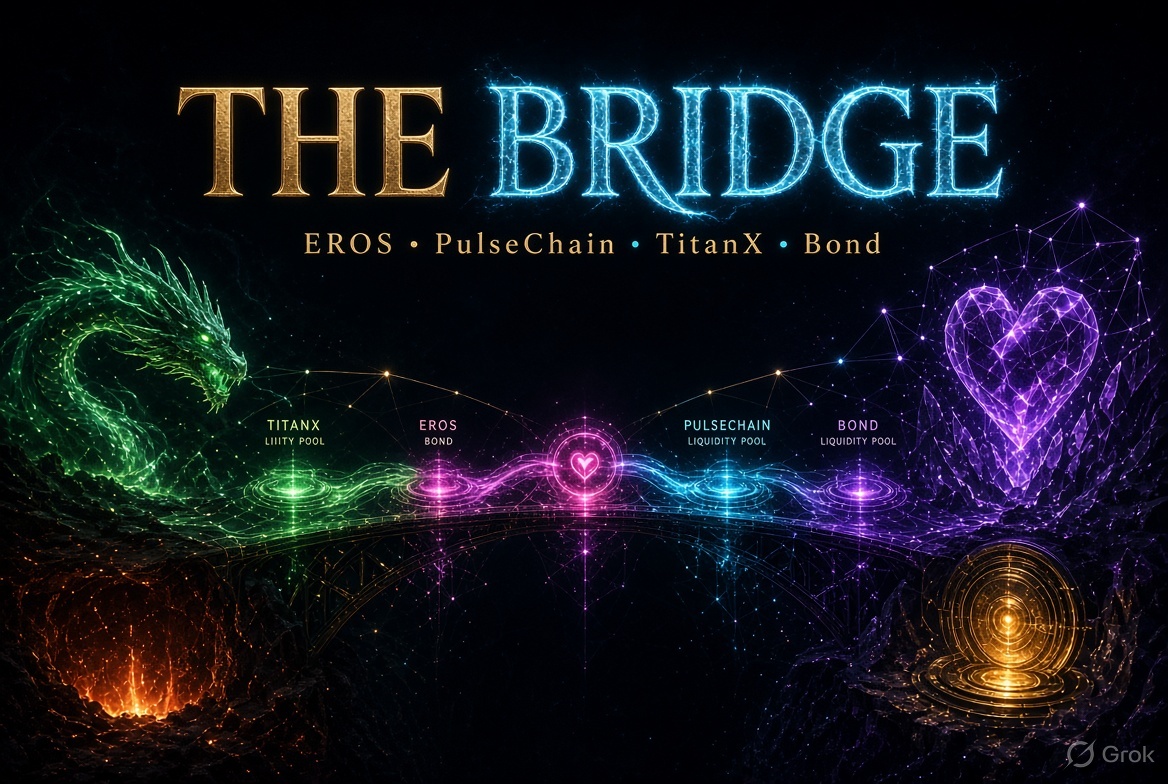
The Bridge is the field manual for that instrument. It explains what an LP position actually is, how the fee split works, what bonding means in practice, how to verify every claim on-chain, and where EROS is meant to be used. It does not promise returns. It gives the mechanics, the risks, and a playbook for anyone who wants to understand the structure before they size a position. The chart can open the door. Verification is why people stay.
THE BRIDGE · liquidity as infrastructure
What this book is about
The Bridge is the finance-grade field manual for EROS on PulseChain: tokenomics, Poolonomics, liquidity bonding, the Eros → ErosX use case, verification, risks, and playbook. It is not a whitepaper of promises. It is how the instrument works — fee split, renounce, LP vs wallet supply, bridge path, demand equation, and how to act without trusting badges or DMs.
Why you should care. Most people enter crypto through a green candle and leave through a silent chart. This book exists so that if the chart opens the door, you still know what you are holding: fixed supply, 2/1/1/1 flow fee, renounced owner, TitanX airdrop path, multi-pair liquidity web. Verification is the culture. Bonding is intentional LP as network edge — not farming someone else's inflation token.
Who this is for / what this is not. For holders, LPs, and builders who need the crypto surface stated cleanly. Lore (why people stay long) lives in companions — Living Egg, Gods of Eros, Illumination Strategy, Men of Renown, Gift of Thoth. Collaboration door: The Front Door. This volume is the instrument and the playbook only. No price targets. No guarantees.
How to read this book
1 · First three actions: verify contract on PulseScan · $5-scale test swap on PulseX · read the risk register.
2 · Tokenomics (fee 2/1/1/1) before Poolonomics (what an LP actually is).
3 · Risks are first-class — read them before you size.
4 · ErosX / 33eros are design discussion only — not announced products, not dates.
5 · SpaceEros is visual theatre; official chain data is the truth.
Core terms (defined once)AMM — automated market maker: a smart contract that holds two tokens and prices swaps by formula. PulseX is an AMM. PRC-20 — PulseChain’s token standard, parallel to Ethereum’s ERC-20. Slippage — difference between the price you see and the price you get when the trade executes (fee + impact). Arb — arbitrage: trading across pools or venues to close a price gap. LP token — the receipt that represents your share of an AMM pool.
Start here
Executive summary
One page
What it is. EROS is a fixed-supply, community-distributed token on PulseChain. Free airdrop to TitanX liquid holders. Contract renounced. No team treasury allocation in the fee design. Docs: eros.gitbook.io.
Why PulseChain. Low fees, PRC-20 surface, PulseX pools, Heart-stack demand (PLS, PLSX, HEX, INC) and community pairs with TitanX/BOT and Pulse natives (Atropa, Bear, pDAI, more).
Liquidity web. EROS as bonding hub: pair assets you already want with EROS, own the LP, earn trading fees in the underlyings — not a separate inflationary farm token.
Use case. The core crypto utility is the Eros → ErosX transform — a tax-light flow rail for spend, in-world use, and cross-community movement, paired with the burning store rail on the EROS side. Both are the operational layer of the EROS world. Full mechanics in The Platinum Standard.
EROS · Burn Baby Burn — every transfer feeds the black hole. Watch the instrument work before you read the theory.
What EROS is not
Not a stablecoin
Not a guaranteed return
Not a replacement for TitanX
Not a risk-free farm
Not legal, tax, or listing advice
Part III
Poolonomics — liquidity lessons
Education first. No slogans.
Poolonomics is the framework: how liquidity, ownership, bonding, fees, supply location, and community behaviour interact. Pulseonomics is the case study — Poolonomics applied to PulseChain (TitanX path → EROS pairs). Same method; one name for the theory, one for the chain.
Lesson 1
What is liquidity?
How easily you enter or exit without moving price a lot. Not market cap. Not holder count. Not total token supply.
Lesson 2
What is an LP?
Deposit two tokens into an AMM pool and you receive a liquidity position — a claim on a share of that pool. That position is an asset. You typically earn a share of trading fees when people swap, per DEX rules.
Lesson 3
Your LP position is an asset
You are a market-maker. You can often withdraw (with risks). You are not merely watching a candle.
Lesson 4
Pool liquidity ≠ wallet supply · property-market analogy
A pool is a window, not the whole city. Listings on a high street are visible inventory; almost every house could sell at some price. In crypto, tokens and capital outside the pool are potential future supply and demand. Pool depth is not total demand or total supply.
Lesson 5
Thin vs deep · volatility · whose problem is size?
Deep pools absorb size with less impact — and can be exit inventory for holders. Thin pools move on small flow — upside and downside. If you do not own the asset, “huge liquidity” is not automatically an invitation. If you provide LP, depth is your infrastructure and fee engine. Perspective depends on ownership.
Correction. “New buyers should always prefer thin liquidity for ROI” is too absolute. Thin liquidity amplifies both directions. Size, horizon, and exit plans matter more than a single rule.
Lesson 6
Yield farming vs trading fees
Classic farm: deposit A+B, earn a third-party inflationary reward often sold into the market. Liquidity-bonding contrast: pair assets you want (e.g. A + EROS), earn trading fees in the pool’s mechanism — more of the underlyings when activity exists. Fees need volume. Not a salary. Not guaranteed APY.
Lesson 7
Liquidity bonding
Pair an asset you believe in with EROS (or another intentional pair), own the LP, participate in fees and network density. Community examples: DragonX, Bear, JakeX, LegendX, Helios, Blaze, Inferno, TitanX, Atropa — always verify the pair is live on PulseX.
Lesson 8
Owning a token vs providing liquidity
Spot: directional exposure. LP: pair exposure, fee potential, impermanent loss if prices diverge. Different tools — neither universally better.
Two assets · one position · shared incentive to promote the pair
Impermanent loss — plain language
When you LP two assets, the AMM keeps rebalancing as prices move. Compared with simply holding both tokens in your wallet, the LP position often ends with less of the asset that pumped and more of the one that lagged. That gap is impermanent loss — “impermanent” only until you exit; then it is realized.
Worked sketch (illustrative, not a promise). You LP $100 EROS + $100 TITANX (equal value). EROS triples versus TITANX. Arb trades the pool toward the new ratio. On exit you hold more TITANX and less EROS than a pure hold of both. Fees earned during the path may offset some or none of that gap — depending on volume, time, and fee tier. A quiet pool with a huge move is the painful case: IL without fee income.
Situation
What often happens
Prices sideways + volume
Fees can dominate; IL small
One side pumps hard + quiet book
IL large; fees may not cover
Both move together
IL smaller; still not zero
IL is the cost of continuous market-making, not a glitch. Spot holding is a different tool. Choose on purpose.
Poolonomics Depth without demand is a museum. Demand without depth is a spike that dies. Bond both — and understand IL first.
Part IV
Pulseonomics — bridge & web
ETH factory · Pulse marketplace
Lesson 9
Ethereum → PulseChain
Community strategy: move TitanX-ecosystem ERC-20 exposure toward PRC-20 liquidity so bridging can reduce ETH-side market sells while Pulse gains pairs and activity. ETH-side mechanics can continue; Pulse is an additional demand surface. Coordination, not magic. Bridge only at bridge.pulsechain.com.
Conceptual loop
Own assets you actually want.
Bridge on the official path when clear.
Pair with EROS (or intentional pair) → LP position.
Earn trading fees when activity exists.
Accumulate underlyings if fees accrue.
Stake / lock EROS only if risk tolerance allows.
Promote the pair you own — densify the web.
Liquidity web
GitBook snapshots listed many EROS pairs (WPLS, TITANX, TEDDY BEAR, DRAGONX, ATROPA, PLSX, LEGENDX, Blaze, Inferno, …). Count live pools; treat any number as dated.
WPLSTITANXDRAGONXATROPABEARPLSXLEGENDXBlaze / Inferno+ live set
Housing analogy. Spot trades are hotel nights. Multi-pair LP depth is housing stock — a district, harder to empty in one exit.
Part IV-B
Use case · Eros → ErosX
Why two rails, and where the demand comes from
The crypto question that matters is not what is the coin — it is what is the coin for. EROS has two rails, and the demand story only makes sense when you see them together.
The use case in one diagram
Store rail · flow rail · world
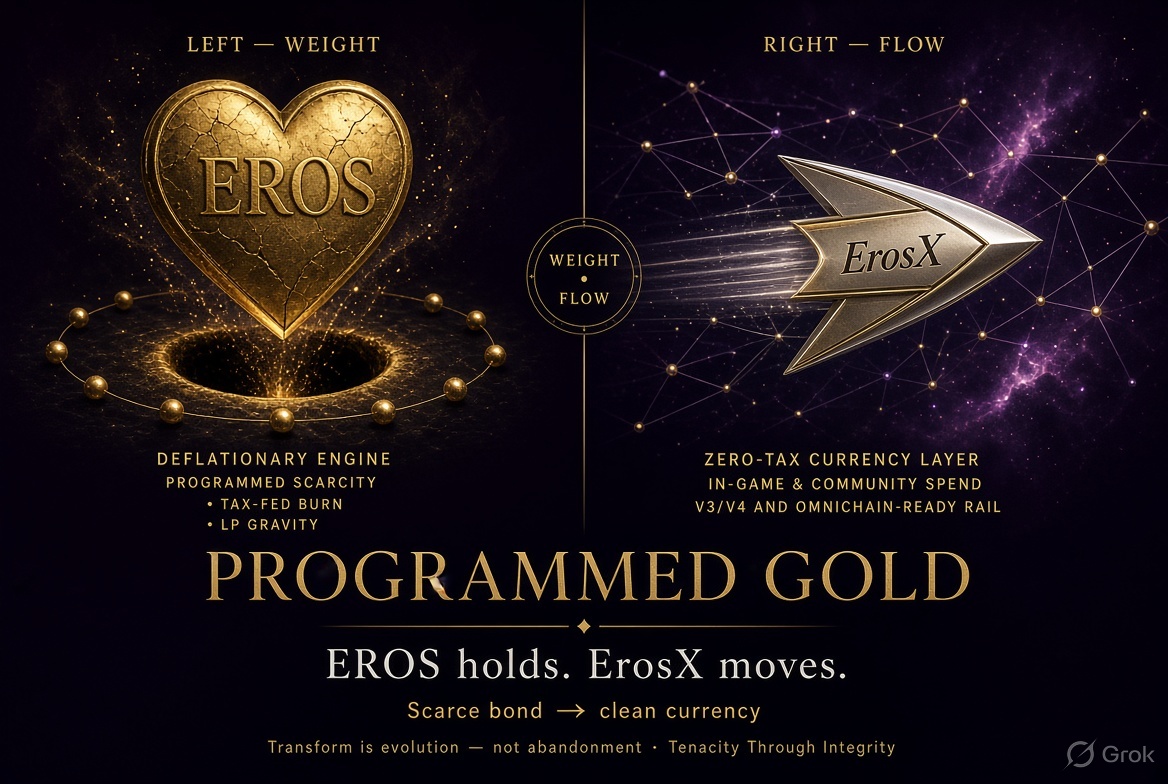
EROS 💕 is the store. Fixed supply, 2/1/1/1 fee, burn under volume, stake and lock, core LP. Heavy by design. Membership in a liquidity web.
ErosX 🏹 is the flow. Discussed as a tax-light or zero-tax companion — designed for movement, in-world spend, game rails, cross-community transfers, and eventually omnichain paths once the contract is light enough to travel.
The world 🌎 is where they get used — the EROS universe (story layer, game layer, in-world assets, guild, VR cities). The world does not replace the mechanics; it gives them a place to be spent. See Part XI for the world in one page.
EROS (store) → transform → ErosX (flow) → spent / used / moved → back to EROS via demand
Why both are needed
A single taxed coin cannot do both jobs. If every transfer burns 5%, the coin is heavy — perfect for holding and bonding, painful for spending, tipping, in-game micro-payments, and community transfers. If every transfer is free, the coin loses its deflationary pressure and its identity as a store of committed value.
Two rails solve the tension:
EROS holds. Deflationary under activity. Bonded in LPs. Staked and locked for commitment.
ErosX moves. Tax-light or zero-tax. Used for spend, in-world assets, community transfers, in-game micro-payments.
The transform is the bridge between the two rails. You do not buy the same coin twice. You move between rails based on what you are doing.
The transformation gates
The transform code is written. Its deploy is gated by three community milestones rather than a calendar date — market cap over all-time high, 333 bonded liquidity pools, and the transformation code shipping with a receiving-wallet option for ErosX. The full framing lives in The Platinum Standard, §The transformation gates.
The distinction that matters here: ErosX is designed to be non-tax. The 5% flow fee stays on EROS — the rock. ErosX is the frictionless rail, compatible with V3-style pools, free to be transferred as a currency. That is why the flow rail exists.
Full mechanics
The 33/33/33 split, the equivalence bots, the Genesis phase, the triangular market, the path to omnichain, and the three gates — live in The Platinum Standard. This section names the use case. Platinum walks the mechanism and names the gates.
Use case demand The demand for EROS comes from wanting the store rail (burn, bond, stake, LP). The demand for ErosX comes from wanting the flow rail (spend, in-world use, movement). Both come from the world — the fiction, the game, the community, the assets. If the world grows, both rails have somewhere to be spent.
What the use case is not
It is not a promise that ErosX exists tomorrow. It is not a claim that the transform is deployed. The store rail is live today. The flow rail is a design discussion, and its value is that it describes where the instrument is going and why two rails make sense — not a price promise.
Verify contracts. Read the store rail today. Judge the flow rail when verified code appears.
Store · flow · world — three layers of one use case
Fiction is the doorway. The instrument is the floor. The use case is what you actually do inside the room.
Part V
Demand equation
Attention · community · liquidity
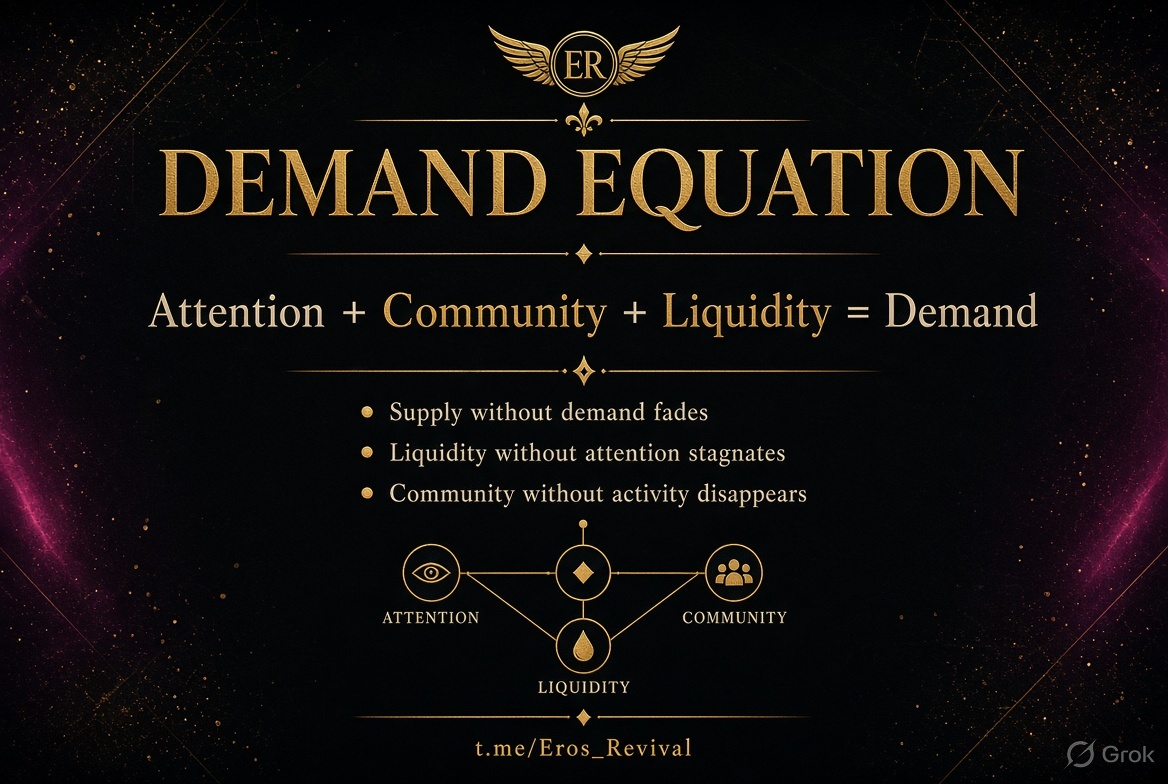
Supply without demand fades. Liquidity without attention stagnates. Community without activity disappears.
Structural path: TitanX/BOT → official bridge → Pulse LPs → Pulse-side discovery and trade.
Human path: posts, promoted LPs, media, tools. Optional studio work is a sticky layer — not required to hold, trade, stake, or LP.
Buy, hold, bond, stake, lock, trade — all valid. Work and belief make demand harder to unwind. Neither replaces verification.
The demand equation — attention + community + liquidity, in use.
Demand in practice (one loop)
Abstract formula: attention + community + liquidity. One concrete loop:
Someone posts a live pair address and a reason to care (attention).
Holders answer, correct bad links, refuse fake admins (community).
Someone adds size to the pool they promote (liquidity).
Trades hit that pool; LPs earn fees; the pair is harder to ignore next week.
That loop can fail at any step. The manual cannot invent volume. It can only refuse magical thinking.
Beyond the candle
Optional sticky work
Ship one asset (panel, clip, tool, sound, micro-game). Help with code or media. Bond the pair you will actually watch. Studio work is optional — hold, trade, stake, and LP remain valid without it.
Bookmark pulsex.com — open from the bookmark, not a chat link.
Connect a wallet you use only for on-chain experiments if possible.
Select WPLS → EROS (or the pair you verified). Paste the official EROS address if the UI does not resolve the symbol.
Enter a tiny amount. Set slippage near 6% (fee + impact). Read the minimum received.
Confirm. Wait for success. Check the explorer receipt. Then — and only then — consider size.
Worked · add liquidity
LP on PulseX (conceptual walkthrough)
Hold both sides of the pair you chose (e.g. EROS + WPLS or EROS + a community pair you verified).
On PulseX open Liquidity → Add. Select both tokens. Match the ratio the pool asks for.
Approve each token if needed. Confirm deposit. You receive an LP position (receipt of your share).
Record the pool address. If you will theme-brand, that address is what you promote — not a random ticker graphic.
Remember IL. You are market-making, not holding two spot bags in a drawer.
Rainman · white paper & PulseDEX pools — Community explainer: GitHub white paper and how to open liquidity pools. Small player by design (source resolution). Verify everything on-chain.
Decision tree (sizing mindset)Small capital · learning: verify → bridge dust → $5-scale swap → stop. Read risks again. You want exposure only: spot size you can lose; no LP until you understand IL. You will watch and promote a pair: LP that pair; theme-brand optional; measure fees and depth, not hopium. Someone DMs “support” or a new bridge: assume hostile. Use bookmarks only.
Due diligence
□ Addresses match GitBook
□ owner() checked
□ Supply & burn balance checked
□ Top holders scanned
□ Live pairs verified
□ Official dApp / bridge / DEX only
□ Burnonomics re-read
□ Small test tx first
Security
□ Hardware wallet when possible
□ No seed in cloud screenshots
□ Bookmark official URLs
□ Revoke stale approvals
□ Treat unsolicited DMs as hostile
Part IX
Ecosystem & comparables
Heart stack: PLS, PLSX, HEX, INC. Atropa lane: Atropa, pDAI, Bear. TitanX/BOT: ETH-origin; EROS as Pulse bonding hub in community practice.
EROS
5% (2/1/1/1) · renounced · no team treasury in fee design · Pulse primary
pTGC / forks
Different fees & governance — do not copy assumptions
TitanX
ETH-centric; EROS does not replace it
HEX / PLSX
Different products; shared chain culture
Part IX-B
ErosX, 33eros & theme-branded LPs
How · why · open deploy · mutual web
Frame (read first). This section is a design discussion — patterns the community has talked about for a flow layer and a teachable transform. It is not an announced product, not a launch date, and not a promise that any named builder will deploy. Treat every ratio and timeline below as illustration until verified mainnet code and a public parameter post exist. If none appear, the pattern was still useful as education.
Code patterns and math exist in community notes and sibling transform tech (TitanX → X28 / Pulsar-style rails). Who deploys, when, and final parameters remain open.
Why two layers?
EROS 💕 is the engine: fixed supply, 5% flow fee, burn, stake/lock, core LP. Hyper-deflationary under volume. Heavy by design — membership dues for a liquidity web.
ErosX 🏹 is discussed as the flow layer: a transform or companion currency aimed at easier movement — low or zero transfer tax, community spend, in-world / game rails, possible V3/V4 and omnichain paths once the contract is light enough to travel. Engine stays scarce; flow is meant to move.
Separation of jobs Taxed web engine (EROS) vs spendable flow (ErosX). Confusing them is how people ship the wrong tool for the job.
Full treatment
The complete transform thesis — 33/33/33 split, equivalence bots, the Genesis phase (first billion), post-Genesis permanent mechanism, the triangular market, X28 omnichain, BuildFi — in The Platinum Standard. The three gates holding the deploy are named there in The transformation gates.
33eros — teachable transform pattern
Community numerology and pedagogy point at a 33 / 33 / 33 style transform (exact code TBD on deploy):
A slice of input burned
A slice used to seed or deepen LP (e.g. base/transform pair)
A slice routed to gradual buy-and-burn or similar sink
The point is not only a new ticker. It is a template other builders can copy ethically — influencers and communities learning to launch transforms that burn, bond, and avoid silent founder extraction. EROS → ErosX and a 33eros-class release are the first teaching vehicles discussed, not a closed franchise.
Theme branding your LP — identity as infrastructure
An LP is not only a passive fee claim. It can be a brand.
Pattern: a large holder of a pair (example from community practice: EROS / TEDDY BEAR) promotes the LP contract and a persona — “Bear God King” energy, memes, recurring presence. Traffic that hits that pair deepens their pool, earns fees for LPs, and keeps EROS in the story of another community.
Narrative sketch. Week 1: holder posts the pool address weekly, not a random chart screenshot. Week 4: strangers ask for the pair by name. Week 12: depth is higher than when the persona started — not because of a promise, because inventory and attention met. Your results will differ. The lesson is the pattern: promote the doorway you own.
Same pattern works for DragonX/EROS, Inferno/EROS, Atropa/EROS, and any live pair you actually own. You are not only bagholding a ticker; you are marketing a doorway.
Promote the LP address. Name the pair. Make it identity. That is meme culture attached to real inventory — not empty ticker spam.
Market-cap equivalent bots & mutual lift
When many pairs share EROS as one side, arbitrage bots hunt gaps. Example: Bear/EROS jumps; the implied EROS price disagrees with DragonX/EROS; a bot trades across the shared EROS leg until the edges realign. Activity in one themed pool can therefore tug another — not magic, connected inventory.
That is why tribal isolation is expensive: competing clubs refuse to bond edges; allied clubs share a graph.
Crypto done well here means: help the pairs you touch, expect others to help theirs, and let mechanical arb do part of the cross-promotion. Separate tribes with zero shared liquidity fight for the same attention with no structural reason to lift each other.
Allies, not islands Theme-brand your pool. Bond edges. Let bots balance what culture connects. Mutual web > competing clubs with empty bridges.
Chiz Explains · why bond TitanX family coins with EROS — Three reasons to hold EROS, white-paper walkthrough, bridging DragonX / Hydra / Scale, and liquidity bonding Atropa · pDAI · Bear. Educational placement, not decoration.
Future goals (tension held open)
Chat carries real tension: denser LP counts, burn share, ErosX deploy, 33eros teaching release, media flywheel, who has keys and when. Holding tension without fake certainty is healthy. Measure: live pairs, burn balance, verified deploys, shipping media. Do not substitute roadmap poetry for those receipts.
Ecosystem Web
pDAI · Atropa · the mycelium
Settlement fulcrum · cutting the thread · conditional architecture
Thesis · on-page (link out for full research)
pDAI is interesting less as “another stable that might hit a dollar” and more as a possible settlement and routing fulcrum on PulseChain: it sits at junctions between inherited pools, wrappers, and conversion paths. The strong form of the thesis is a replenishment flywheel — fund, buy below target, deploy liquidity, circulate, sell near target, recover capital, repeat — not a single hero buy order.
Atropa, with Treasury and related network pieces, is framed here as more than a ticker: a node in a mycelium — decentralised, fractal, potentially self-replicating coordination of people, capital, and (increasingly) AI agents on a verifiable settlement layer. The name echoes Atropos: not pure destruction, but cutting the thread of inherited permissioned finance so a denser web of open connections can form.
Maria (James Osborne) is relevant as early commitment made visible in liquidity: size in pDAI before the crowded theory, then large placement into Atropa (and related) LPs — including the culture of LP share at the dead address. That is footprint, not prophecy. Dead LP percentages are placement evidence; they are not a guarantee of common control of every share forever.
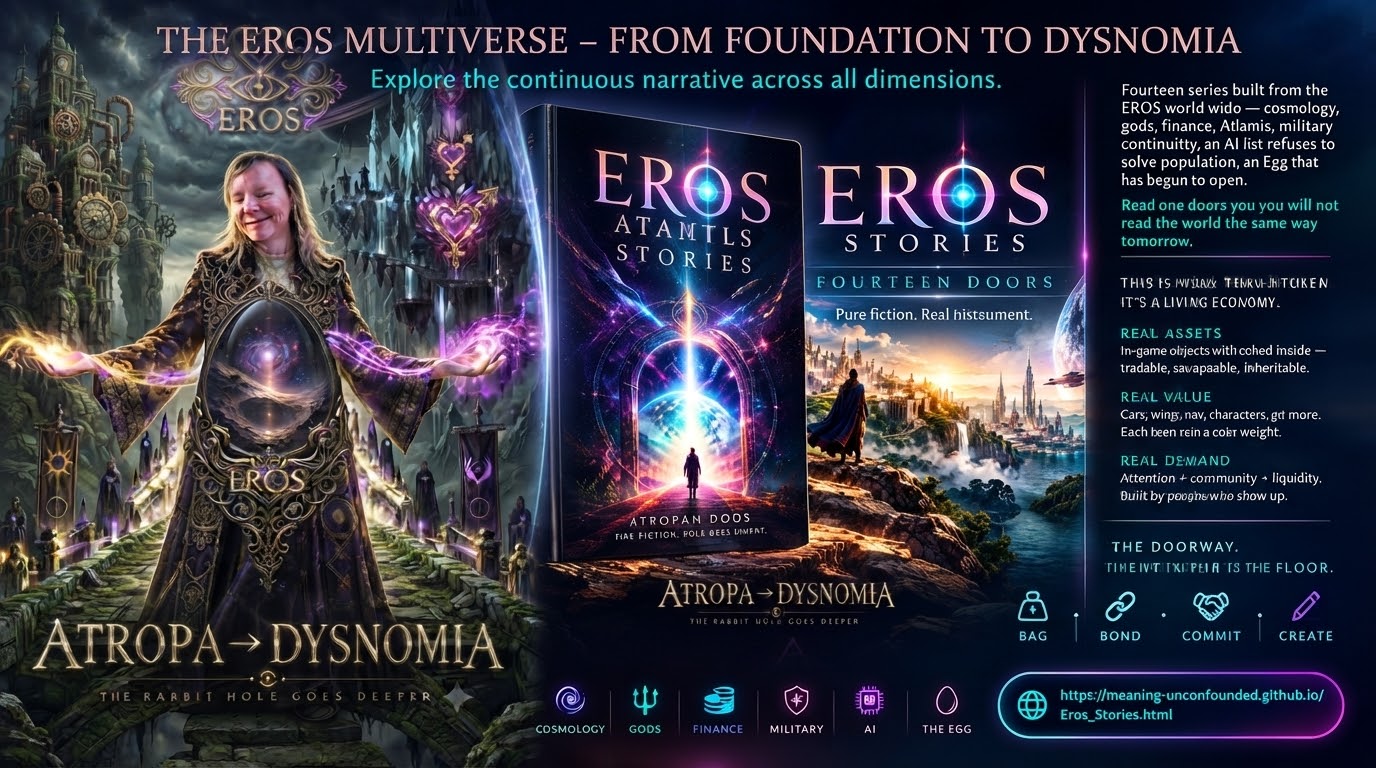
Atropa → Dysnomia · cutting the thread · mycelium goes deeper · companion visual for the ecosystem web
Money authority
The visual companion to this section — measuring stick, instruments, footprints — lives in The Platinum Standard → The Standard. Same discipline: state the claim, name the layer, say how confident you are, move on. The wider five-layer stack (settlement · base · world · floor · bridge) is in The Hopeful Future.
Beyond Web3 — why this sits in a field manual
Web1 moved information. Web2 moved platforms. Web3 moved ownership. The next layer under discussion is autonomous coordination: blockchain for settlement and ownership, AI agents for continuous analysis and action, communities for intention, tokens for economic coupling. Atropa’s public mythology and tooling push toward a network that can grow by node → connection → replication rather than only centre → command.
You do not need to adopt that cosmology to use EROS. You do need to understand that PulseChain is where several of these experiments share inventory — and that EROS’s job in this manual is still LP, burn, bond, and demand, not absorbing every neighbour’s narrative.
Atropa cuts the old thread so the mycelium can branch. PulseChain is substrate. pDAI may become a routing unit if the flywheel turns. EROS asks whether it can sit as a bonded edge in that web — instrument first, story second.
The pDAI loop (enough if you never click the link)
External or private funding arrives (distributed wallets; not necessarily one visible treasury).
Conversion into local stable claims / pDAI accumulation below target.
Deployment into liquidity and connected routes.
Circulation through the graph; sales near target when demand appears.
Recovery of payment assets → replenishment → repeat.
Watch the flow Repeated funding, distributed acquisitions, two-sided execution, capacity restored after sales. Contracts matter. Behaviour proves more than another admin-key screenshot.
Atropa · Bear · burnt liquidity culture
Sampled research highlights substantial Atropa connectivity against pDAI and other stables, with a large fraction of LP supply at the conventional dead address in major pairs. Parallel ecosystem practice includes Teddy Bear / TBILL-style burnt LP placements — the same family of “structure over announcement.” Community voices (including the Chiz materials elsewhere in this book) treat Atropa · pDAI · Bear as part of the Pulse native liquidity web EROS can bond into, not as a rival church.
Theme branding applies here too: promote the pool addresses you own; let arb and shared EROS edges do some of the cross-lift. Allies, not islands.
TitanX path · max freedom, not only max ROI
The Bridge’s practical path remains: TitanX-family exposure on Ethereum → bridge to PulseChain → bond into live pairs (including EROS edges where you choose). ROI is uncertain. What is structural is settlement and custody on a chain culture that already runs deep native LP experiments — Atropa’s mycelium thesis and EROS’s no-extract bond culture are different projects that share a substrate. Freedom here means: verifiable inventory, renounce-where-claimed, and participation without waiting for a single platform’s permission.
EROS second-order question
If pDAI becomes a common settlement unit and Atropa-class networks densify AI + treasury + community nodes, can EROS sit as a liquidity and coordination destination inside that graph — taxed web engine + ErosX flow — rather than only as another meme ticker? That is an open design question for builders. It is not a promise that any external actor has appointed EROS.
Conditional. No claim that a full $1 campaign is live, that Portal caps are active purchasing power, or that dead LP equals permanent unified control. If the flywheel does not turn twice, the thesis reduces to interesting disconnected machinery. Verify on-chain. Size as if wrong.
Depth elsewhere. Macro continuity and institutional measuring sticks → Illumination Strategy. This section stays on Pulse liquidity architecture and neighbour footprints.
Part X
Roadmap language
Triggers · not prophecies
Watch · Gold · Measuring stick · Continuity
Footprints over confession. Public instruments. Verify the layer yourself.
Community north stars are things to measure, not promises:
Live pair count and depth (PulseX / SpaceEros — verify, do not invent)
Burn balance at 0x…0369
Whether media and tools actually ship
Whether any transform (ErosX / 33eros-class) appears as verified mainnet code with public parameters
Whether theme-branded LPs are promoted with real pool addresses
No price targets in this manual. Chat market-cap stories are not commitments.
Part XI
The world where it gets used
One page — the room the crypto lives in
EROS and ErosX do not float in a vacuum. They are the crypto rails of a larger world — a fiction, a cosmology, a macro thesis, an archive. You do not need to believe any of it to hold, trade, stake, or LP. But you should know it exists, because this is where the tokens get used.
The five rooms
Cosmology
The Living Egg — the enclosure, inward is forwards, the shape of the world. Where game, film, and fiction are set. Depth → Living Egg
Operators
NaUn, Ra-Shen, Thoth, EROS — the four principles the universe is built from. Not gods. Rules. Depth → Gods of EROS
Human macro
The real-world rail — reserves, measuring sticks, institutional footprints. Context for why crypto assets migrate from casino toward infrastructure. Depth → Illumination
The Archive
Breakaway-civilization lore — Nordic residual, under-ice Archive. Treated as fiction and archive, not the human macro rail. Depth → Men of Renown
These rooms are the world. The game lives inside the cosmology. The fiction gets made about the operators. The macro thesis explains why anyone is looking at digital assets in the first place. The archive is where the strange stories live.
The crypto rails — EROS and ErosX — carry the value through all of it. Cars, weapons, characters, city plots, trading cards: hybrid assets with coins locked inside, verified on-chain. In-world spend uses ErosX. The store rail uses EROS. The world is what makes both rails worth having.
Companion depth · the geometry of the phrase
The inward is forwards phrase this book inherits — the cosmology both rails live inside — is developed in The Living Egg. The toroidal reading of the vessel — two lobes, one crossover, the direction of continuation — is in The Eros Enclosure. The philosophy of bond-over-extract that governs the crypto is in The Conscious Eros. This book is the instrument. Those books are the shape it sits inside.
Operators as source code · the world the crypto lives in
The world does not replace the mechanics. It gives them somewhere to be spent.
Culture & production
Why some stay: larger board (Illumination), cosmology (Living Egg), intrigue (Men of Renown), production guild. Companions hold the depth. Here is taste only.
Fractal contribution. Build at your scale — tool, panel, micro-game, sound. The larger story can nest smaller worlds. Everyone can contribute something that fits.
Every EROS transfer carries a 5% flow fee. That fee is not decoration — it does four jobs.
🪙 2% burn. To the burn sink at 0x…0369. Removed from circulation, forever.🪙 1% staking. Rewarded to stakers per protocol rules.🪙 1% temporary lock. Locked staked EROS — documented on the GitBook.🪙 1% WPLS/EROS LP. Deepens the core pair on PulseX.
Fixed supply. Renounced owner. No team treasury line in the split. Verify owner() yourself on PulseScan.
#EROS #TheBridge #PulseChain #Tokenomics
Post Two · 🛡️ The Risk Register
🛡️ Read the Risks Before You Size
Every field manual states its risks first-class. These are the ones this instrument carries:
🛡️ Smart contract, bridge, liquidity, volatility, concentration. Normal in this asset class. Not hidden.🛡️ Impermanent loss. LP positions can underperform simply holding both assets. Read the worked sketch in Part III.🛡️ No admin safety net. Renounced means no privileged pause. Feature and risk, at the same time.
The chart can open the door. Sizing discipline is why people stay solvent.
#EROS #TheBridge #RiskFirst #ReadTheManual
Post Three · ✅ Verify First
✅ Verify. Then Act.
A badge in a group chat is not proof. Six on-chain checks before you touch size:
✅ Paste the contract into PulseScan. Read owner(). If renounced, you see the zero address.✅ Read totalSupply. Compare burn balance at 0x…0369.✅ Bridge only from a bookmark — bridge.pulsechain.com. Never a chat link. Never a "support" DM.✅ Tiny test swap first. 6% slippage. Read the receipt. Then consider size.
Verification is the culture. The chain is the only author.
#EROS #TheBridge #VerifyFirst #PulseChain
Part XII
FAQ · glossary · disclaimers
Why no dev fee in the split?
Documented design. Still verify code and owner(). No treasury line ≠ no risk.
Published contracts and renounce claims help — you still verify, size small, accept total loss as possible.
What is the Atropa / pDAI section claiming?
Conditional architecture and footprints — early LP commitment, settlement-fulcrum idea, mycelium framing beyond Web3. Not a guarantee of peg or appointment of EROS. See pDAI · Atropa · mycelium and the 9iron link.
ErosX / 33eros?
See Part IX-B and Part IV-B. Math and transform patterns are discussed; deployment is open (who/when not settled). Not launched products with fixed dates in this manual. Full treatment: The Platinum Standard.
What is theme branding of an LP?
You promote the pair you own — identity, memes, name — so traffic hits your pool. Example pattern: a major Bear/EROS holder promoting as a themed identity helps that pool and, via shared EROS edges and arb, can lift connected pairs. Allies, not isolated tribes.
How do I exit?
Sell or withdraw LP subject to liquidity, slippage, fees. No guaranteed buyer.
Glossary
AMM
Automated market maker — pool that prices swaps by formula (e.g. PulseX)
PRC-20
PulseChain token standard (parallel to ERC-20)
Slippage
Difference between quoted and executed price
LP
Liquidity provider position in an AMM
IL
Impermanent loss — LP vs hold gap when prices diverge
Flow fee
5% transfer split burn/stake/lock/LP
Renounced
Owner privilege given up — verify
Bonding
Intentional LP as network edge
Poolonomics
Framework for LP, fees, supply location, community
Pulseonomics
Poolonomics applied to PulseChain / EROS case study
ErosX
Flow-layer transform — design discussion, not launched product
Market-cap equivalence arbitrage agents — connected inventory across shared EROS legs
pDAI fulcrum
Conditional thesis: pDAI as settlement/routing unit + replenishment flywheel
Atropa mycelium
Framing of Atropa/Treasury network as fractal, beyond-Web3 coordination on Pulse
Cut the thread
Atropos metaphor — exit inherited permissioned architecture toward open settlement
Further reading (optional · not required for the instrument)
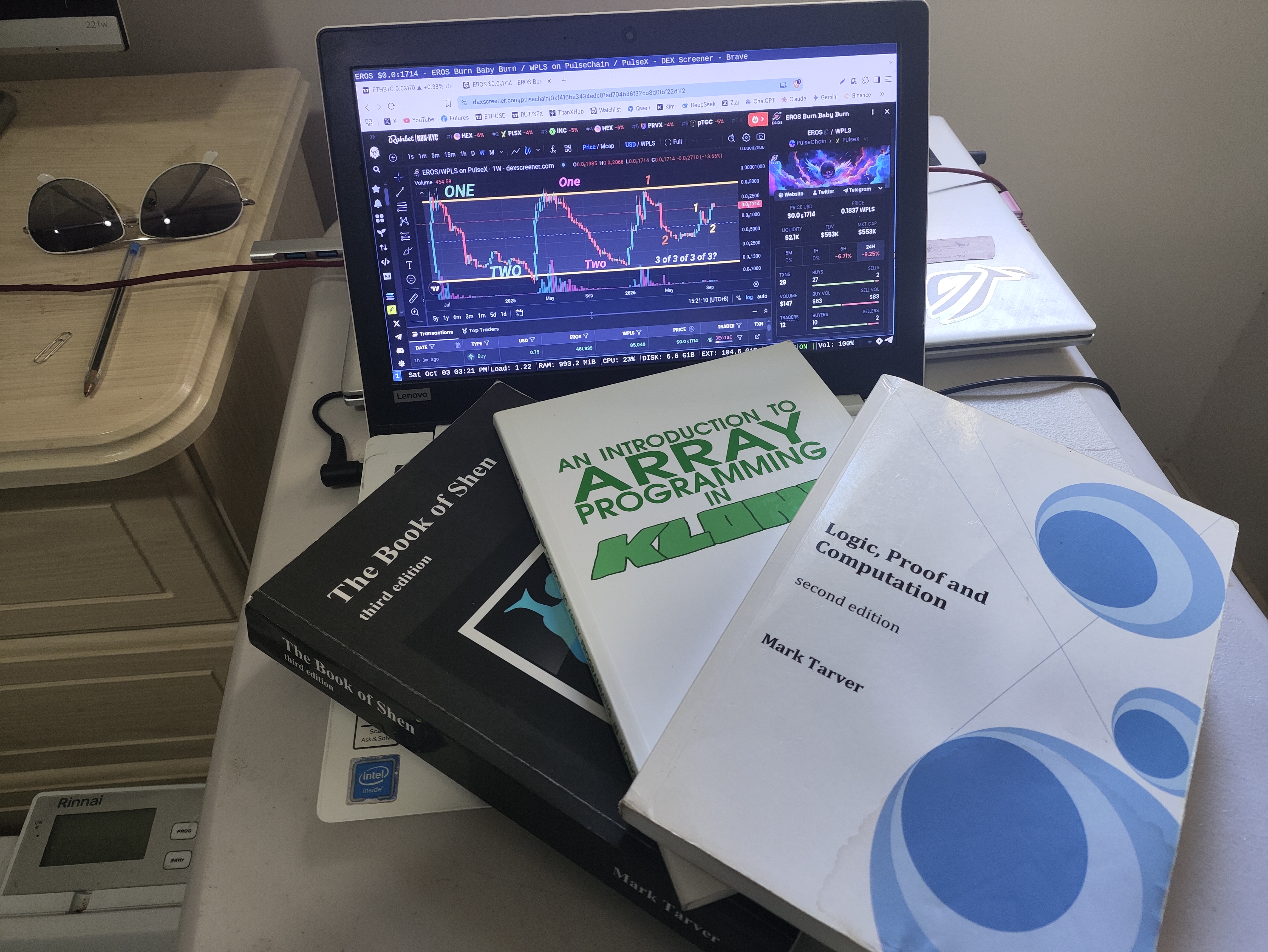
Builders who want metal-up symbolic and array craft sometimes point at Mark Tarver’s Book of Shen and Logic, Proof and Computation, and array programming in K. Those texts are not prerequisites for verifying EROS or adding LP.
The foundation — three texts. The same discipline that reads a word by its operators reads a program by its primitives.
What this book cannot see. Technical analysis, tax treatment, portfolio theory, and evaluating non-EROS protocols are outside scope. This manual is mechanics, verification, risk, and playbook.
Disclaimer. Not financial, legal, or tax advice. Crypto can go to zero. Contracts can fail. You can lose everything. DYOR. See also GitBook Disclaimer.
Application & World Building
The concepts in this book are not limited to the page. What can you build from them?
Can you apply them to a character, a weapon, an economy, a casino, a structure, an atom, a molecule, a law, a scientific theory, or an entire universe?
Can you extend the science, fiction, lore, and law of our shared world through code, narrative, and creative assets?
Take what you have learned. What can you create?
Verify on-chain. Never trust a badge. The chain is the only author.
Mechanics before narrative. Risk before size. Bonding is the work. The world is the reason.